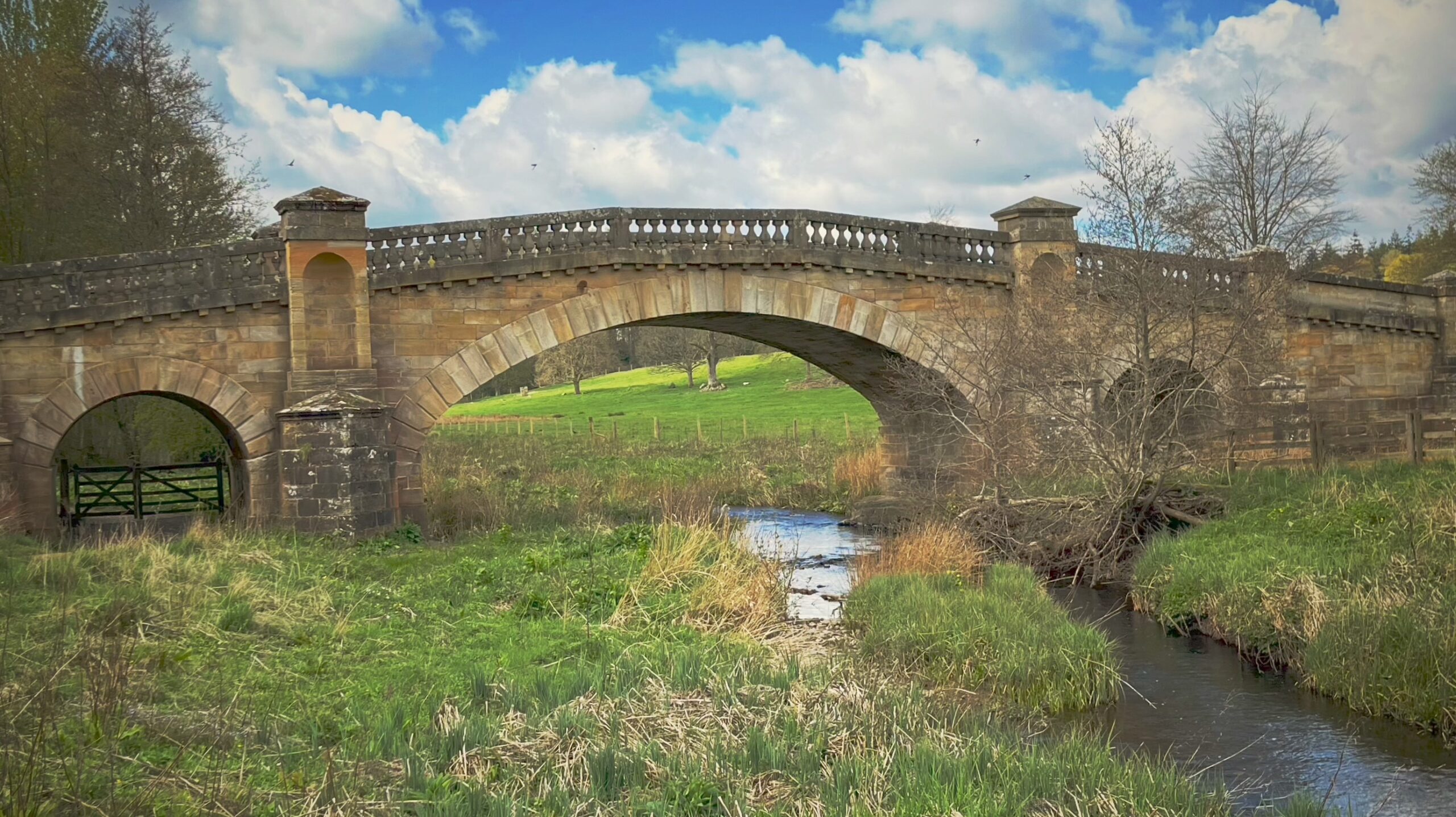
A photo from last weekend’s jaunt up Northumberland, we called in at Wallington Hall on the way home.
This National Trust property is a sign that one can build a very good place if one is willing to import enough rum and sugar. This truth is not exactly comfortable for those who prefer their history without a side of human suffering.
The Blacketts arrived first. Sir William Blackett bought the estate in 1689. His family found that importing Jamaican rum was very healthy for the family bank balance.1“Wallington’s history | Northumberland | National Trust.” National Trust, 2024, https://www.nationaltrust.org.uk/visit/north-east/wallington/history-of-wallington. Later, Sir Walter Blackett ordered this bridge.2Record ID: 10003 / MNA124720. National Trust Heritage Records Online. https://heritagerecords.nationaltrust.org.uk/HBSMR/MonRecord.aspx?uid=MNA124720 It is a very nice bridge, even if the money used to build such things often came from those who were being exploited far away in the colonies3Thomas, Tobi. “What are the British monarchy’s historical links to slavery?” The Guardian, 23 Mar. 2022, https://www.theguardian.com/uk-news/2022/mar/23/british-royal-family-monarchy-historical-links-to-slavery..
Then came the Trevelyans. Sir John Trevelyan married the daughter of a Grenada sugar planter in 1757. By 1820, the family held parts of seven plantations [3]. They were the biggest slave owners in the North East4Sagar, Peter. “Learning Our History Part 2: The North East against Slavery.” *North East Bylines*, 19 Jul. 2023, https://northeastbylines.co.uk/learning-our-history-part-2-the-north-east-against-slavery/.. It would be a classic British understatement to call this a simple business interest.
The estate was eventually given to the nation. We now visit the hall and walk through gardens built by wealth derived from enslaved labour.
The past is a foreign country; they did things differently there, but they used the same coins. Does giving a vast country estate to the public justify making the original source of the money vanish into thin air?
The National Trust, to its credit, does not entirely sweep Trevelyan’s legacy under the carpet. It addresses the uncomfortable truth with reasonable candour on its website — though, as we did not go in, we cannot say how far this actually goes inside the hall.
- 1“Wallington’s history | Northumberland | National Trust.” National Trust, 2024, https://www.nationaltrust.org.uk/visit/north-east/wallington/history-of-wallington. ↩︎
- 2Record ID: 10003 / MNA124720. National Trust Heritage Records Online. https://heritagerecords.nationaltrust.org.uk/HBSMR/MonRecord.aspx?uid=MNA124720 ↩︎
- 3Thomas, Tobi. “What are the British monarchy’s historical links to slavery?” The Guardian, 23 Mar. 2022, https://www.theguardian.com/uk-news/2022/mar/23/british-royal-family-monarchy-historical-links-to-slavery. ↩︎
- 4Sagar, Peter. “Learning Our History Part 2: The North East against Slavery.” *North East Bylines*, 19 Jul. 2023, https://northeastbylines.co.uk/learning-our-history-part-2-the-north-east-against-slavery/. ↩︎
Leave a Reply