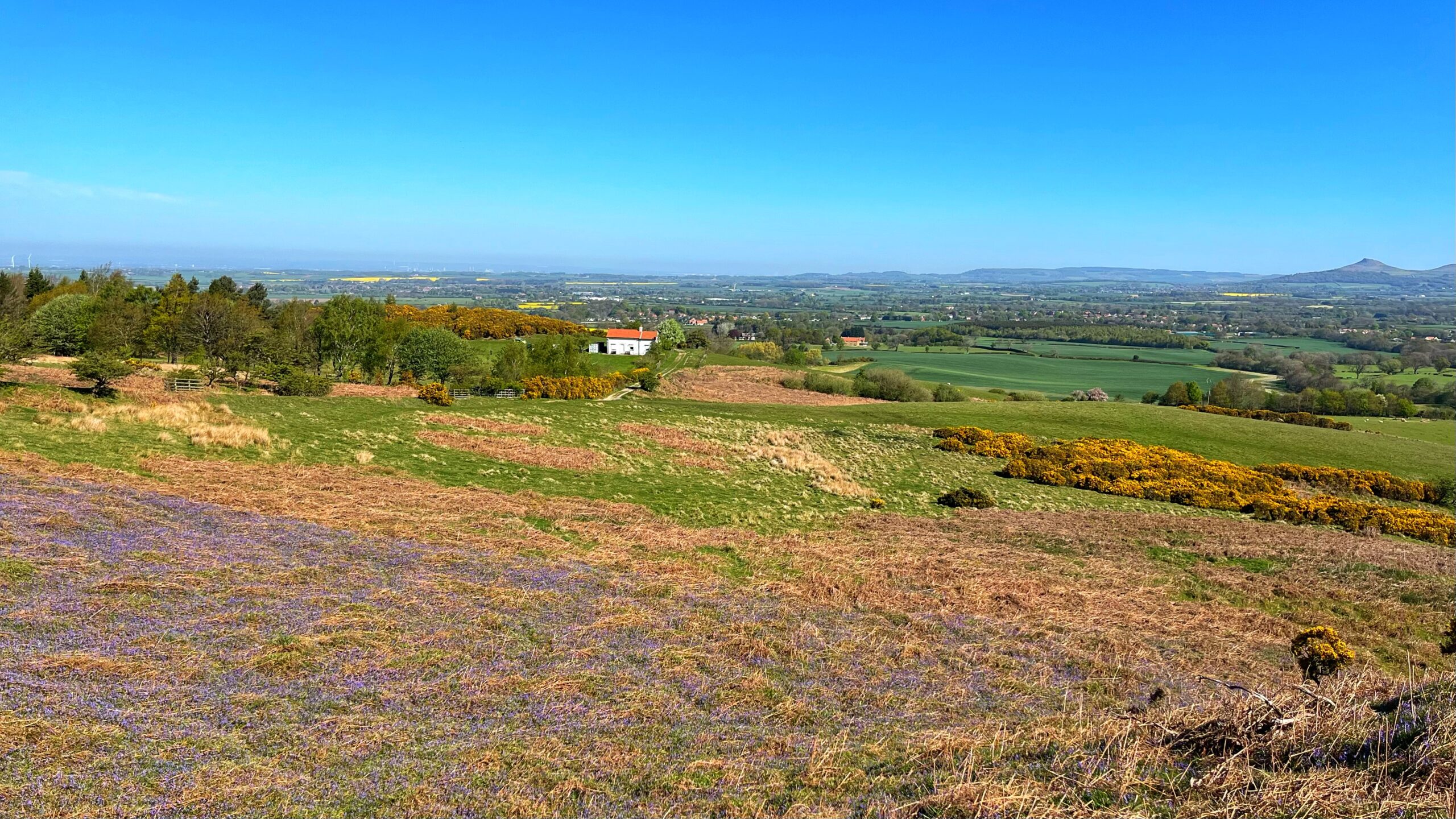
Bluebells pour down the sun-baked flank of Kirby Bank above the plain of Cleveland. Gorse burns yellow across the slopes. Below, the white walls of the Pybus Scout Centre gleam in the spring light. Beyond the green patchwork of fields, Roseberry Topping rises on the far horizon under a sky without a single cloud.
A peaceful enough picture. But something niggles. Bluebells are woodland plants — creatures of shade, damp soil and ancient tree canopy. They have no business whatsoever being here on a bare, wind-scoured hillside, pushing up through last year’s dead bracken.
And yet here they are. Which means something rather interesting: the native English bluebell is one of nature’s most reliable signposts to ancient woodland. Spot them in the open and they are not lost — they are remembering. A wood once stood on Kirby Bank.
The question is when.
Was it wooded in the early 1700s, when the alum works was filling the moorland air with smoke and considerably worse? Shale rock, quarried from the Bank itself, was piled up and set alight for months on end. The burnt rock was then soaked in water, and the resulting liquid piped through wooden troughs to the alum houses, where it was boiled for a full day and night. The final, rather unsavoury, step involved treating it with human urine — shipped in by the barrel from towns up and down the coast. The finished alum, a vital fixative in cloth dyeing, was loaded onto carts and hauled down the trod to textile makers across the plain. The works is believed to have occupied the level ground just below the gorse line. It flourished briefly but lucratively between 1706 and 1720.
Or does the memory stretch further back, to the Medieval packhorses that laboured up this same slope — strings of twelve to forty animals, small, sturdy forebears of the Cleveland Bay — laden with fish, salt and coal for the Cistercian monks of Rievaulx Abbey? The lead horse wore a bell, its ring carrying ahead through the trees as fair warning to anyone coming the other way. Each animal was fitted with wicker panniers built for the job: open baskets for fish or wool, hinged frames for coal or stone, tipped empty at the end of the run.
The bluebells were here before any of it. With any luck, they will outlast the lot of us.
Leave a Reply