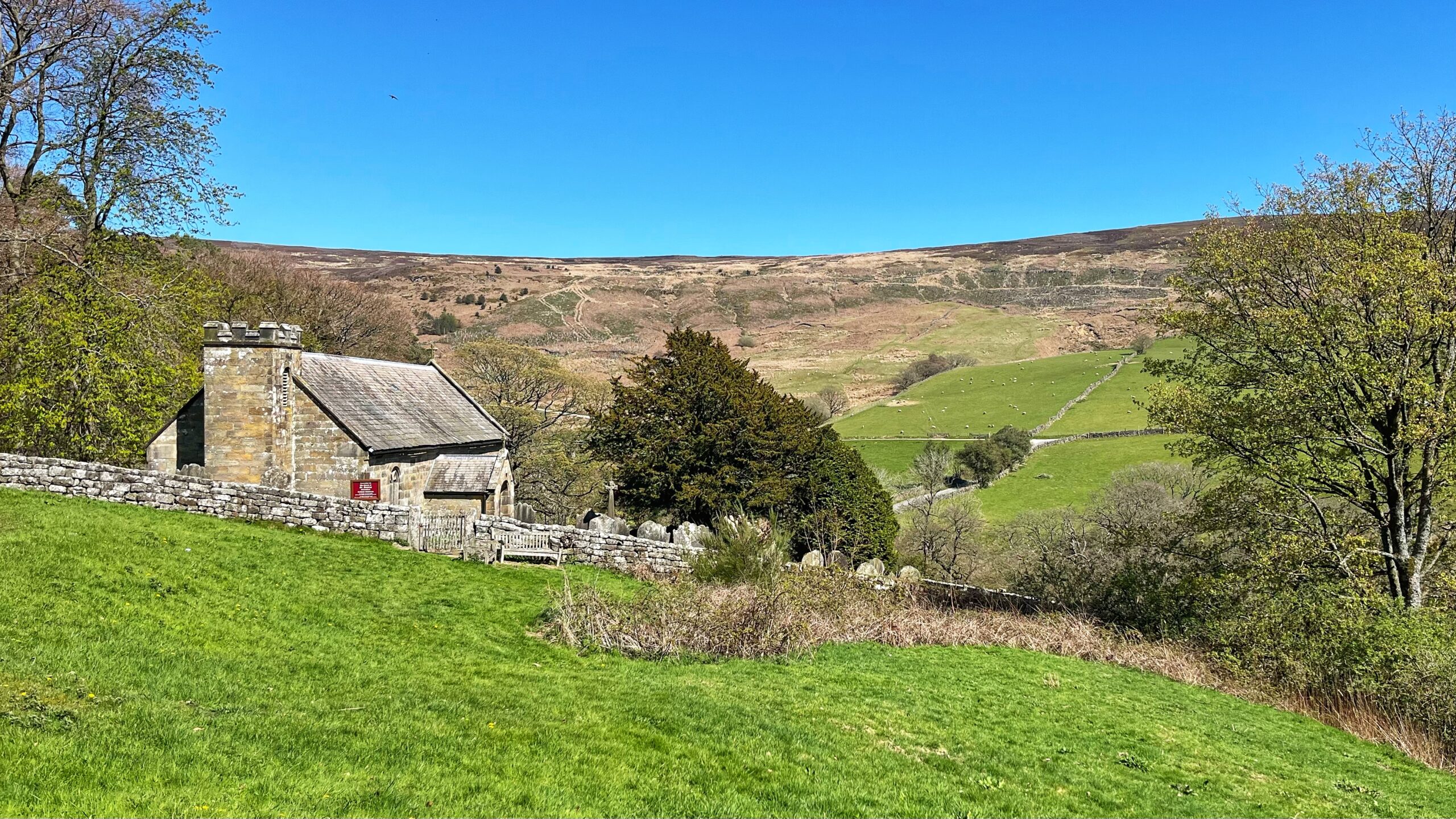
Medieval peasants dreamed of a place called Cockaigne — a land of luxury and ease where roasted pigs wandered about with knives in their backs to make carving easy, grilled geese flew directly into one’s mouth, and the wine flowed freely. Streets paved with pastry. Skies that rained cheese. You get the idea.
Then someone named a remote Yorkshire hamlet after it.
To be fair, Bransdale’s Cockayne is not entirely without its charms. At its peak, the dale housed 400 people — jet miners, two blacksmiths, two millers, an innkeeper, and shoemakers. The ironstone railway crossed the heather to Rosedale, hauling in timber and fertiliser and hauling out farm produce to Teesside. The Earl of Feversham kept a shooting lodge here. Servants flooded in when he arrived, briefly making the place resemble something almost festive.
The little church of St Nicholas, meanwhile, has been in a quiet architectural crisis for seven centuries. A 13th-century record. An 1800 “establishment.” A datestone reading 1886. An extension in 1934. The renown architect Goodhart-Rendel surveyed the results and declared, with magnificent defeat: “I don’t understand this.”
The parish records are livelier still. In 1538, a local called Will Wood threatened the priest he would have “of him a leg or an arm.” The clerk was sacked in 1567 for mumbling. The roof collapsed in 1714.1RUSHTON, JOHN. THE RYEDALE STORY—A YORKSHIRE COUNTRYSIDE HANDBOOK. PUBLISHED BY THE RYEDALE DISTRICT COUNCIL. SECOND EDITION 1986.
The surname Cockayne originally served as a nickname for an idle dreamer. For a hamlet whose residents were threatening priests, losing clerks to poor diction, and rebuilding their church every other century, that seems rather unfair.
The legend promised rivers of wine. Yorkshire gave them moorland and a collapsing roof. Close enough.
- 1RUSHTON, JOHN. THE RYEDALE STORY—A YORKSHIRE COUNTRYSIDE HANDBOOK. PUBLISHED BY THE RYEDALE DISTRICT COUNCIL. SECOND EDITION 1986.
Leave a Reply