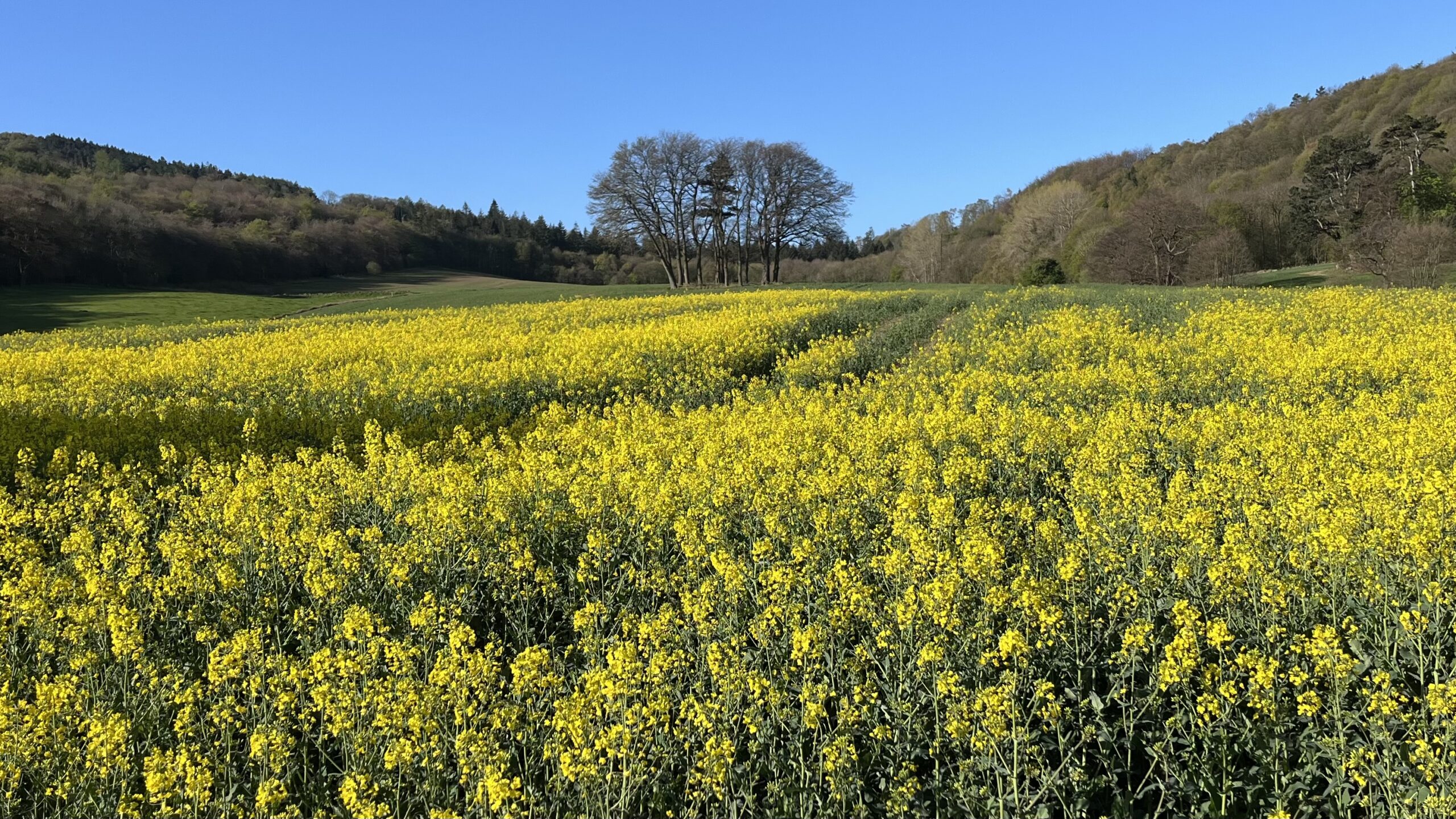
Every spring, Britain turns yellow. These vast, almost aggressive swathes of rapeseed feel utterly modern — the crop of motorway verges, cooking oil, and biodiesel. Surely this is a 20th-century invention?
Sort of.
This is almost certainly some genetically engineered new cultivar, but let’s meet the navew. That is what our ancestors called rapeseed, and they knew it rather well1Halliwell-Phillipps, J. O. (James Orchard), 1820-1889. “A dictionary of archaic and provincial words, obsolete phrases, proverbs, and ancient customs, from the fourteenth century”. Page 572 NAVET. https://ia802702.us.archive.org/34/items/dictonaryofarcha02hallrich/dictonaryofarcha02hallrich.pdf. By the 17th century, writers were recording it matter-of-factly alongside established farming wisdom handed down from Roman authors like Pliny, Columella, and Varro2Rapeseed. Wikipedia. https://en.wikipedia.org/wiki/Rapeseed#Cultivation [Accessed 20 April 2026].
It was not only grown for oil. It was also used as a trap.
Farmers discovered that weevils — the tiny beetles that devastated grain stores — could not resist navew seeds. The insects would abandon entire corn heaps to gorge on them, eating so greedily that they swelled up and burst3Topsell, Edward “The history of four-footed beasts and serpents”. 1658. Page 1090. https://archive.org/details/historyoffourfoo00tops/page/102/mode/2up?q=Navew. Pest control powered entirely by gluttony. Brilliant, really.
The plant had a darker side too. The finer variety, “Navew-gentil,” was recorded as lethal to deer, listed plainly alongside Oleander as a straightforward poison:
“If he [the deer] eate spiders he instantly dyeth thereof, except he eate also wilde ivy or sea-crabs. Likewise navew-gentill and oleander, kill the hart. “4Topsell, Edward “The history of four-footed beasts and serpents”. 1658. Page 102. https://archive.org/details/historyoffourfoo00tops/page/102/mode/2up?q=Navew
Today rapeseed covers around 240,000 hectares of British farmland — a fraction of its peak of 756,000 hectares in 2012. Its story of rise and near-collapse is almost as dramatic as its history. It feeds people, fuels cars, and feeds bees.
Four centuries ago, it was quietly killing weevils and deer.
- 1Halliwell-Phillipps, J. O. (James Orchard), 1820-1889. “A dictionary of archaic and provincial words, obsolete phrases, proverbs, and ancient customs, from the fourteenth century”. Page 572 NAVET. https://ia802702.us.archive.org/34/items/dictonaryofarcha02hallrich/dictonaryofarcha02hallrich.pdf
- 2Rapeseed. Wikipedia. https://en.wikipedia.org/wiki/Rapeseed#Cultivation [Accessed 20 April 2026]
- 3Topsell, Edward “The history of four-footed beasts and serpents”. 1658. Page 1090. https://archive.org/details/historyoffourfoo00tops/page/102/mode/2up?q=Navew
- 4Topsell, Edward “The history of four-footed beasts and serpents”. 1658. Page 102. https://archive.org/details/historyoffourfoo00tops/page/102/mode/2up?q=Navew
Leave a Reply