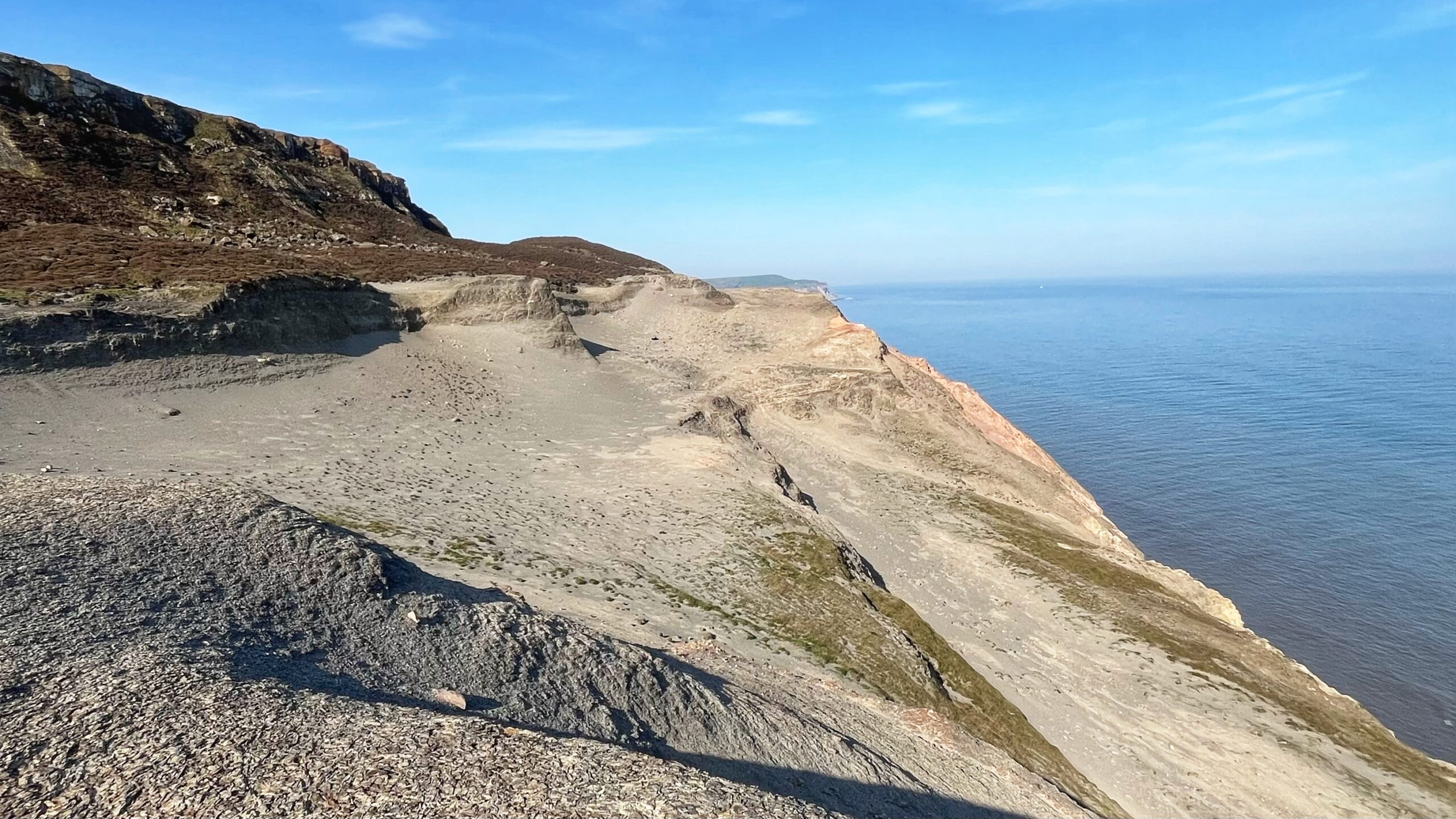
Stand on the site of the old Loftus Alum Works and you feel rather small. These 213-metre cliffs are not pretty. For centuries, workers burned shale and processed aluminium sulphate here, poisoning the ground so thoroughly that almost nothing grows. The place looks dead. It seems more of the remains of the seeping pits and channels have succumbed to the ravages of the North Sea since my last visit. And yet, somewhere in this industrial wasteland, one of the greatest ideas in the history of science was born.
Lewis Hunton grew up nearby at Hummersea House. His father ran the alum works, he was destined to take over his father’s position, so the smoke, the stone and the chemical stench were simply home. Most boys would have found something better to do. Lewis collected fossils1Windle, Mike. The History Tree. 2 Louis Hunton, a Scientist who Changed the World https://www.nyma.org.uk/_webedit/uploaded-files/All%20Files/History%20Tree/2%3A%20Louis%20Hunton%2C%20a%20Scientist%20who%20Changed%20the%20World.pdf(Accessed 5 November 2019).
In 1829, something extraordinary happened. Michael Faraday — the most celebrated scientist in Britain — came to visit. Lewis was 15 years old, living at the edge of nowhere, and suddenly he was shaking hands with a legend. Whatever Faraday said that day, it lit a fire that never went out2Appleton, Peter. “A Forgotten Industry. The alum shale industry of north-east Yorkshire”. Boroughgate Books. 2018. Appendix 7 – The fossil discoveries..
Lewis looked at what other geologists were doing and reached an awkward conclusion: they were doing it wrong. Collecting fossils from rubble at the cliff base told you almost nothing. You had to find them still locked in the rock face, exactly where they had been for millions of years. Only then could you say with confidence what age the rock was. By the time Lewis was 21, he had proved it. Specific ammonites meant specific rock layers. Full stop.
“[Hunton proposed] principles for investigating rocks and fossils… ammonites provided a means by which rocks of similar age… could be identified.”3Information board at NZ 73171 19709
He died of tuberculosis two years later.
He was 23. His work was ignored for nearly two centuries, until 2014 when a project finally marked the 200th anniversary of his birth. The world had spent 200 years not noticing that a teenager in a Yorkshire quarry had worked out the logic that now drives oil prospecting and climate research — industries worth billions.
The cliffs are still here. Still scarred. Still largely dead. But the rock face that Lewis Hunton studied so carefully still holds its ancient graveyard of Ichthyosaurs, Plesiosaurs and Pterosaurs. It is still waiting, as it always has been, for the next person who looks closely enough to see what everyone else has missed.
- 1Windle, Mike. The History Tree. 2 Louis Hunton, a Scientist who Changed the World https://www.nyma.org.uk/_webedit/uploaded-files/All%20Files/History%20Tree/2%3A%20Louis%20Hunton%2C%20a%20Scientist%20who%20Changed%20the%20World.pdf(Accessed 5 November 2019)
- 2Appleton, Peter. “A Forgotten Industry. The alum shale industry of north-east Yorkshire”. Boroughgate Books. 2018. Appendix 7 – The fossil discoveries.
- 3Information board at NZ 73171 19709
Leave a Reply