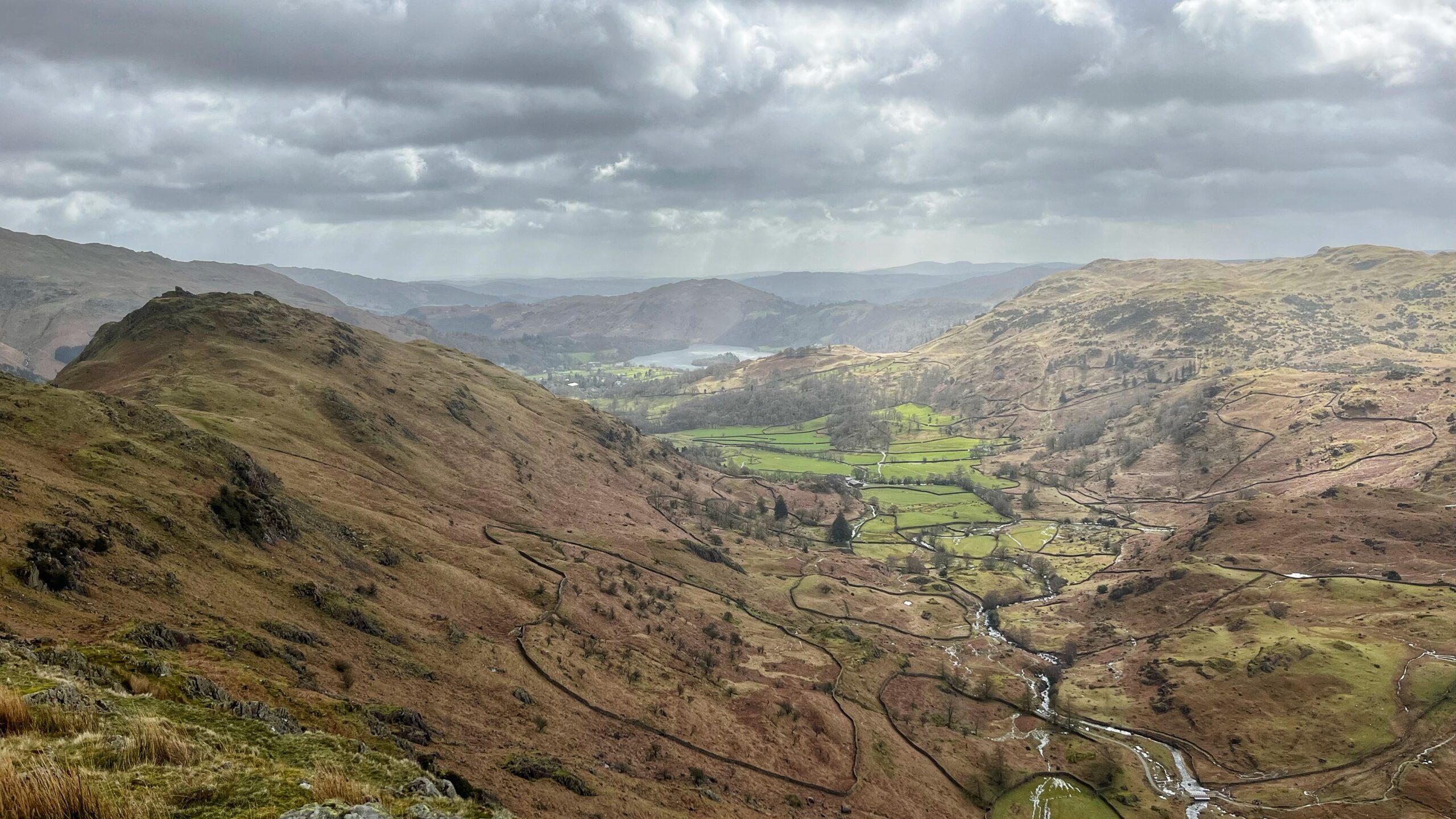
Another photo from Monday’s climb up Helm Crag. Looking down Easedale, you see more than a rugged Cumbrian landscape. You see a living library.
To the left, Helm Crag rises as what Dorothy Wordsworth called “a Being by itself” in 1801. Its summit bristles with famous rock formations: the “Lion and the Lamb,” the “Astrologer,” and the “Ancient Woman,” all of which Wordsworth himself thought worth immortalising in verse1Lindop, Grevel. “A Literary Guide to the Lake District”. Pp 103/4. Chatto & Windus. 1993.. Not bad for a pile of rocks.
Tucked at the foot of the fell is Lancrigg, where a Latin inscription marks the Wordsworths’ outdoor office. Dorothy sat on a glacier-smoothed boulder here, writing out large portions of the 1805 Prelude while William paced about composing aloud. One imagines the neighbours found it all rather wearing.
Higher up the valley lies Far Easedale, what Dorothy called the “second circle of Easedale.” At its heart sits a flat field centred on one specific “beautiful rock,” where the two siblings walked through the winter of 1800, presumably in the rain.
In the distance, Grasmere shimmers. Closer in, the Easedale Beck flows beneath a tiny one-arched packhorse bridge that Coleridge described as cemented by “moss and mould.” The water of its many tributaries catches and throws back the light under what Dorothy might well have called “fearful” clouds. Easedale, waterlogged as ever, remains inextricably tied to the poets who wandered here.
- 1Lindop, Grevel. “A Literary Guide to the Lake District”. Pp 103/4. Chatto & Windus. 1993.
Leave a Reply