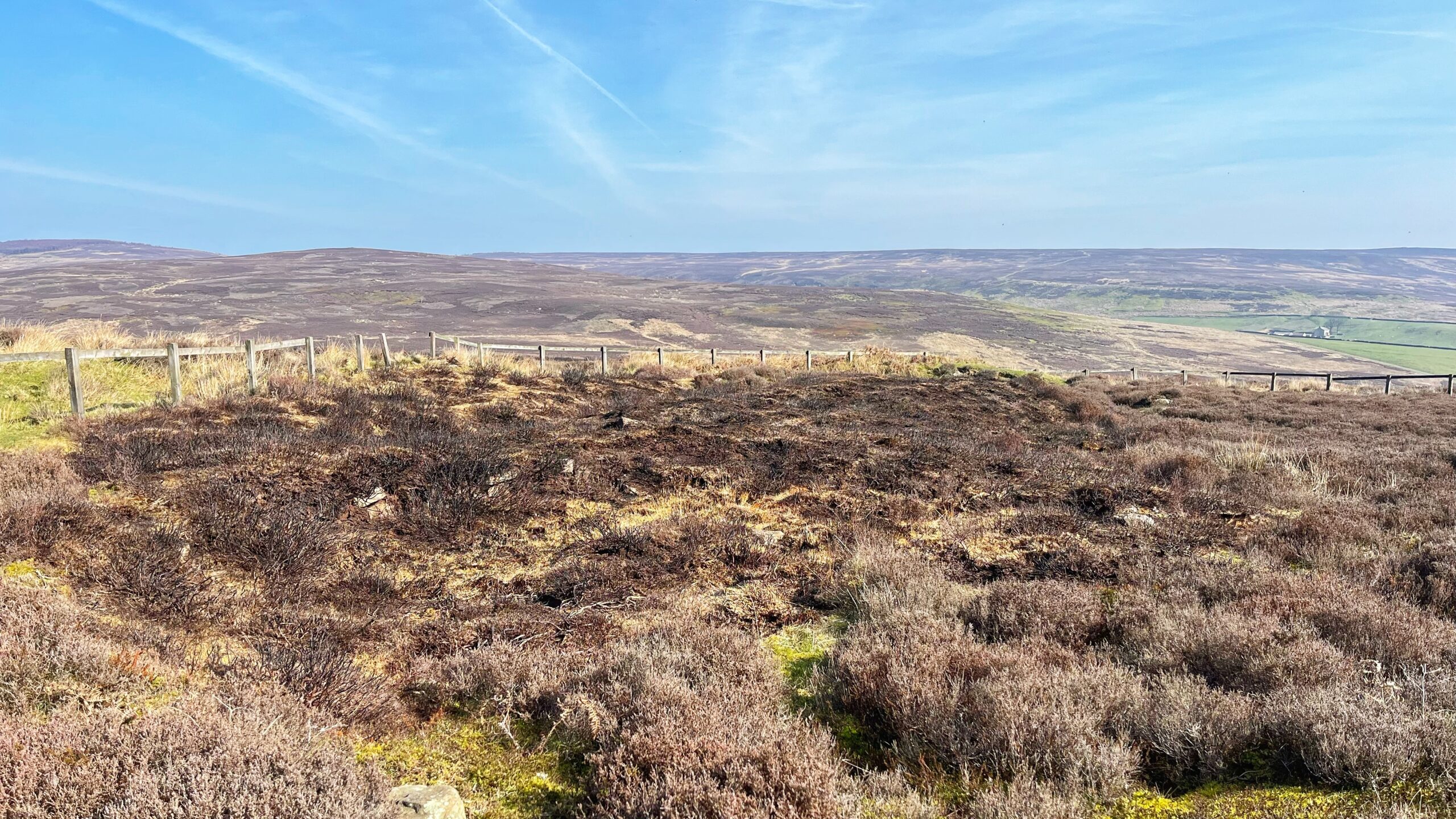
For centuries, five Iron Age round houses sat quietly on this ridge in North Yorkshire, and nobody noticed. Not bad for a neighbourhood that was probably occupied for over 300 years.
The site was only spotted in 1962, when Fred Proud of Sleddale Farm found it and reported it to local archaeologists Roland Close and Raymond Hayes. Better late than never.
Excavations ran from 1962 to 1968, with findings published in the Yorkshire Archaeological Journal in 1972. A further partial excavation was undertaken in 2019 by the Hidden Valleys Community Project1Teesside Archaeological Society BULLETIN 2024, No.28. Page 50-59. https://teesarchsoc.com/wp-content/uploads/2024/04/bulletin-2024-28.pdf.
The site comprises five round houses, along with at least five field boundaries that appear to form rectangular fields running north-east to south-west towards Sleddale Beck.
The most striking conclusion is social, not structural. It appears that only one house stood at any one time, in isolation amongst the field system — hardly your average Iron Age housing estate. The quality of workmanship in one particular house indicates a large input of labour and cost, something only an aristocrat would have had access to.
The pottery suggests a late Iron Age date, while grey ware from one particular house could extend occupation into the second century AD, giving a span of over 300 years. Rather grand for a windswept Yorkshire ridge, all things considered.
So who is looking after the site now?
That is where things become rather less impressive. The photograph above shows the site after a bout of heather burning — a common moorland management practice. The dark, scorched patches tell their own story.
Burning on peat can cause upstanding stone archaeological features to shatter and become unstable, and underground burning can affect buried archaeology2Holmes, John. 2025. ‘Natural England’s Response to Defra’s Consultation on Heather and Grass Burning’, Blog.gov.uk <https://naturalengland.blog.gov.uk/2025/10/03/natural-englands-response-to-defras-consultation-on-heather-and-grass-burning/> [accessed 21 March 2026]. Not exactly what you want happening to a site that survived two thousand years of Yorkshire weather.
Moorland burning in England is governed by various regulations3‘The Heather and Grass Etc. Burning (England) Regulations 2021 – Protect the Wild’. 2021. Protect the Wild <https://protectthewild.org.uk/protectors-of-the-wild/the-heather-and-grass-etc-burning-england-regulations-2021/> [accessed 21 March 2026]. These prohibit burning on peat over 40cm deep within Sites of Special Scientific Interest that are also Special Areas of Conservation or Special Protection Areas — unless a licence has been granted. Percy Rigg falls within the North York Moors National Park, which deserves some scrutiny here.
Burning archaeology is, rather surprisingly, not entirely illegal — but the law is catching up, at a pace that would make a tortoise look sprightly.
The government plans to amend the Regulations with strengthened safeguards specifically for heritage and archaeological features, and to change the definition of “deep peat” from 40cm to 30cm depth, which would protect over 676,000 hectares4‘Summary of Responses and Government Response’, GOV.UK <https://www.gov.uk/government/consultations/heather-and-grass-burning-in-england/outcome/summary-of-responses-and-government-response> [accessed 21 March 2026]. A small mercy, arriving fashionably late.
There is one firmer line in the law. Any deliberate or reckless damage to a Scheduled Monument is already a criminal offence, with consent required from Historic England before any work begins5‘Scheduled Monument Consent | Historic England’. 2019. Historicengland.org.uk <https://historicengland.org.uk/advice/planning/consents/smc/> [accessed 21 March 2026]. However Percy Rigg is not listed by Historic England, but it is recorded on the NYM NP Historic Environment Register6NYMNPA HER No: 4028 — Hut circle settlement on Percy Rigg. That is at least a start, though a listing is not the same as a lock on the door.
For unscheduled sites, however, the law has been something of a grey area. The incoming amendments aim to close that gap.
In the meantime, the best advice is straightforward: if in any doubt, do not light the match.
- 1Teesside Archaeological Society BULLETIN 2024, No.28. Page 50-59. https://teesarchsoc.com/wp-content/uploads/2024/04/bulletin-2024-28.pdf
- 2Holmes, John. 2025. ‘Natural England’s Response to Defra’s Consultation on Heather and Grass Burning’, Blog.gov.uk <https://naturalengland.blog.gov.uk/2025/10/03/natural-englands-response-to-defras-consultation-on-heather-and-grass-burning/> [accessed 21 March 2026]
- 3‘The Heather and Grass Etc. Burning (England) Regulations 2021 – Protect the Wild’. 2021. Protect the Wild <https://protectthewild.org.uk/protectors-of-the-wild/the-heather-and-grass-etc-burning-england-regulations-2021/> [accessed 21 March 2026]
- 4‘Summary of Responses and Government Response’, GOV.UK <https://www.gov.uk/government/consultations/heather-and-grass-burning-in-england/outcome/summary-of-responses-and-government-response> [accessed 21 March 2026]
- 5‘Scheduled Monument Consent | Historic England’. 2019. Historicengland.org.uk <https://historicengland.org.uk/advice/planning/consents/smc/> [accessed 21 March 2026]
- 6NYMNPA HER No: 4028 — Hut circle settlement on Percy Rigg
Leave a Reply