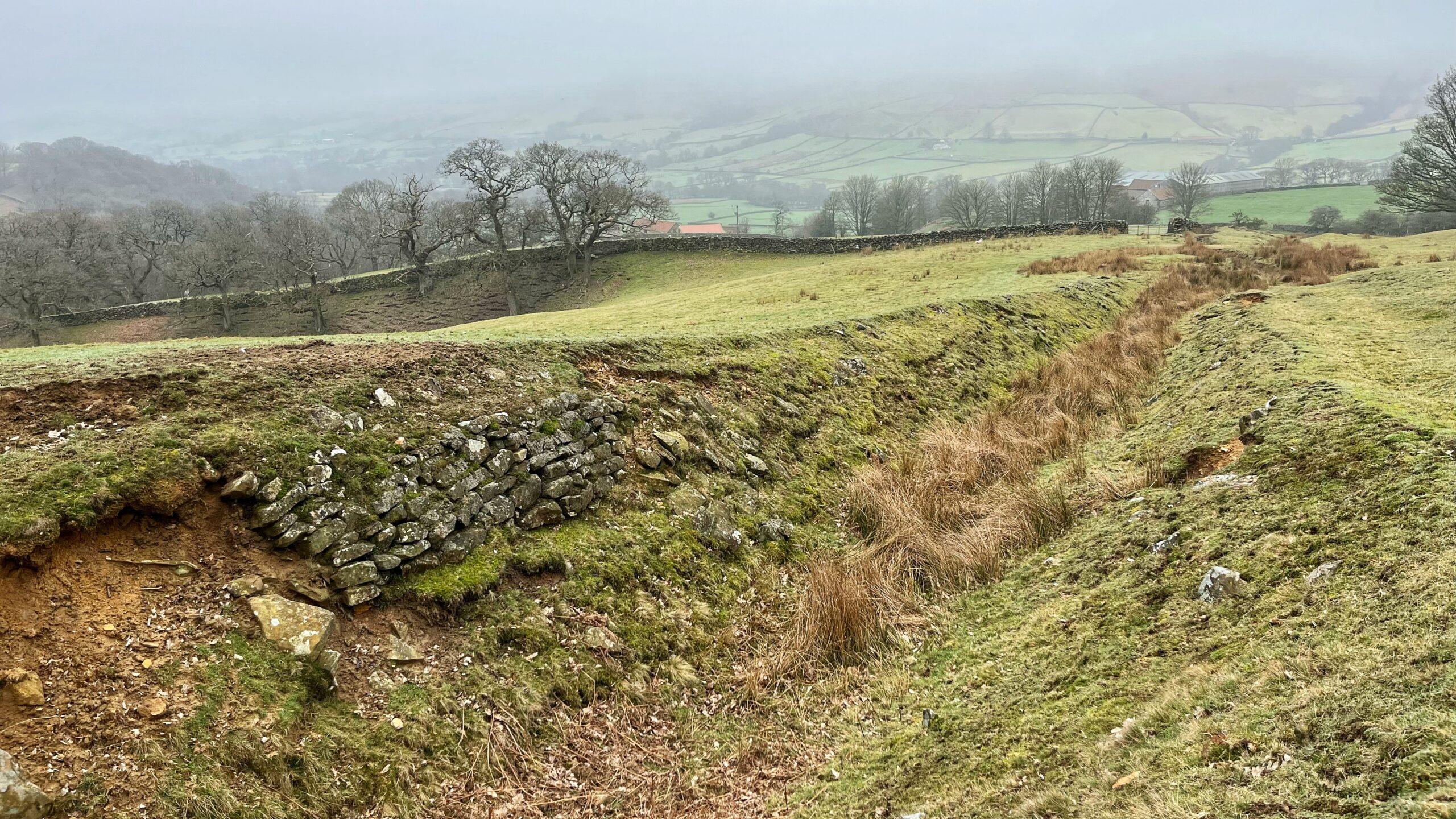
The watershed between the River Esk and River Rye tributaries was today more than a geographical line. It was a weather frontier. While Castleton and Westerdale basked in spring sunshine a mile or two away to the north, Farndale sulked under a damp mist so thick you could almost wring it out.
From the aptly named Esk House in upper Farndale, a Public Bridleway climbs over the col into Esklets and Westerdale. This is almost certainly a very old packhorse and traders route. The evidence is written in the ground itself, worn down over centuries into a sunken hollow-way, deep as a secret and twice as old1NYMNPA HER No: 13225. Hollow way north of Esk House..
Normally when these hollow-ways sink too far, travellers simply pick a line alongside and a braided track forms. Here though, someone went to rather more trouble. A dry-stone retaining wall was built to hold the route in place, which was no small undertaking on a remote moorland hillside. The cost and effort suggest someone with deep pockets and long ambitions. Monastic influence seems the most likely answer. The medieval monasteries of Yorkshire built trods the way they built abbeys, to last.
Peering down through the mist into upper Farndale, it is worth pausing to consider what might have been. In the late 1960s, Hull Corporation had grand plans to drown the whole dale under a reservoir. The proposed Farndale Reservoir would have covered 400 acres, swallowed 20 farm holdings whole and held 8 million gallons of water. Fortunately, common sense eventually won the day, which in 1960s Britain was rather a surprise.2North. 2016. ‘A to Z: A Flock of Fs’, The Official Blog for the North York Moors National Park <https://northyorkmoorsnationalpark.wordpress.com/2016/02/29/a-to-z-a-flock-of-fs/#:~:text=Farndale%20is%20probably%20the%20most%20famous%20dale%20in%20the%20North%20York%20Moors%2C%C2%A0mainly%20due%20to%20its%20population%20of%20wild%20daffodils%20which%20bring%20the%20visitors%20in%20spring%20to%20admire%20the%20golden%20views> [accessed 20 March 2026].
- 1NYMNPA HER No: 13225. Hollow way north of Esk House.
- 2North. 2016. ‘A to Z: A Flock of Fs’, The Official Blog for the North York Moors National Park <https://northyorkmoorsnationalpark.wordpress.com/2016/02/29/a-to-z-a-flock-of-fs/#:~:text=Farndale%20is%20probably%20the%20most%20famous%20dale%20in%20the%20North%20York%20Moors%2C%C2%A0mainly%20due%20to%20its%20population%20of%20wild%20daffodils%20which%20bring%20the%20visitors%20in%20spring%20to%20admire%20the%20golden%20views> [accessed 20 March 2026]
Leave a Reply