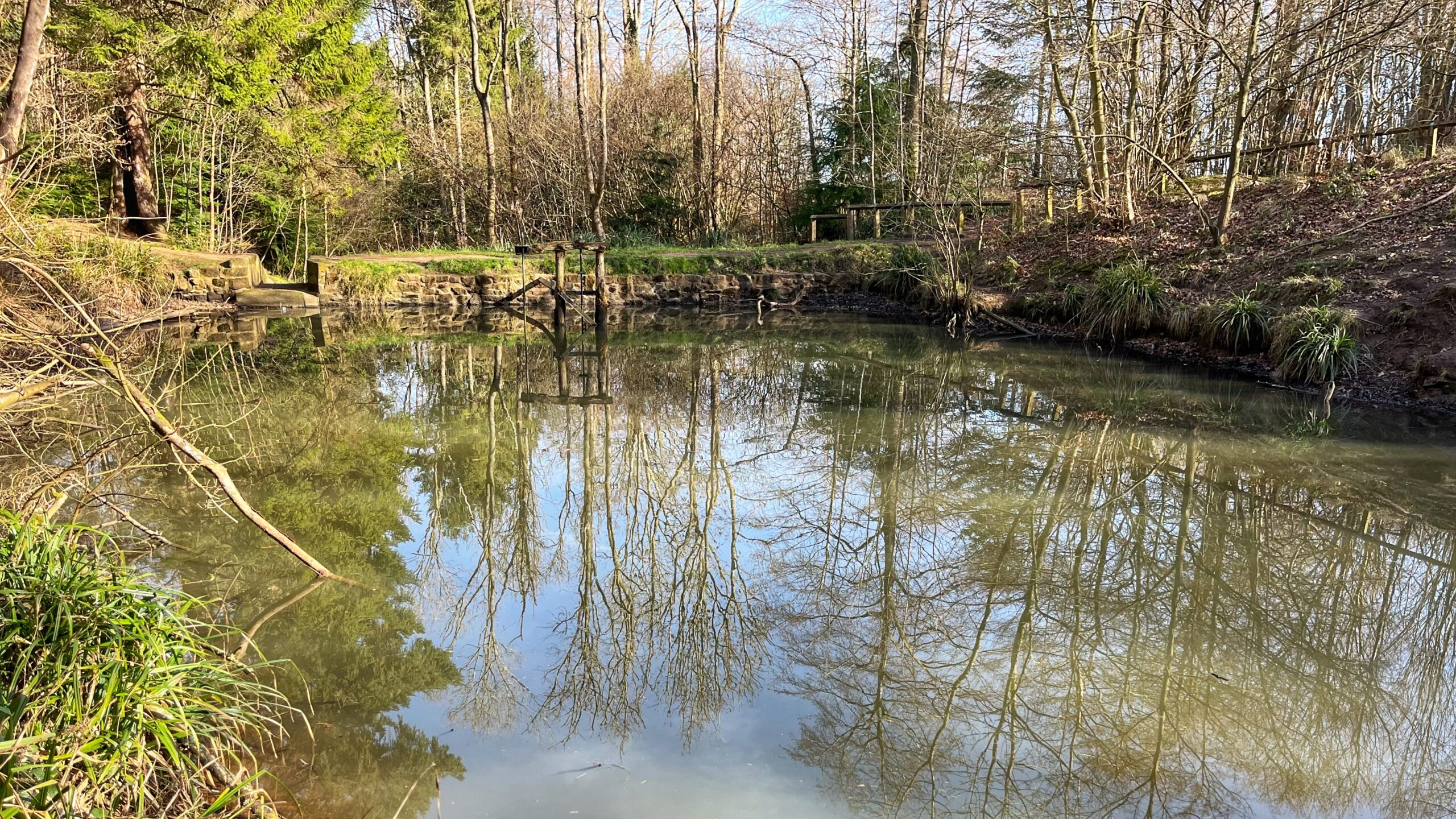
The pond in this photo was built in 1880 by Sir Joseph Whitwell Pease to power hydraulic machinery at his Home Farm half a kilometre downstream. It served that purpose until the 1950s, after which it became a swamp. Local volunteers restored it in 2004/5.
Known originally as Hanging Stone Dam, it sits at the top of the gill variously called Hall Gill or Middle Gill, though most people would know it as Blue Lake or Blue Lagoon. The blue name comes from the bluish tinge caused by salts leaching from alum shales. To me, it has always looked a mucky brown.
Pease was a Quaker banker, industrialist and railway pioneer from a wealthy and influential family. He built the nearby Codhill ironstone mine and the model village of Hutton for his workers. When the mine closed in 1865, he built Hutton Hall and its Home Farm. He became MP for South Durham and later Barnard Castle, and was active in the Peace Society, the Society for the Suppression of the Opium Trade and the campaign against capital punishment.
His grandfather Edward disapproved of his extravagance. In 1878, Pease brought 800 guests to Hutton by train to celebrate his son Alfred’s twenty-first birthday. The Avenue was planted with trees as part of the same celebrations.
Respected and generous, it came as rather a shock when Pease was rescued from bankruptcy in 1902. His troubles began in the 1880s when two engineering firms he had invested in heavily began losing money, at a time when iron and coal were in recession. By 1890 he was selling property. The final blow came when his niece Beatrice demanded payment for her shares, the resulting legal complications finished him off, and he died shortly afterwards.
Source: Smith, Paul. “Blue Lake and Home Farm.” 2005. Westgate Publishing.
Leave a Reply