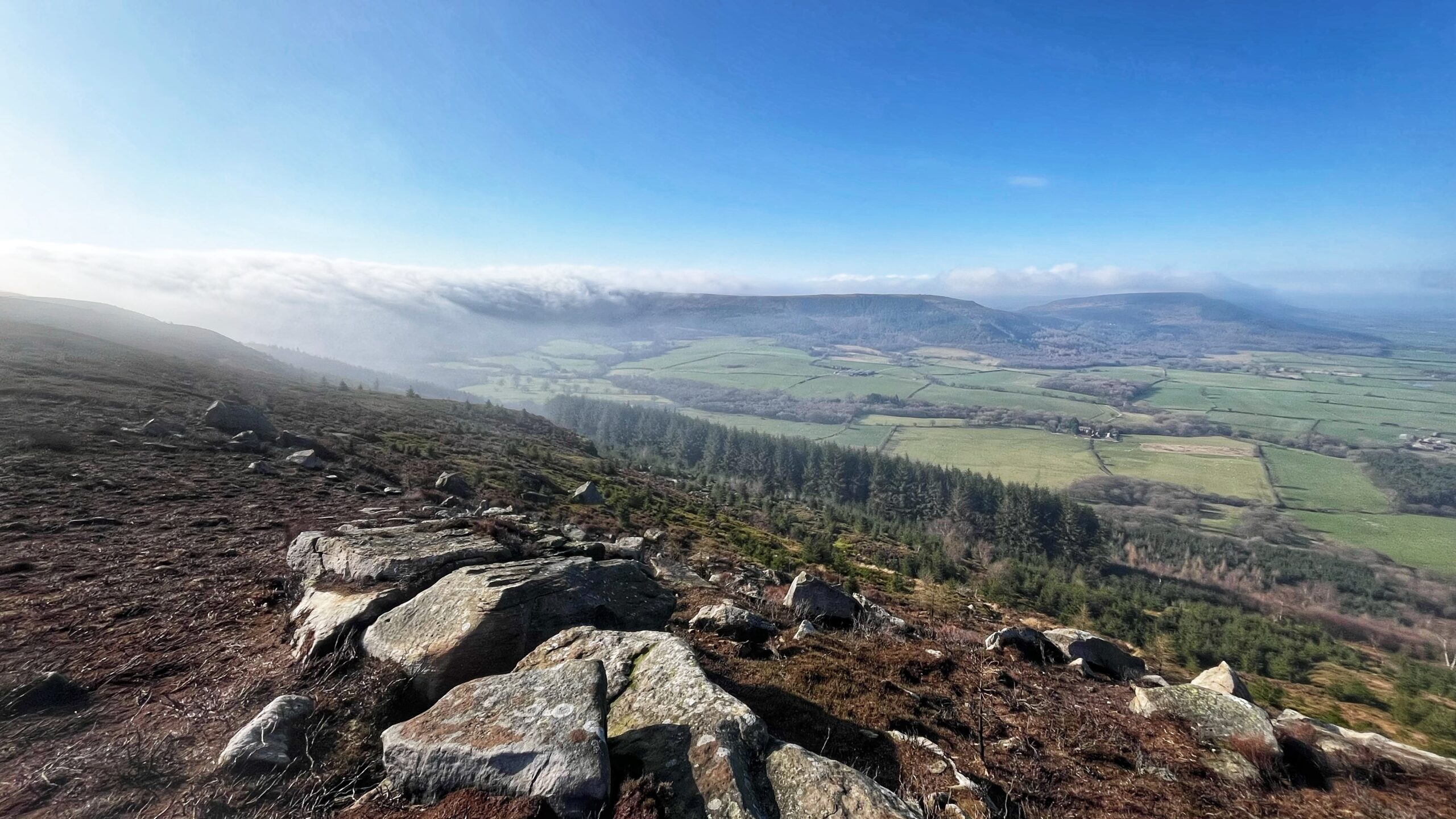
Up on the moors above Greenhow Botton today, where the Cleveland Hills were doing their best impression of a waterfall in the clouds. The kind of view that makes the uphill pedal entirely worth it. Just another quiet Wednesday on the North York Moors.
At the head of the valley lies Midnight Corner, which never sees sunlight in the depth of winter because it faces north. Midnight Farm, visible in the centre of the image, looks rather pleased with itself in the spring sunshine. Nobody is entirely sure which name came first, Midnight Corner or Midnight Farm, and Midnight Corner does not appear on any maps. Some mysteries are best left alone.
The name Botton comes from the Old Norse “botn,” meaning a bottom or depth1Proceedings of Cleveland Naturalists’ Field Club 1905-06. Page 3. Available online at http://barlow.me.uk/clevelandnats/1905_6_.pdf. Greenhow is a township of Ingleby parish, though it did not make the cut for the Domesday Book of 1086. However, a Camisdale is and some think Greenhow Botton and Camisdale are one and the same. Considering Camisdale means “the valley beside a crest or ridge,” this fits Greenhow Botton rather well, though 19th-century local historian John Ord was convinced it referred to Commondale instead2Wilson, Carol M. “Westerdale: the origins and development of a medieval settlement”. Pages 3,5. ISBN 978-0-9565779-2-4 2013.
The “how” element of Greenhow, or “houe,” a small round hill, is thought to refer to How Hill, a modest glacial mound that has been quietly getting on with things since the Ice Age3Proceedings of Cleveland Naturalists’ Field Club 1905-06. Page 3. Available online at http://barlow.me.uk/clevelandnats/1905_6_.pdf.
- 1Proceedings of Cleveland Naturalists’ Field Club 1905-06. Page 3. Available online at http://barlow.me.uk/clevelandnats/1905_6_.pdf
- 2Wilson, Carol M. “Westerdale: the origins and development of a medieval settlement”. Pages 3,5. ISBN 978-0-9565779-2-4 2013
- 3Proceedings of Cleveland Naturalists’ Field Club 1905-06. Page 3. Available online at http://barlow.me.uk/clevelandnats/1905_6_.pdf
Leave a Reply