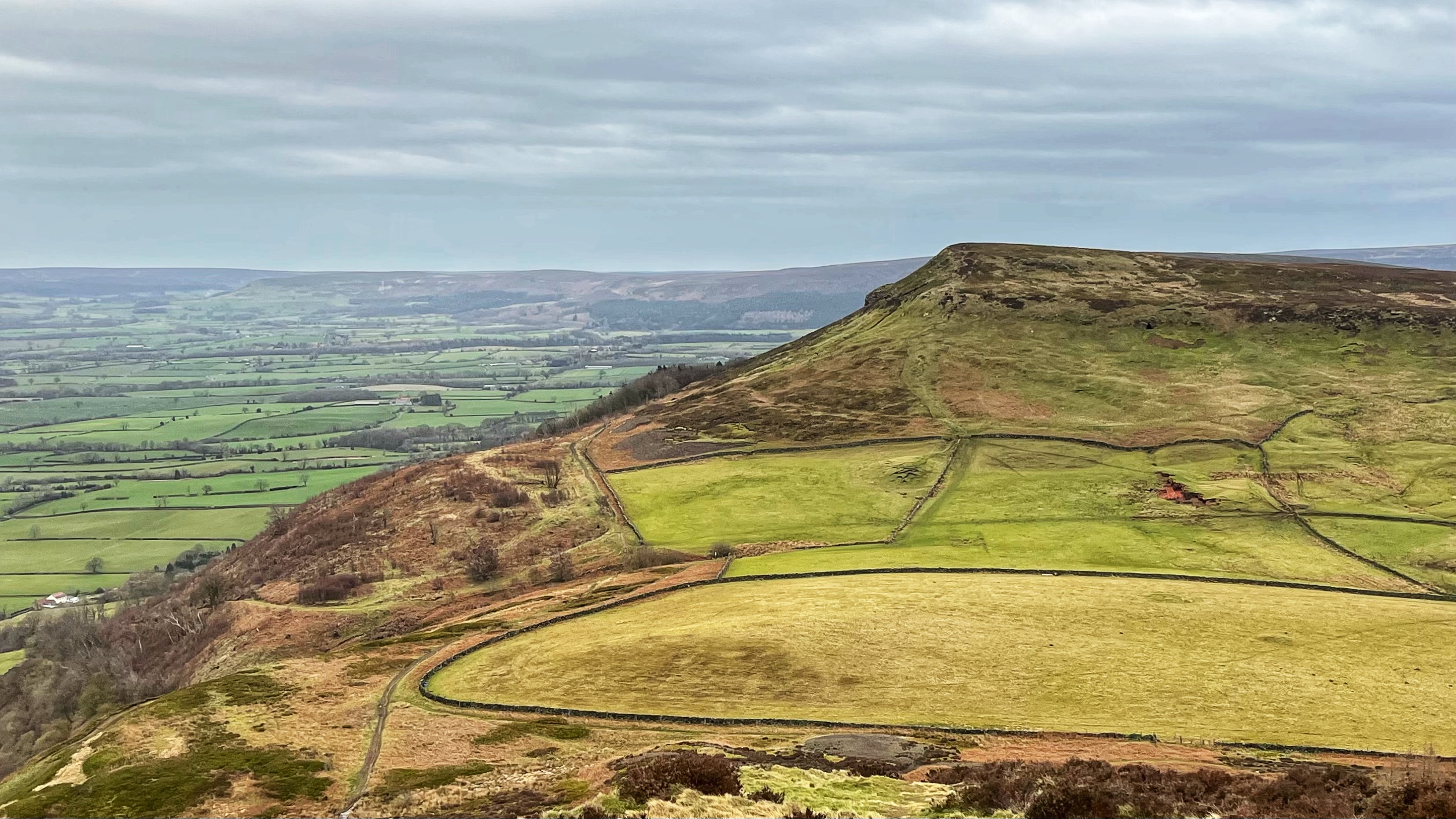
Cold Moor today looks like the sort of place that looks as though history slipped it by. Green, quiet, and peaceful. You would never guess how close it came to becoming a roaring industrial scar.
In 1911 the calm nearly ended. Plans were laid to turn this part of Lord Feversham’s vast estate into an ironstone venture1Sources of Iron Ore. Tees-side Weekly Herald – 28 January 1911. https://www.britishnewspaperarchive.co.uk/viewer/bl/0004244/19110128/038/0003. The hillside would have carried an overhead cableway rattling ore down to Stokesley Station. A deep adit was begun to reach a rich fourteen-foot seam, with sheds, spoil heaps and machinery ready to spread across these slopes near Beakhills Farm. That small triangular shadow visible on the opposite hillside is the trial adit, sitting directly above the reddish stain left by burnt shale once spread on farm tracks. In May of that year, a small team of miners started digging, fuelled by rising demand for ironstone even as other pits were already closing2Ironstone mines, Wainstone’s Hill. Whitby Gazette – 05 May 1911. https://www.britishnewspaperarchive.co.uk/viewer/bl/0001103/19110505/298/0012. Men were expected to drift here in search of work, like swallows chasing summer.
The real upheaval would not have been the machinery but the people. Three hundred miners were expected to arrive. Rows of temporary “iron cottages” were planned in Kirkby and Great Broughton, neat lines of necessity where open land once lay. The villages, then praised as peaceful holiday retreats, would have traded birdsong for smoke and noise3Whitby Gazette – Friday 27 October 1911. https://www.britishnewspaperarchive.co.uk/viewer/bl/0001103/19111027/224/0007.
By October optimism still lingered, though the project had begun to falter. The National Coal Miners’ Strike of 1912 brought industry across Cleveland to a halt. Ironstone without coal was useless, furnaces went cold, and hardship followed quickly. Relief committees struggled to support families as mines and works stood silent4SKELTON – IN – CLEVELAND IN HISTORY—1912. https://skeltonincleveland.com/wp-content/uploads/Skelton1912_1912.html#:~:text=DISTRESS%2C%20RELIEF%20COMMITTEE.. In the end, the truth proved simpler and harsher. The ore was no longer worth the cost. The grand plan collapsed under its own arithmetic.
So Cold Moor survived by accident rather than design. What remains is an unspoilt hillside instead of a forgotten industry. The question lingers like mist on the hills: when faced with a choice between our countryside and secure jobs, would we recognise the cost before it was too late?
- 1Sources of Iron Ore. Tees-side Weekly Herald – 28 January 1911. https://www.britishnewspaperarchive.co.uk/viewer/bl/0004244/19110128/038/0003
- 2Ironstone mines, Wainstone’s Hill. Whitby Gazette – 05 May 1911. https://www.britishnewspaperarchive.co.uk/viewer/bl/0001103/19110505/298/0012
- 3Whitby Gazette – Friday 27 October 1911. https://www.britishnewspaperarchive.co.uk/viewer/bl/0001103/19111027/224/0007
- 4SKELTON – IN – CLEVELAND IN HISTORY—1912. https://skeltonincleveland.com/wp-content/uploads/Skelton1912_1912.html#:~:text=DISTRESS%2C%20RELIEF%20COMMITTEE.
Leave a Reply