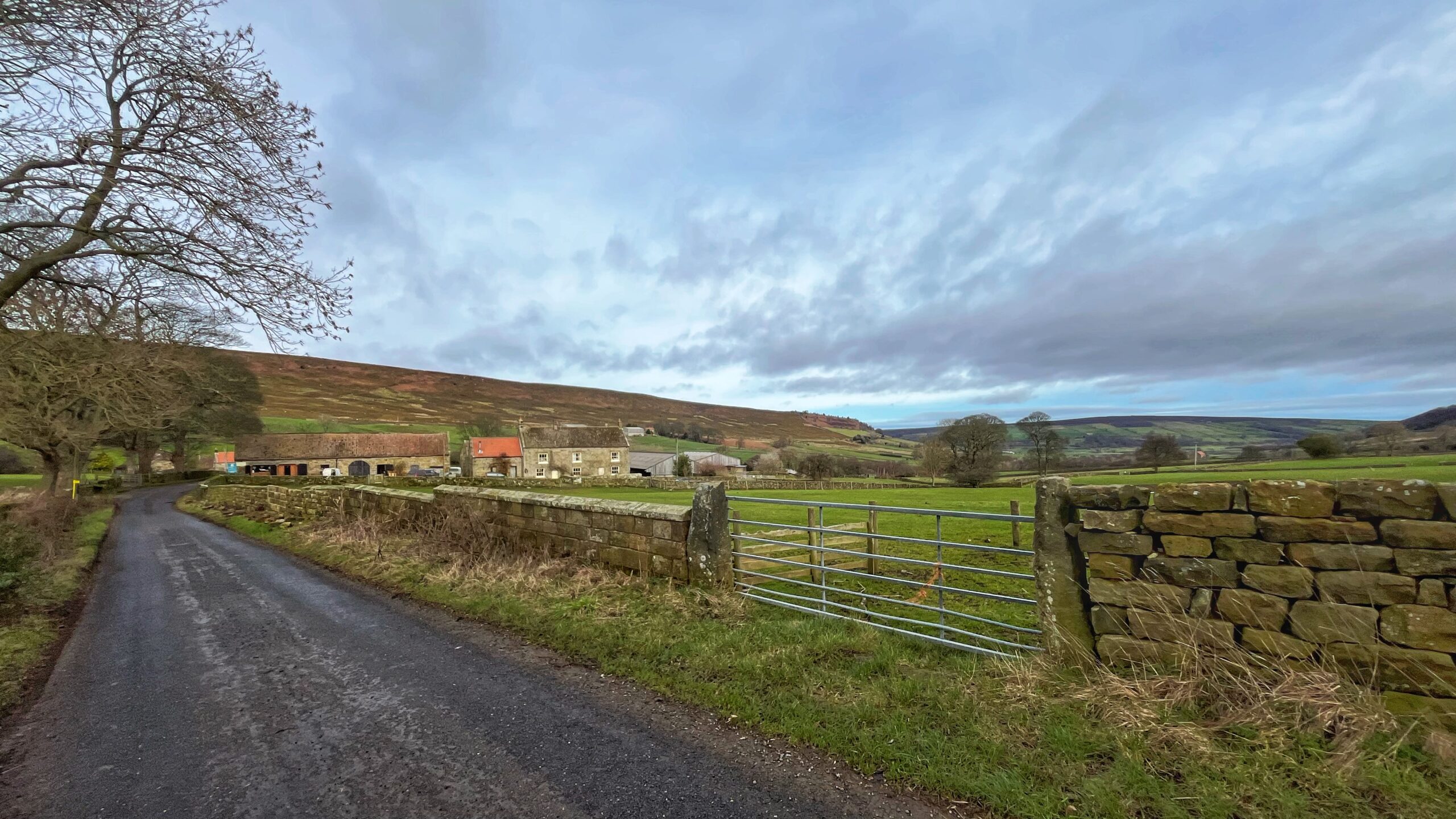
Stonebeck Gate Farm sits quietly in Little Fryup Dale, minding its own business, yet the real story lies in the wall that cuts across the foreground. On the right of the metal gate stands ordinary random-coursed dry-stone walling, the sort seen across these hills without a second glance. To the left, however, the tone changes. Stepped sections appear, built with dressed stone and tidy coping, work done with care rather than haste. This is no farmer’s boundary. It is the surviving trace of something grander, the lost Fryup Church1NYMNPA HER No: 12307. Church at Stonebeck Gate.2Ordnance Survey Maps – 25 inch England and Wales, 1841-1952. Yorkshire XLIV.3 Surveyed: 1892, Published: 1893. https://maps.nls.uk/view/125626042#zoom=5.4&lat=4067&lon=11747&layers=BT.
The church was pulled down in 1965, just before Nikolaus Pevsner fixed it in print in his great survey of architecture in 19663Pevsner, Nikolaus. “The Buildings of England – Yorkshire – The North Riding”. Penguin Books. Reprinted 1985.. One imagines him seeing it in its final act, like a scholar arriving as the curtain falls. He judged it older than the accepted date of 1871, when Viscountess Downe paid for its construction on land given by Viscount Downe4“Parishes: Danby”. A History of the County of York North Riding: Volume 2. Ed. William Page (London, 1923), British History Online. Web. 22 February 2026. https://www.british-history.ac.uk/vch/yorks/north/vol2/pp332-340#:~:text=Danby.-,A%20church%20was%20built%20at%20Stonebeckgate%2C%20Little%20Fryup%2C%20in%201871%20on%20a%20site%20given%20by%20Viscount%20Downe%20but%20at%20the%20expense%20of%20Viscountess%20Downe.,-(fn and built by Mr Boyes of Stonebeck Gate5Not necessarily creditable: ‘Little Fryup Dale – Church Site’. 2026. Flickr (Little Fryup Dale – Church Site | Can you spot the clue as t… | Flickr) <https://www.flickr.com/photos/16714425@N04/51734448595/> [accessed 22 February 2026]. By calling it “pre-ritualist” and “pre-ecclesiologist”, and “pre-archaeological” which are just fancy ways of saying “simple and old-fashioned,” Pevsner was reading the building’s character like a seasoned detective reads a face. Style, to him, told a truer story than paperwork. Given his reputation, arguing with him would be like telling the tide to turn back.
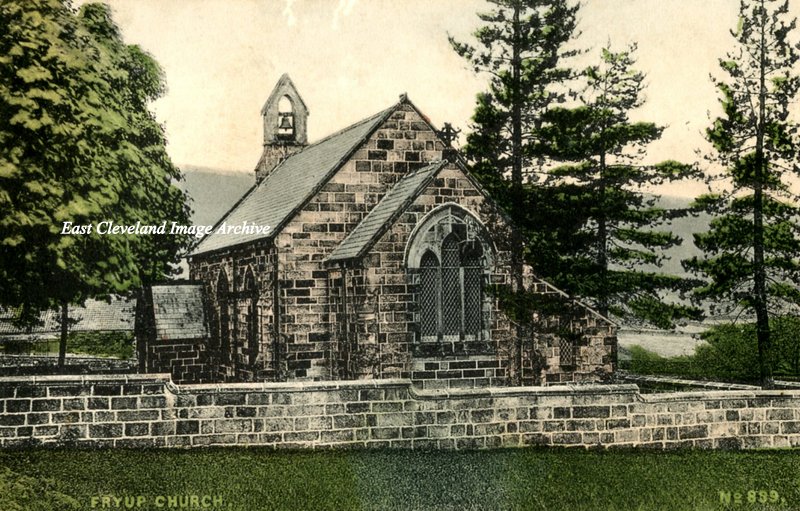
An old postcard from the East Cleveland Image Archive, taken from the south-east, shows a church of real grace, modest yet dignified, standing easily in its landscape. It fell under the ministry of Danby, where Rev. Canon Atkinson served as vicar, and for a time at least it must have seemed as permanent as the dale itself. Now only the wall remains, doing the quiet work of memory.
- 1NYMNPA HER No: 12307. Church at Stonebeck Gate.
- 2Ordnance Survey Maps – 25 inch England and Wales, 1841-1952. Yorkshire XLIV.3 Surveyed: 1892, Published: 1893. https://maps.nls.uk/view/125626042#zoom=5.4&lat=4067&lon=11747&layers=BT
- 3Pevsner, Nikolaus. “The Buildings of England – Yorkshire – The North Riding”. Penguin Books. Reprinted 1985.
- 4“Parishes: Danby”. A History of the County of York North Riding: Volume 2. Ed. William Page (London, 1923), British History Online. Web. 22 February 2026. https://www.british-history.ac.uk/vch/yorks/north/vol2/pp332-340#:~:text=Danby.-,A%20church%20was%20built%20at%20Stonebeckgate%2C%20Little%20Fryup%2C%20in%201871%20on%20a%20site%20given%20by%20Viscount%20Downe%20but%20at%20the%20expense%20of%20Viscountess%20Downe.,-(fn
- 5Not necessarily creditable: ‘Little Fryup Dale – Church Site’. 2026. Flickr (Little Fryup Dale – Church Site | Can you spot the clue as t… | Flickr) <https://www.flickr.com/photos/16714425@N04/51734448595/> [accessed 22 February 2026]
Leave a Reply