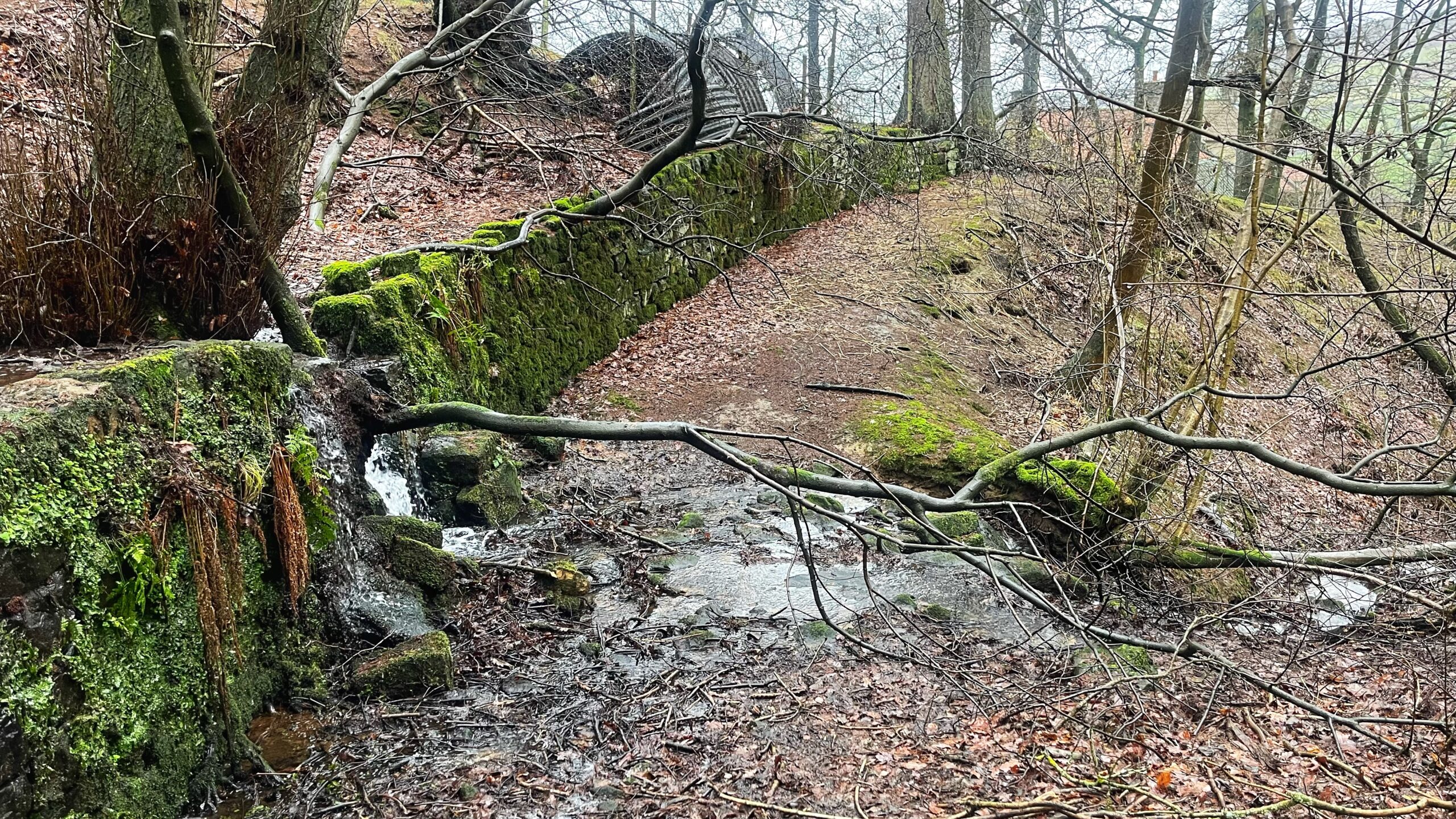
Hall Wood in Farndale hides a solid, well-made track, the sort that suggests purpose and history. It is said to have led to a sawpit. If so, it kept its secret well today. I found the path, but not the pit. The wood was less forthcoming than the National Trust’s heritage records1‘MNA178892 | National Trust Heritage Records’. 2026. Nationaltrust.org.uk <https://heritagerecords.nationaltrust.org.uk/HBSMR/MonRecord.aspx?uid=MNA178892> [accessed 12 February 2026]2‘MNA178891 | National Trust Heritage Records’. 2026. Nationaltrust.org.uk <https://heritagerecords.nationaltrust.org.uk/HBSMR/MonRecord.aspx?uid=MNA178891> [accessed 12 February 2026].
Timber once mattered in the dales in a way it no longer does. In the countryside, wood was not decoration. It was shelter, tools, fuel, livelihood. A farmer without trees had to keep an eye out for a bargain or a favour. A farmer with woodland watched it like a bank account. Oak was king. Ash, elm, holly, alder, hazel and hawthorn all had their turn beneath the axe. By the fourteenth century the great Forest of Pickering had already been thinned. Oaks went to abbeys and castles, to ships and houses, to carts, ploughs and barrels, to iron furnaces and even to smoke herrings. The appetite did not ease. In the eighteenth and nineteenth centuries new woods were planted to feed demand3Hartley, Marie and Joan Ingilby. “Life and Tradition on The Moorlands of North-East Yorkshire”. Pp 103-4. J.M. Dent & Son. 1990.. Hall Wood was likely one of them.
Dales farmers were famously self-reliant. Tools were made and mended at home. Joiners in every village carried older skills forward with hand tools and hard graft. Wheelwrights knew their trees as others know their livestock. Elm for hubs, rock-grown and twisted, was chosen with care. Timber was seasoned for years on the north side of a building before the whip-saw bit deep. Sometimes trees were cut up where they fell4Ibid.. Sometimes, as in Hall Wood, a track was carved across a ravine, so wood could travel from forest to farm more easily.
- 1‘MNA178892 | National Trust Heritage Records’. 2026. Nationaltrust.org.uk <https://heritagerecords.nationaltrust.org.uk/HBSMR/MonRecord.aspx?uid=MNA178892> [accessed 12 February 2026]
- 2‘MNA178891 | National Trust Heritage Records’. 2026. Nationaltrust.org.uk <https://heritagerecords.nationaltrust.org.uk/HBSMR/MonRecord.aspx?uid=MNA178891> [accessed 12 February 2026]
- 3Hartley, Marie and Joan Ingilby. “Life and Tradition on The Moorlands of North-East Yorkshire”. Pp 103-4. J.M. Dent & Son. 1990.
- 4Ibid.
Leave a Reply