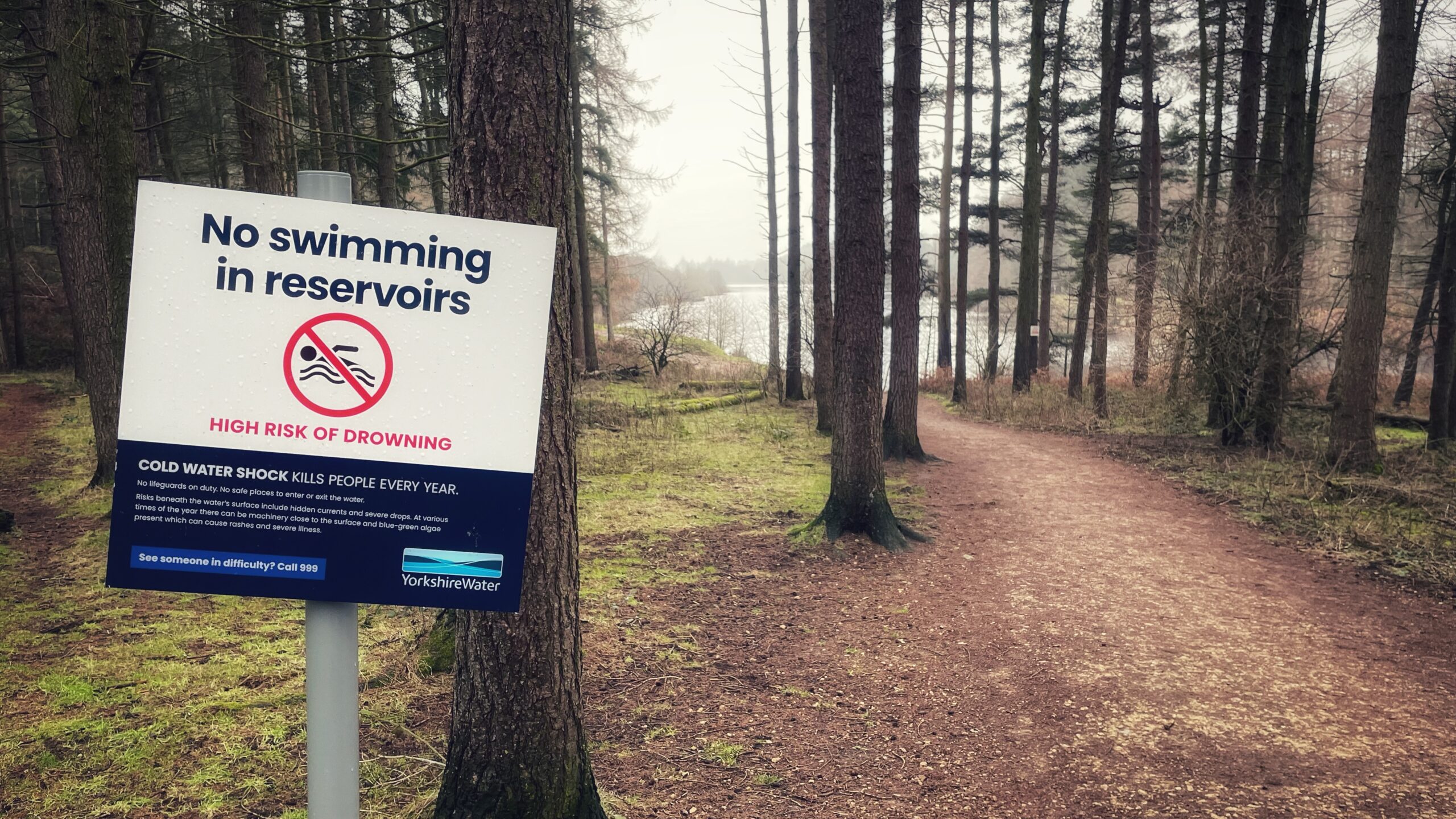
It may have been a cold walk around Cod Beck Reservoir today, but imagine it is hot. The height of the summer. You are with friends. A dull sign saying “No Swimming” stands between you and a better afternoon. Many people have stared down that sort of sign and decided it probably does not apply today. Usually nothing happens. Sometimes everything does.
That is what happened on a baking bank holiday in May 1995 at Brereton Heath country park. John Tomlinson was eighteen, fit, and familiar with the place. The lake looked inviting. Despite clear signs banning swimming, he ran into the water and performed a shallow dive, something he had done before without trouble. This time he struck his head on the sandy bottom, fractured his neck, and was left tetraplegic1Tomlinson v Congleton BC, Wikipedia. https://en.wikipedia.org/wiki/Tomlinson_v_Congleton_BC.
Lord Hoffmann later described it as a “relatively minor act of carelessness”. Minor, perhaps. The consequences were catastrophic. What followed was eight years of legal argument, winding its way from the High Court to the Court of Appeal and finally to the House of Lords. The final judgment reshaped how English law thinks about risk, blame, and personal responsibility.
The first surprise was that Tomlinson’s legal status changed the moment he entered the water. While walking around the park, he was a lawful visitor, owed a full duty of care under the Occupiers’ Liability Act 1957. By ignoring the “Dangerous Water: No Swimming” signs and entering the lake, he became a trespasser under the 1984 Act with the same name. The duty owed to him dropped sharply. You can be welcome in a place and still trespass by using it in a way you have been clearly told not to. The old example fits neatly. You invite someone to use the stairs, not to slide down the banisters.
The second lesson was blunter still. The law does not exist to protect people from obvious dangers. Diving into water of unknown depth is risky. That is not specialist knowledge. A warning sign spelling it out adds nothing. The judges held that the council was not liable because the injury was not caused by the state of the premises. There was no hidden hazard, no trap. As the court put it, “It was a normal lake with shallow and deep parts.” The danger lay in the activity, not the place.
Lord Hutton was unimpressed by the idea that landowners must guard against such risks, calling it “contrary to common sense to expect an occupier to offer protection against an obvious danger like a cliff or water.”
At the heart of the case sat an old principle with a long memory: volenti non fit injuria. If you freely accept a risk, the law will not rescue you when it goes wrong. Tomlinson chose to dive. He chose to ignore the ban. The risk was his.
Lord Hoffmann summed it up with lasting clarity: “The law does not require him to prevent people from taking risks which are inherent in the activities they freely chose to undertake.”
There was also a wider concern. To make the lake completely safe, the council would have had to destroy it. Reeds, ballast, fences, and mud would have replaced open water and sand. The court refused to impose that social cost. It was not reasonable to ruin a public space for everyone in order to protect a few from their own decisions.
The case is bleak, but its message is plain. Freedom carries weight. Choice has consequences. The law will not always catch you when you jump.
Of course, the usual caveat applies: I am not a lawyer.
- 1Tomlinson v Congleton BC, Wikipedia. https://en.wikipedia.org/wiki/Tomlinson_v_Congleton_BC
Leave a Reply