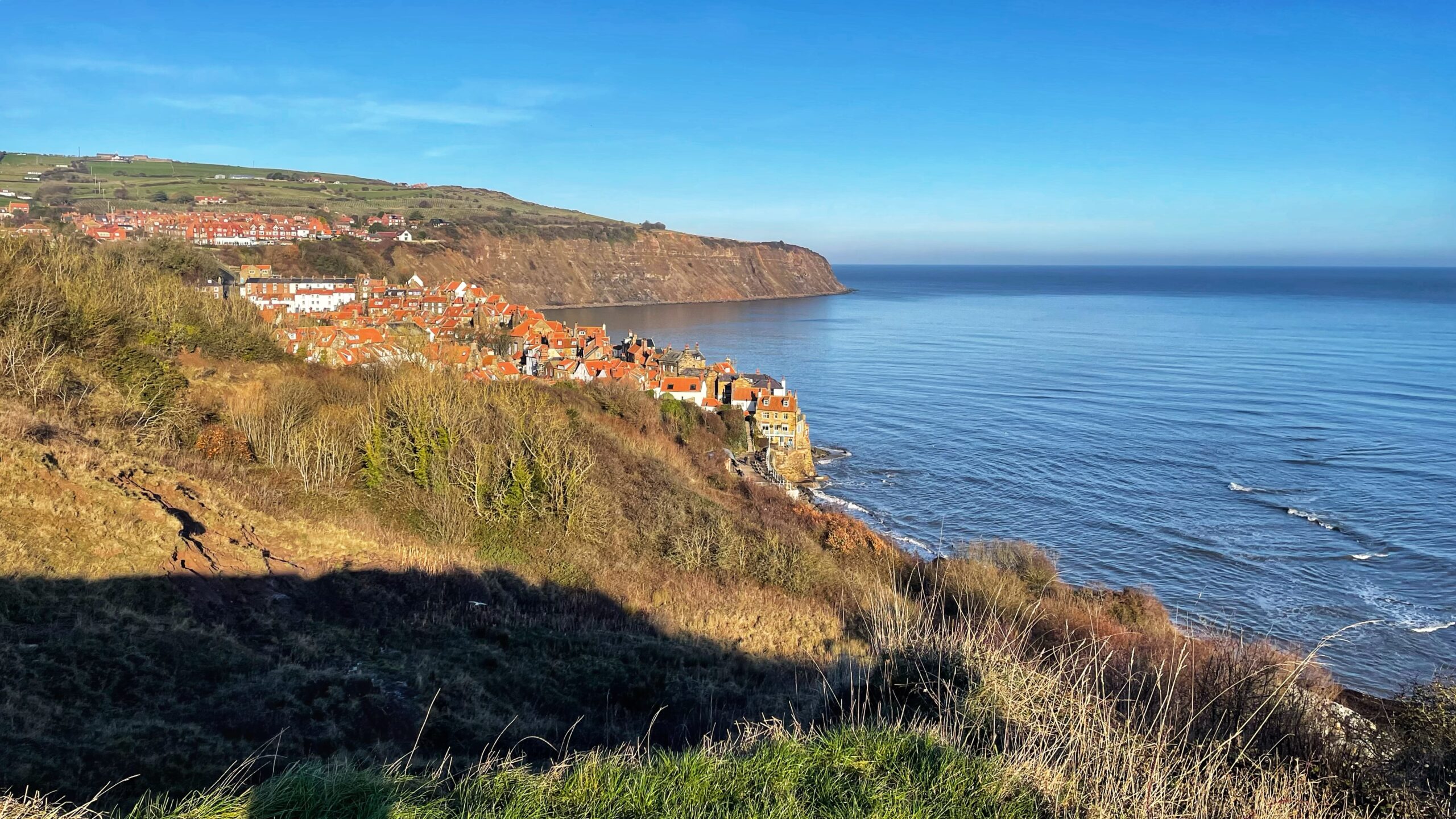
A fine day today on the coast south of Robin Hood’s Bay, the sort that invites postcards and ice creams, albeit a little chilly. In January 1881 it was another matter. A storm was brewing, snow lay in eight-foot drifts on the high ground, and the village was all but cut off from the world.
On the morning of 16 January, a vicious south-easterly gale gave way to a north-easterly blast of snow and hail. Offshore, in appalling seas, the collier brig Visiter was breaking up. Her six-man crew abandoned ship and clung to a small open boat, knowing the rocks below the Ravenscar cliffs would finish the job if the sea did not. A rescue was urgent. What followed, however, was not decided by the water but by the land.
The rescue is usually told as a lifeboat story, with Henry Freeman at its centre. The truth is broader and stranger. It is a tale of stubborn leadership, grim teamwork, and a community that refused to accept the obvious answer.

The local Robin Hood’s Bay lifeboat was old and judged unsafe for the towering seas. Rowing from Whitby was impossible. Captain Gibson, the Whitby RNLI secretary, along with coxswains Henry Freeman and John Storr, made a decision that sounded like folly. They would haul the Whitby lifeboat, the Robert Whitworth, overland.
The journey was six miles of winter misery. Eighteen horses and more than two hundred volunteers dragged the lifeboat carriage through snowdrifts as high as cottage doors. Some men cleared ahead while others pushed and pulled. The route climbed to over five hundred feet before dropping sharply into the bay. The final descent down Bay Bank was so tight and steep that ropes were needed to stop the carriage running away. At one bend, there was barely an inch to spare. After three hours of this, the boat reached the shore.
Even then, the sea had not finished arguing. A massive wave smashed six oars, forcing the lifeboat back. Several crewmen were spent. Freeman called for fresh volunteers, borrowed oars from the old Bay lifeboat, and went again. This time they reached the Visiter’s men and brought all six ashore alive. It was not elegance. It was persistence.
Freeman himself carried older scars. In 1861, he had been part of a lifeboat crew lost during repeated rescues in ferocious seas. Their boat was overturned by colliding waves. Every man drowned except Freeman. He survived because he wore a newer lifebelt that stayed on his shoulders. The others wore older designs that failed them. That piece of equipment kept Freeman alive and, twenty years later, placed him on the beach at Robin Hood’s Bay when it mattered.
He went on to save more than three hundred lives and became a public figure for the RNLI. Yet he was never a saint. In 1883 he was fined for stealing fishing lines at sea, spared prison only by his reputation. After his first wife died, he married her sister, an illegal act at the time, and quietly went to Hartlepool to do it.
None of this weakens the story. It strengthens it. The rescue of the Visiter was not just bravery at sea but stubborn will on frozen land. It was shaped by chance, by technology, and by a man prepared to defy storms, exhaustion, and occasionally the law. Like most real heroes, Henry Freeman was complicated, awkward, and entirely human.
Source:
‘The History Tree: Moments in the Lifetime of a Memorable Tree’. North York Moors Association. Pages 69 and 77. https://www.nyma.org.uk/books/
Leave a Reply