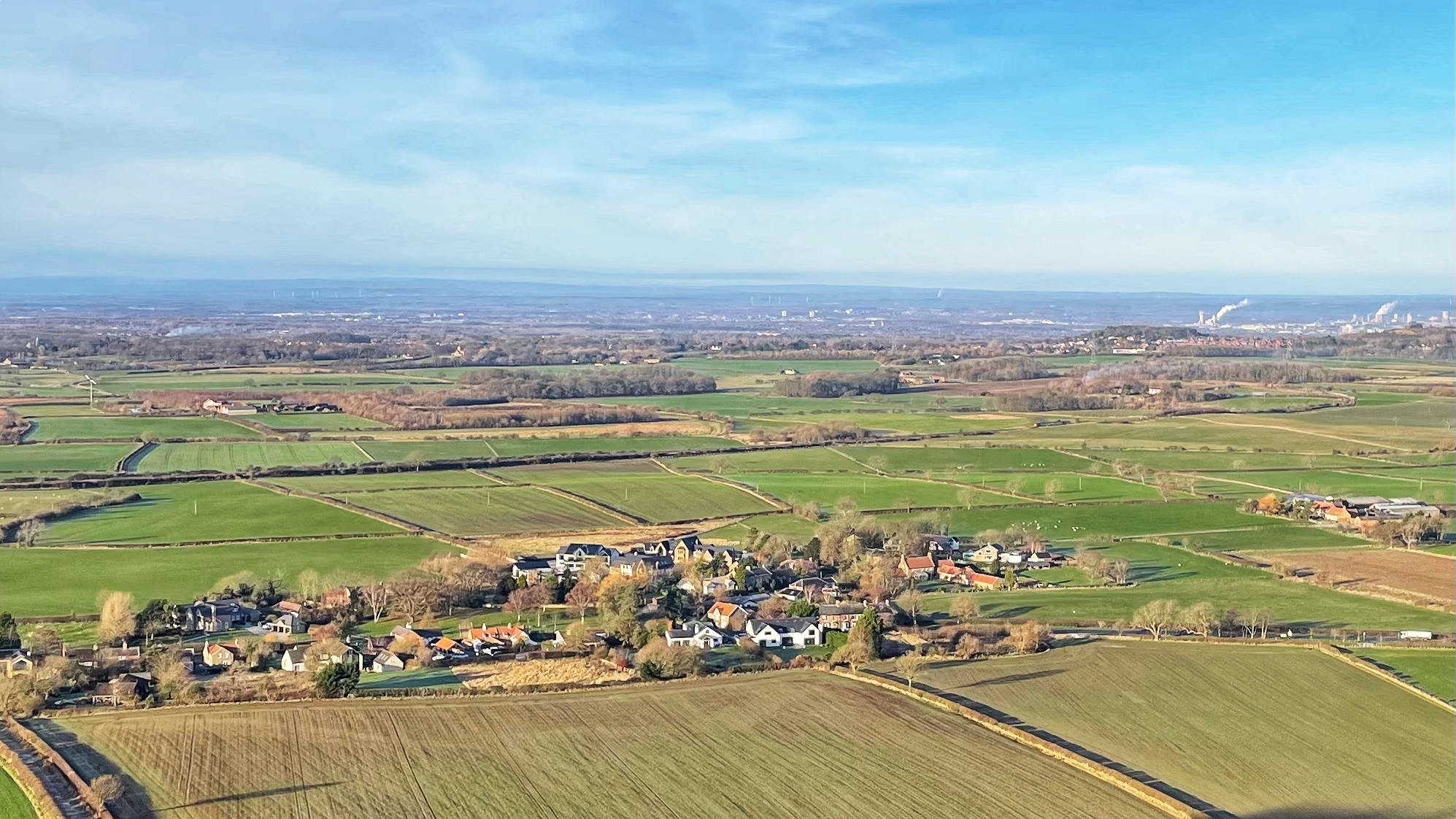
From the slopes of Roseberry Topping the view opens out like a well-thumbed map. Below sits Newton-under-Roseberry, neat and patient in the cold. It is a clear winter’s day, the sort that looks honest but bites hard. The eye moves easily from the hush of the village, across the chequerboard fields of Morton Carr, and on to the hard line of Middlesbrough on the horizon, where the land stops pretending to be rural.
Early nineteenth-century writers John Graves and John Walker Ord had little time for Newton. They dismissed it as a small, dirty, insignificant place, a scatter of huts with no ambition at all1Britishnewspaperarchive.co.uk. (2022). Newton-In-Cleveland. The History Of A Yorkshire | Newcastle Daily Chronicle | Saturday 07 May 1904 | British Newspaper Archive. [online] Available at: https://www.britishnewspaperarchive.co.uk/viewer/bl/0001634/19040507/092/0008 [Accessed 25 Mar. 2022].. They were not being kind, but they were being thorough. Today the village tells a different story. It is quaint and pleasant, made up of stone cottages and a short row of modest villas, holding its ground against the slow creep of new-build executive houses. There is even a pub, the King’s Head, which tradition insists must be mentioned. After last year’s meal there, discretion suggests it should not be lingered over. Hard to imagine now, but the village once managed to support at least one shop, which feels like a bold claim for such a small place.
The word “Carr” describes low, wet ground, the sort that squelches underfoot and smells faintly of old secrets. These marshy fens, rich in peat and scrub, would be poor for walking but excellent for memory. Waterlogged and starved of air, they preserve wood, bone, and pollen with quiet determination. Morton Carr has long been drained and turned into good, obedient farmland, yet the ground keeps giving things away. Signs of early human activity are emerging, proof that people were drawn to this awkward landscape long before it learned to behave2ICE AND FIRE — The Eston Hills Rescue Archaeology Project. A Community Project in Redcar & Cleveland, North Yorkshire. Spencer D. Carter, Terri Edwards, David Errickson and Adam Mead. 2018..
- 1Britishnewspaperarchive.co.uk. (2022). Newton-In-Cleveland. The History Of A Yorkshire | Newcastle Daily Chronicle | Saturday 07 May 1904 | British Newspaper Archive. [online] Available at: https://www.britishnewspaperarchive.co.uk/viewer/bl/0001634/19040507/092/0008 [Accessed 25 Mar. 2022].
- 2ICE AND FIRE — The Eston Hills Rescue Archaeology Project. A Community Project in Redcar & Cleveland, North Yorkshire. Spencer D. Carter, Terri Edwards, David Errickson and Adam Mead. 2018.
Leave a Reply