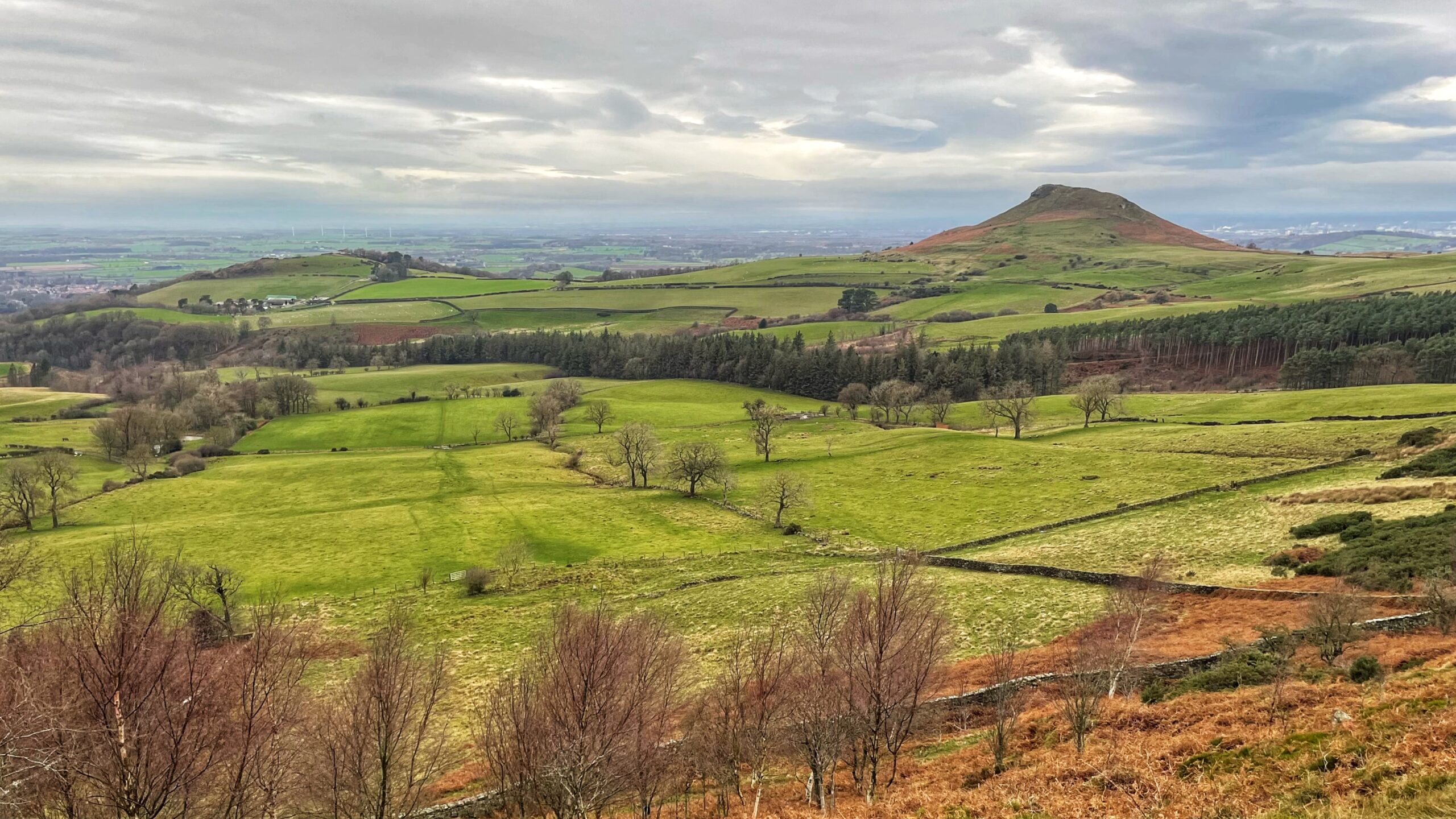
The nearest field in today’s photograph marks the site of the old farmstead of Summerhill, born out of Great Ayton’s enclosure of the common land in 1658. At that time, the commons stretched all the way to the top of Roseberry, open and shared in a way that would soon vanish.
The enclosure was carried out by the township’s twenty-one freeholders, who carved up the ancient open fields and common pastures. It was hardly an even-handed affair. The driving force was the more powerful landowners, above all the Lord of the Manor, John Coulson. He oversaw the process and, as one might expect, emerged with the lion’s share of the land.
Such enclosures were usually about money dressed up as progress. Freeholders wanted tighter control, better yields, and a slice of the growing dairy trade. Enclosed pastures made cattle easier to manage and profits easier to count. In the process, shared rights and customs were swept aside and replaced by private ownership. The result was a transformed landscape: smaller fields, neatly boxed in by hedges, walls, or fences.
Before enclosure, four areas in Ayton were classed as stinted common pasture, where grazing and other rights were fixed by long-standing manorial custom. Two of these, Aireyholme and Ayton Banks, lie on this higher ground to the east of the township, these very fields in the photograph.
Up to around the tenth or eleventh century, land had slowly been won from forest, marsh, and moor, bringing it into permanent cultivation. For centuries after that, up to the mid-seventeenth century, farming was largely managed as a community concern, often under the watchful eye of the manorial courts. Fields lay open, divided into furlongs and strips. In Great Ayton, enclosure had been an ongoing process; several hundred acres had already been privately enclosed long before 1658, some of it going back at least to Tudor times.
It is hard to measure the full weight of suffering borne by the poorest villagers, but for workers whose rights to the land had just been stripped away the change must have been brutal. They were pushed down from being people with a living bond to the soil into little more than hired hands, present by tolerance rather than right. To add insult to injury, these same men would often have been compelled to build the walls and plant the hedges that locked them out, sealing the land for the benefit of the owner while they stood on the wrong side of it.
Summerhill itself enjoyed fine views, but comfort was another matter. Perched and exposed, it would have been a hard place to make a living. Even so, the tenanted farm seems to have carried on against the odds and, according to a now-vanished Facebook post, survived until the 1970s. Not bad going, all things considered.
Source: O’Sullivan, Dan. The Enclosure of the Open Fields in 1658. October 2009. https://greataytonhistory.co.uk/wp-content/uploads/2025/02/Enclosure-of-the-Open-Fields-in-1658.pdf. [Accessed 17 December 2025]
Leave a Reply