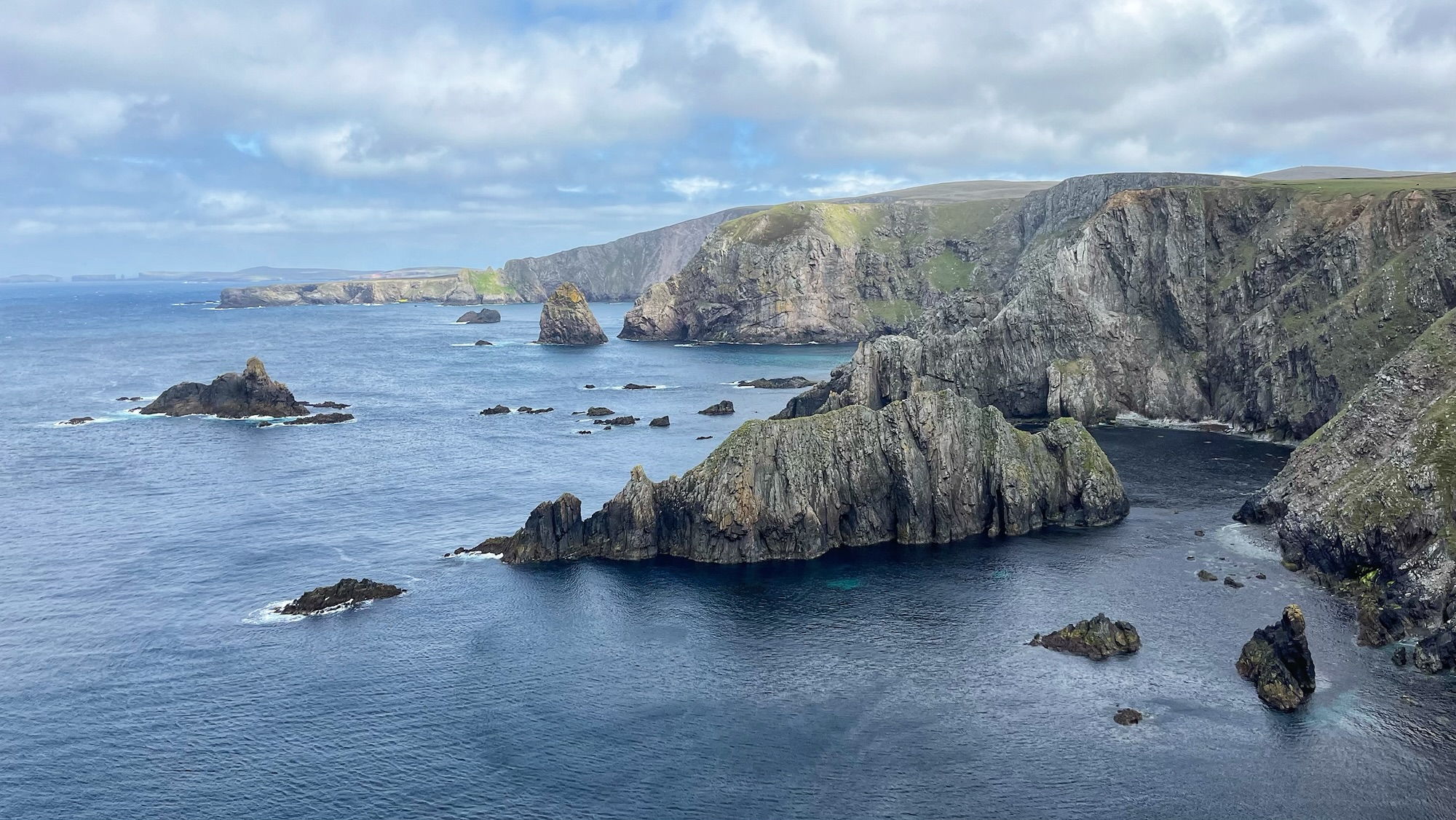
This stretch of the coastline is considered “one of the finest walks in Shetland”1Tait, Charles. The Shetland Guide Book. 2003.. It is chaotic, uniformity would certainly spoil the view. The geology results from a messy struggle in the distant past between stubborn granite and weak sandstone. Granite holds itself against the waves. Sandstone is less reliable and erodes more easily. This difference in character creates the “drongs”, a Shetlandic name for these lonely sea stacks, apparently just waiting to fall over. The 170m sandstone cliffs of Ramna Vord in the distance are steeply eroded because the Atlantic is having a real go at them. There is however a distinct lack of geos along this coast, but sea caves, and arches abound. A geo is one of those narrow inlets that looks like a collapsed cave. It is a bleak scene where the rocks and the sea are at loggerheads. The landscape is rather untidy. Nature does know when to leave well alone.2“Shetland.” Wikipedia, 28 May 2026, https://en.wikipedia.org/wiki/Shetland.
- 1Tait, Charles. The Shetland Guide Book. 2003.
- 2“Shetland.” Wikipedia, 28 May 2026, https://en.wikipedia.org/wiki/Shetland.