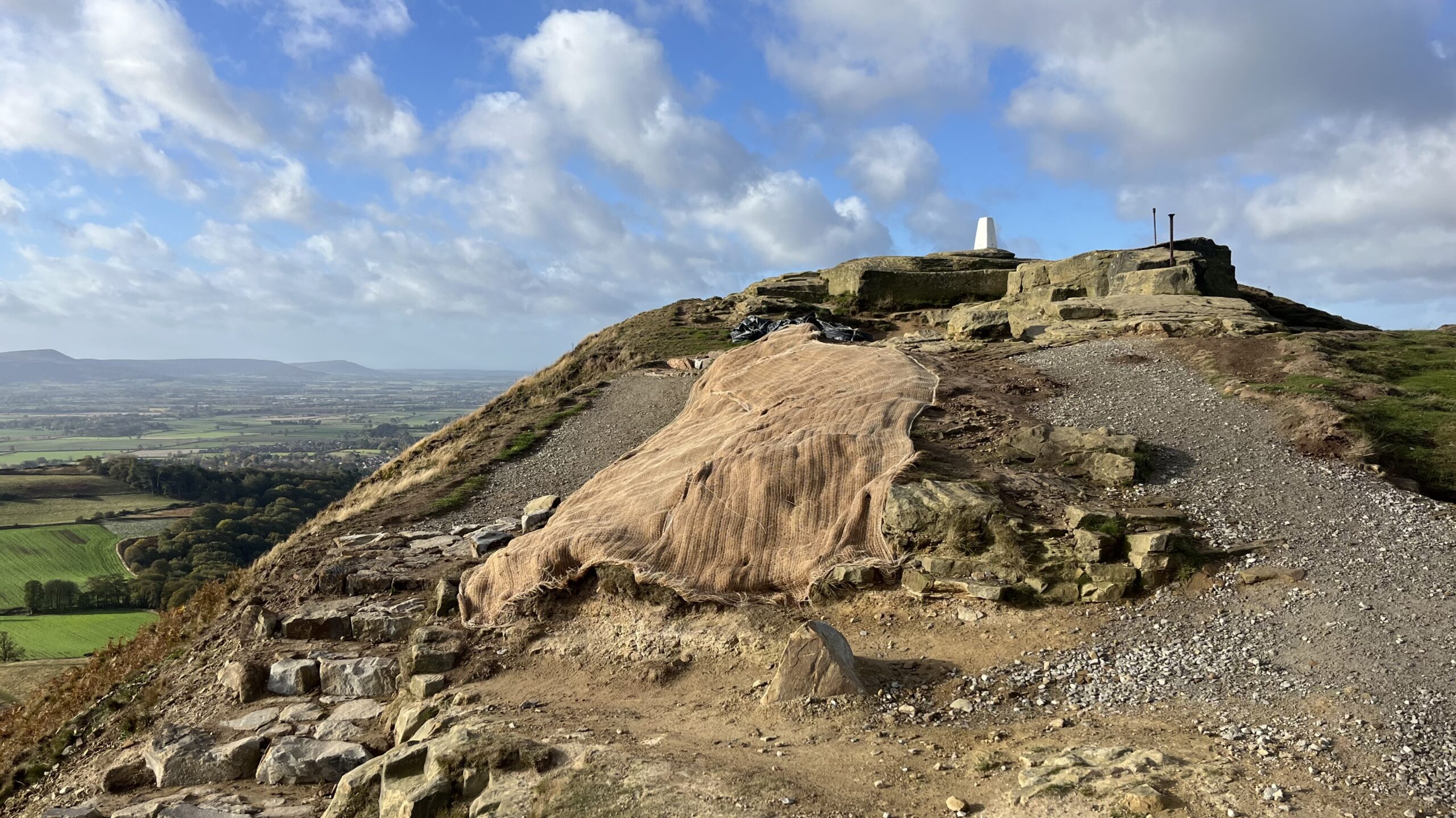
So begins the old rhyme, but it’s not a cap that now lies on the summit but a brown blanket, lying on the bare ground just below the trig point. Close up, it is an open weave of thick, coarse fibre. It looks like coir, which is made from coconut husk, though I have no knowledge of the stuff.
Matting of this kind is recommended for exposed sites such as uplands and coasts. The gaps in the weave are deliberate, since plants can grow up through them 1“Hill Erosion Control.” erosioncontrol-products.com, www.erosioncontrol-products.com/hillerosioncontrol.html. Accessed 27 Oct. 2026.. One manufacturer I looked at adds that the fibres shelter seedlings from wind and protect seed from birds, animals and footfall 2“CoirMesh 700 Biodegradable Erosion Control Mesh.” Hy-Tex (UK), Specified By, www.specifiedby.com/hy-tex-uk/coirmesh-700-biodegradable-erosion-control-mesh. Accessed 27 Oct. 2026.. Steel pegs hold the blanket down, and it has so far stayed put through Storms Austen and Boelo, the first two named storms of the season, although we were on the periphery of both. It was pretty windy today too.
The same manufacturer says its mesh breaks down in three to five years, while other suppliers quote between two and six. The idea is to hold seed and soil until grass takes over. Few things in a landscape are built to vanish, but this is one of them. The steel pegs are less obliging. I doubt anyone will collect them in five years, so they will probably be left to rust away. A mystery for future archaeologists.
- 1“Hill Erosion Control.” erosioncontrol-products.com, www.erosioncontrol-products.com/hillerosioncontrol.html. Accessed 27 Oct. 2026. ↩︎
- 2“CoirMesh 700 Biodegradable Erosion Control Mesh.” Hy-Tex (UK), Specified By, www.specifiedby.com/hy-tex-uk/coirmesh-700-biodegradable-erosion-control-mesh. Accessed 27 Oct. 2026. ↩︎
Leave a Reply