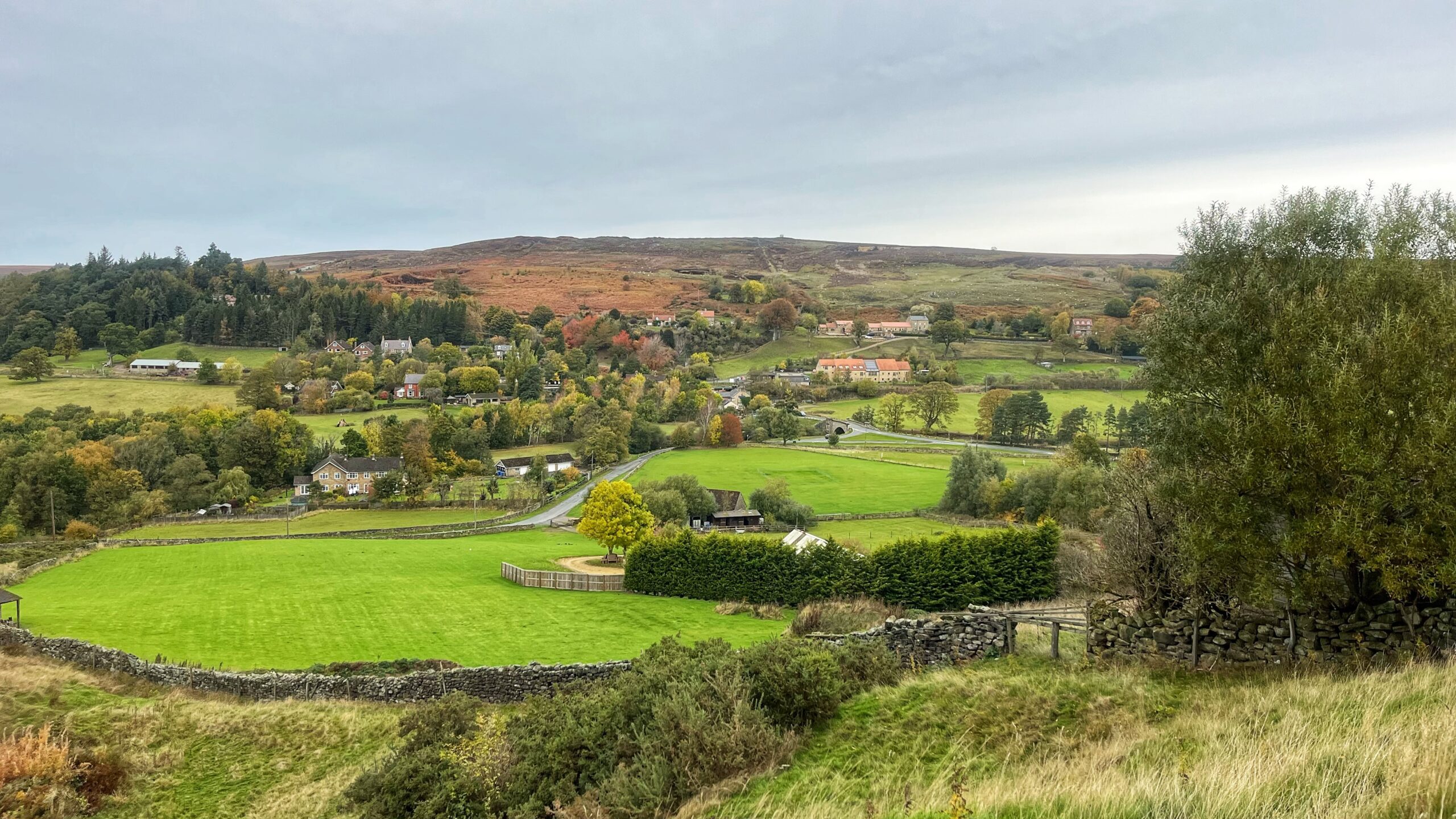
I set out to recreate an old black-and-white view of the Esk valley at Castleton, which I found on Facebook, but fell disappointingly short. I think the original was taken from the old Methodist Chapel, now a private home. Trees block the view from Station Bank, and houses rule out the rest of the village, so I ended up 500 metres west, looking north-north-east instead of north-west. Bow Bridge and the Eskdale can be discerned on both images though.
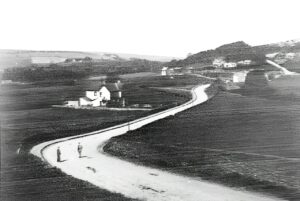
I admit the old photo is not the best, a lot having been lost in the scanning, but it clearly shows the old fields are bare. The new ones are crowded. I have been under the impression that the tree cover in England is at an all-time low. England’s woodland bottomed out at 5.2 per cent in 1905 1“A History of UK Woodland.” Helen Elizabeth Art, www.helenelizabethart.com/copy-of-managing-ancient-woodland. Accessed 25 Oct. 2026. (This page cites Forest Research 2018 as its source.) but now covers about 10 per cent 2Forest Research. “Chapter 1: Woodland Area & Planting.” Forest Research, 2025, www.forestresearch.gov.uk/?p=147288. Accessed 25 Oct. 2026.. On the Moors it actually reaches 22 per cent 3North York Moors National Park Authority. “North York Moors Nature Recovery Plan Annex 1.” North York Moors National Park, www.northyorkmoors.org.uk/__data/assets/pdf_file/0024/187503/North-York-Moors-Nature-Recovery-Plan-Annex-1.pdf. Accessed 25 Oct. 2026., nearly three-quarters of it conifer plantation 4North York Moors National Park Authority. “NYMNPA Section 3 Woodland.” data.gov.uk, www.data.gov.uk/api/2/rest/harvestobject/2d341834-20fe-456f-addf-24983e981911/html. Accessed 25 Oct. 2026.. Some 61,000 acres of the Moors have been planted with trees 5“A Biography of an Acre: A Book Review.” Woodlands.co.uk, www.woodlands.co.uk/?p=1592. Accessed 25 Oct. 2026..
There have been recent gains, with England creeping from 9.5 to 10.3 per cent since 1998 6Department for Environment, Food and Rural Affairs. “D3: Area of Woodland in England.” oifdata.defra.gov.uk, https://oifdata.defra.gov.uk/themes/wildlife/D3/. Accessed 25 Oct. 2026.. The Forestry Commission not surprisingly rates this as little change 7Forestry Commission. FC Key Performance Indicators Report 2025-26. 25 June 2026, https://assets.publishing.service.gov.uk/media/6a3bca5230b491f55b3c487e/FC-Key-Performance-Indicators-Report-2025-26.pdf. Accessed 25 Oct. 2026.. Old woodland though is scarce, covering less than 5 per cent of the Moors 8North York Moors National Park Authority. “Woodland: About.” North York Moors National Park, www.northyorkmoors.org.uk/wildlife-and-habitats/woodland/about. Accessed 25 Oct. 2026., and across Britain native woodland has been sometimes cleared and replanted with conifers 9Oak National Academy. “Mapping Changes in the UK’s Forests.” Oak National Academy, https://thenational.academy/pupils/lessons/mapping-changes-in-the-uks-forests/video. Accessed 25 Oct. 2026..
- 1“A History of UK Woodland.” Helen Elizabeth Art, www.helenelizabethart.com/copy-of-managing-ancient-woodland. Accessed 25 Oct. 2026. (This page cites Forest Research 2018 as its source.) ↩︎
- 2Forest Research. “Chapter 1: Woodland Area & Planting.” Forest Research, 2025, www.forestresearch.gov.uk/?p=147288. Accessed 25 Oct. 2026. ↩︎
- 3North York Moors National Park Authority. “North York Moors Nature Recovery Plan Annex 1.” North York Moors National Park, www.northyorkmoors.org.uk/__data/assets/pdf_file/0024/187503/North-York-Moors-Nature-Recovery-Plan-Annex-1.pdf. Accessed 25 Oct. 2026. ↩︎
- 4North York Moors National Park Authority. “NYMNPA Section 3 Woodland.” data.gov.uk, www.data.gov.uk/api/2/rest/harvestobject/2d341834-20fe-456f-addf-24983e981911/html. Accessed 25 Oct. 2026. ↩︎
- 5“A Biography of an Acre: A Book Review.” Woodlands.co.uk, www.woodlands.co.uk/?p=1592. Accessed 25 Oct. 2026. ↩︎
- 6Department for Environment, Food and Rural Affairs. “D3: Area of Woodland in England.” oifdata.defra.gov.uk, https://oifdata.defra.gov.uk/themes/wildlife/D3/. Accessed 25 Oct. 2026. ↩︎
- 7Forestry Commission. FC Key Performance Indicators Report 2025-26. 25 June 2026, https://assets.publishing.service.gov.uk/media/6a3bca5230b491f55b3c487e/FC-Key-Performance-Indicators-Report-2025-26.pdf. Accessed 25 Oct. 2026. ↩︎
- 8North York Moors National Park Authority. “Woodland: About.” North York Moors National Park, www.northyorkmoors.org.uk/wildlife-and-habitats/woodland/about. Accessed 25 Oct. 2026. ↩︎
- 9Oak National Academy. “Mapping Changes in the UK’s Forests.” Oak National Academy, https://thenational.academy/pupils/lessons/mapping-changes-in-the-uks-forests/video. Accessed 25 Oct. 2026. ↩︎
Leave a Reply