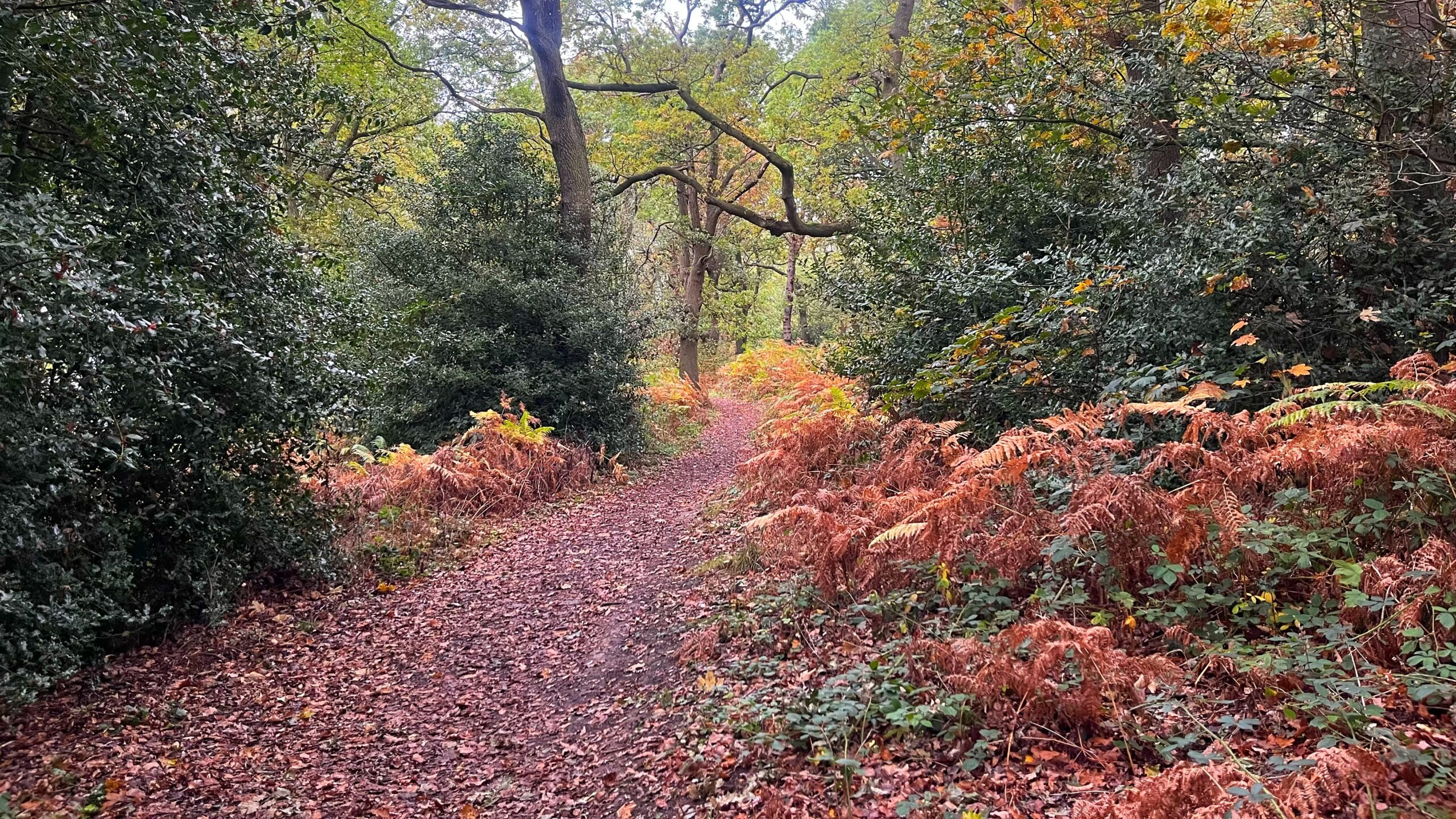
There is something magical about autumn, with its rich palette of colours transforming the woodland into a living canvas.
Today, I was volunteering with the National Trust in Newton Wood, building dead hedges to encourage visitors to stick to the newly improved path and give the woodland undergrowth a chance to recover from the pressure of footfall.
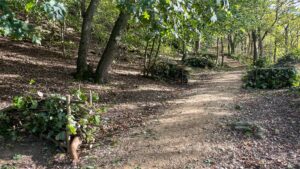
We used dead wood and sycamore saplings to build the barriers. Sycamore is an invasive species in this oak woodland, so removing young trees serves two purposes. It helps restore the woodland’s natural balance, while the dead hedges themselves provide valuable habitats for wildlife. Beetles and other insects find shelter among the branches, while small mammals and birds benefit from both protection and feeding opportunities. A practical bit of conservation, with benefits extending well beyond the path.
While searching for sycamore saplings, I stumbled across a line of small crags. I have walked through Newton Wood for at least fifty years and even orienteered here, yet somehow these rocky outcrops had escaped my attention. It is a reminder that familiarity with a place does not mean you have discovered all its secrets.
Naturally, curiosity got the better of me.
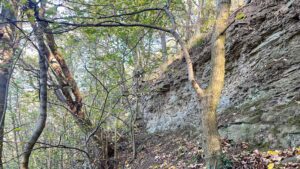
The rock is known to geologists as the Staithes Sandstone Formation. It is relatively soft and thinly bedded, making it less suitable as a building stone than the sandstone that forms the cap of Roseberry Topping, the Saltwick Formation. The Staithes sandstone has found a more practical use, however, as flooring flagstones in coastal villages such as Staithes and Runswick, where the rock is exposed at the surface1Historic England 2023 North Yorkshire, East. Building Stones of England. Swindon. Historic England..
There is more to investigate. The sandstone apparently preserves clear evidence of waves disturbing the seabed and currents moving sediment when these rocks were first laid down. Fossils point to a thriving marine environment, with life on the seabed and belemnites swimming through the shallow waters above2Roseberry Topping, Great Ayton Community Archaeology Project, 2006. Page 30..
That was millions of years ago. Today, the same geological history helps shape the landscape beneath our feet. The sandstone resists erosion more effectively than the underlying mudstone, creating the steep slope known as Cockle Scar.
I shall have to return for a closer look. Fifty years of walking these woods, and they can still surprise me. There is always another path to explore, another detail to notice, or another story hidden in the rocks.
Autumn, it seems, is a good time for discovering the things you have been walking past for years.
Leave a Reply