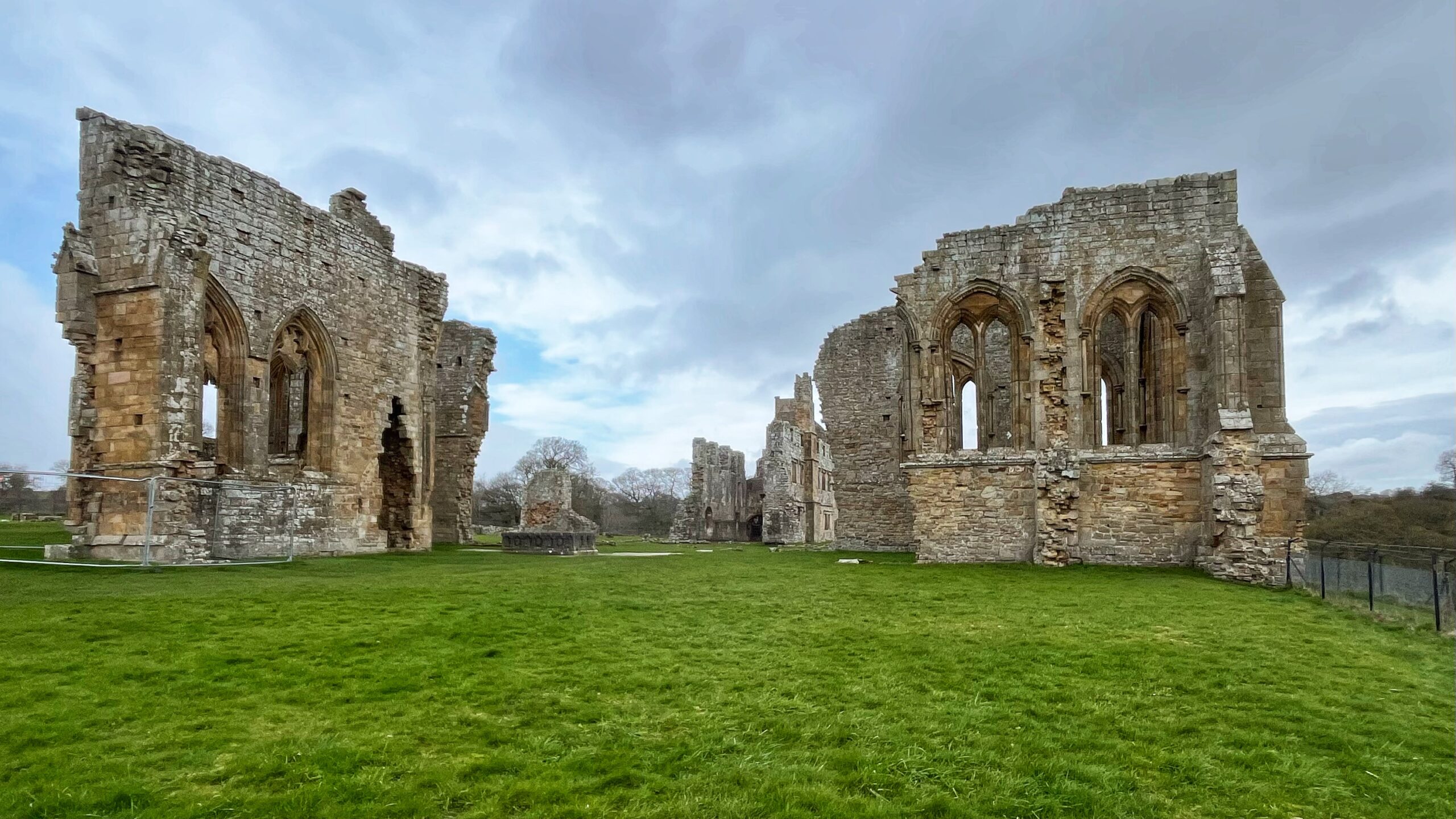
Just under two miles south-east of Barnard Castle, the remains of Egglestone Abbey stand above the south bank of the Tees. They are, not to put too fine a point on it, rather good.
Egglestone was a Premonstratensian house, founded around 1195. The Premonstratensians — known as the White Canons — were ordained priests who served nearby communities. They were a serious, no-nonsense order, not given to showing off1Wood, Eric S. “Historical Britain”. 1997. The Harvill Press.. The community was never large, though they built a sizeable church in the latter half of the thirteenth century2Pearson, Lynn F. “Building the North Riding”. 1994. Smith Settle Ltd.. It did not have an easy life. Scottish and English soldiers knocked it about during the fourteenth century, and by 1535, when Henry VIII’s commissioners came knocking, it was the poorest Premonstratensian house in England. Five years later it was dissolved, and the abbot and eight canons were packed off with pensions.
The abbey then had the indignity of becoming a salvage yard. In the eighteenth century, the east range was converted into cottages, and farm buildings went up nearby. Both were abandoned by the late 1800s, and in 1925 the state took the ruins into its care.
It is, frankly, a place worth visiting. Quiet, unpretentious, and blissfully free of the sort of improvements that ruin a good ruin. Alfred J Brown though, who wrote about the North Riding at considerable length, felt the “ruins cannot compare in beauty of setting with Rievaulx” and was left cold3Brown, Alfred J. “Fair North Riding”. 1952 Country Life Limited.. Pevsner, however, got quite worked up about the reredorters — the lavatories, since you ask — which survive in “a room with three bays of rib vaulting with heavy chamfered ribs.”4Pevsner, Nikolaus. “The Buildings of England – Yorkshire – The North Riding”. Penguin Books. Reprinted 1985. Each to his own.
- 1Wood, Eric S. “Historical Britain”. 1997. The Harvill Press.
- 2Pearson, Lynn F. “Building the North Riding”. 1994. Smith Settle Ltd.
- 3Brown, Alfred J. “Fair North Riding”. 1952 Country Life Limited.
- 4Pevsner, Nikolaus. “The Buildings of England – Yorkshire – The North Riding”. Penguin Books. Reprinted 1985.
Leave a Reply