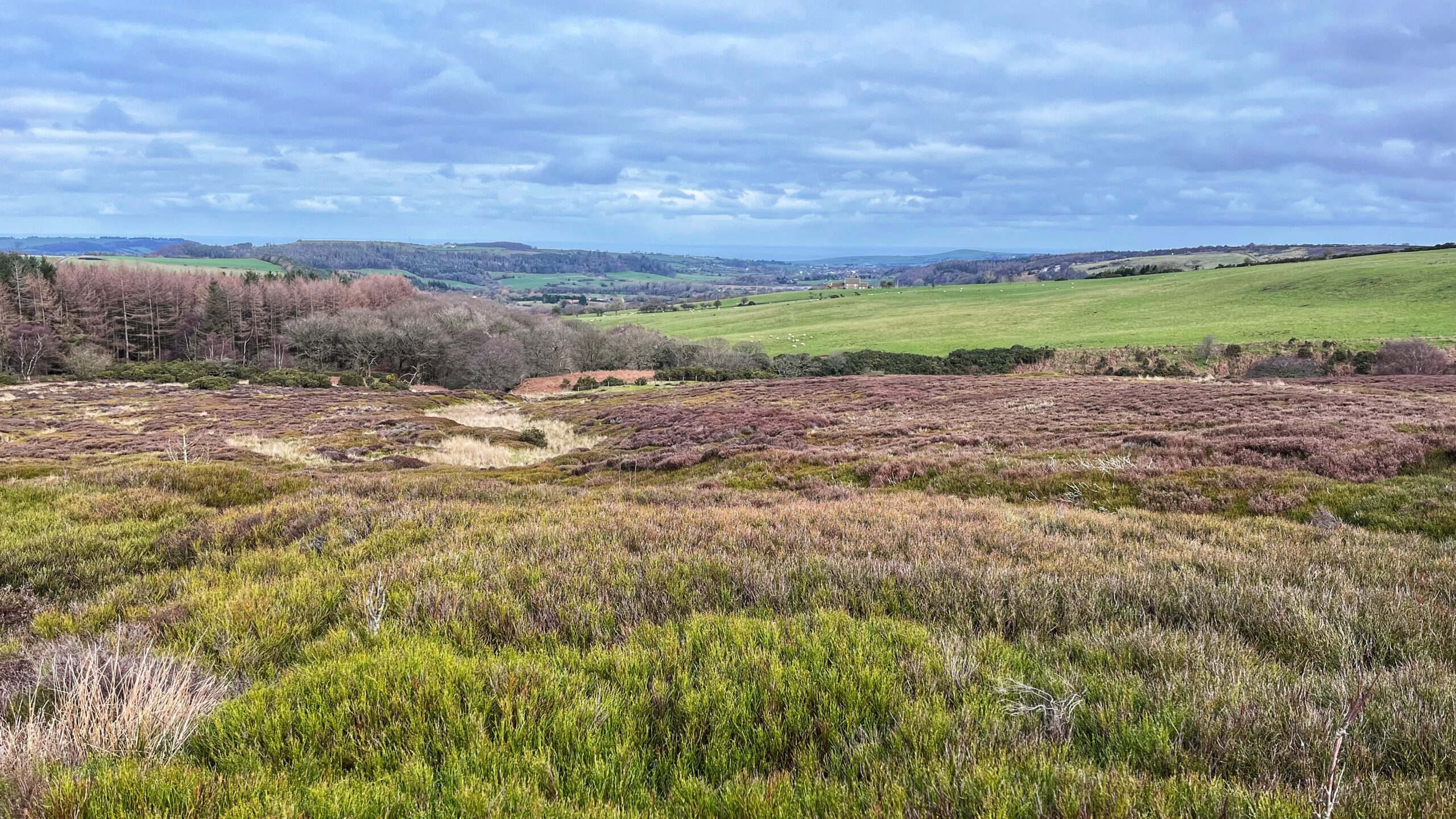
The other day, while wandering the web as one does when sense has taken the afternoon off, I found a digitised photocopy of a 1982 legal decision about Tidkinhow Moor1Tidkinhow Moor. Register Unit No. CL 213 in the Register of Common Land. https://acraew.org.uk/sites/default/files/uploads/Cleveland/TIDKINHOW%20MOOR%20-%20LANGBAURGH%20NO.CL.213(1).pdf. The page is mottled with foxing, stained by time, and the typewriter ink has faded like an old promise. It looked interesting to say the least. Understanding it was another matter.
The document settled an awkward truth: nobody had ever been officially registered as owner under the Commons Registration Act 1965. Management of the moor instead rested with two groups of trustees, their authority stitched together from indentures dating back to 1906. A tidy answer built on a very untidy past.
Pinning down the moor itself proved harder than expected. Tidkinhow Farm appears on the map (right of centre in the photo on the crest of that ridge), along with Tidkinhow Head at Hob Cross, and the drainage channel of Tidkinhow Slack (also right of centre before the pasture). Beyond that, it all gets a bit woolly. The safest guess is that the moor covers at least the enclosed land around the farm, though certainty remains as rare as sunshine in February.
The papers divide the land neatly on paper, if nowhere else. Most fell to the Trustees of the Skelton and Gilling Estates, including an awkward triangular parcel settled by a deed of compromise in 1906 and later confirmed by a 1968 conveyance. A smaller western portion belonged to another group of trustees named in a 1973 declaration.
This patchwork ownership grew from generations of sales, disputes, and estate breakups, reaching back to a Chancery case over a disputed will in 18362Leeds Intelligencer – 03 September 1836. TO BE PEREMPTORILY SOLD. https://www.britishnewspaperarchive.co.uk/viewer/bl/0000193/18360903/017/0001. In 1982, after a hearing in Durham, the Chief Commons Commissioner finally ordered the land registered.
The moor keeps its secrets well. Following its history feels less like reading law and more like tracking footprints across wet peat.
- 1Tidkinhow Moor. Register Unit No. CL 213 in the Register of Common Land. https://acraew.org.uk/sites/default/files/uploads/Cleveland/TIDKINHOW%20MOOR%20-%20LANGBAURGH%20NO.CL.213(1).pdf
- 2Leeds Intelligencer – 03 September 1836. TO BE PEREMPTORILY SOLD. https://www.britishnewspaperarchive.co.uk/viewer/bl/0000193/18360903/017/0001
Leave a Reply