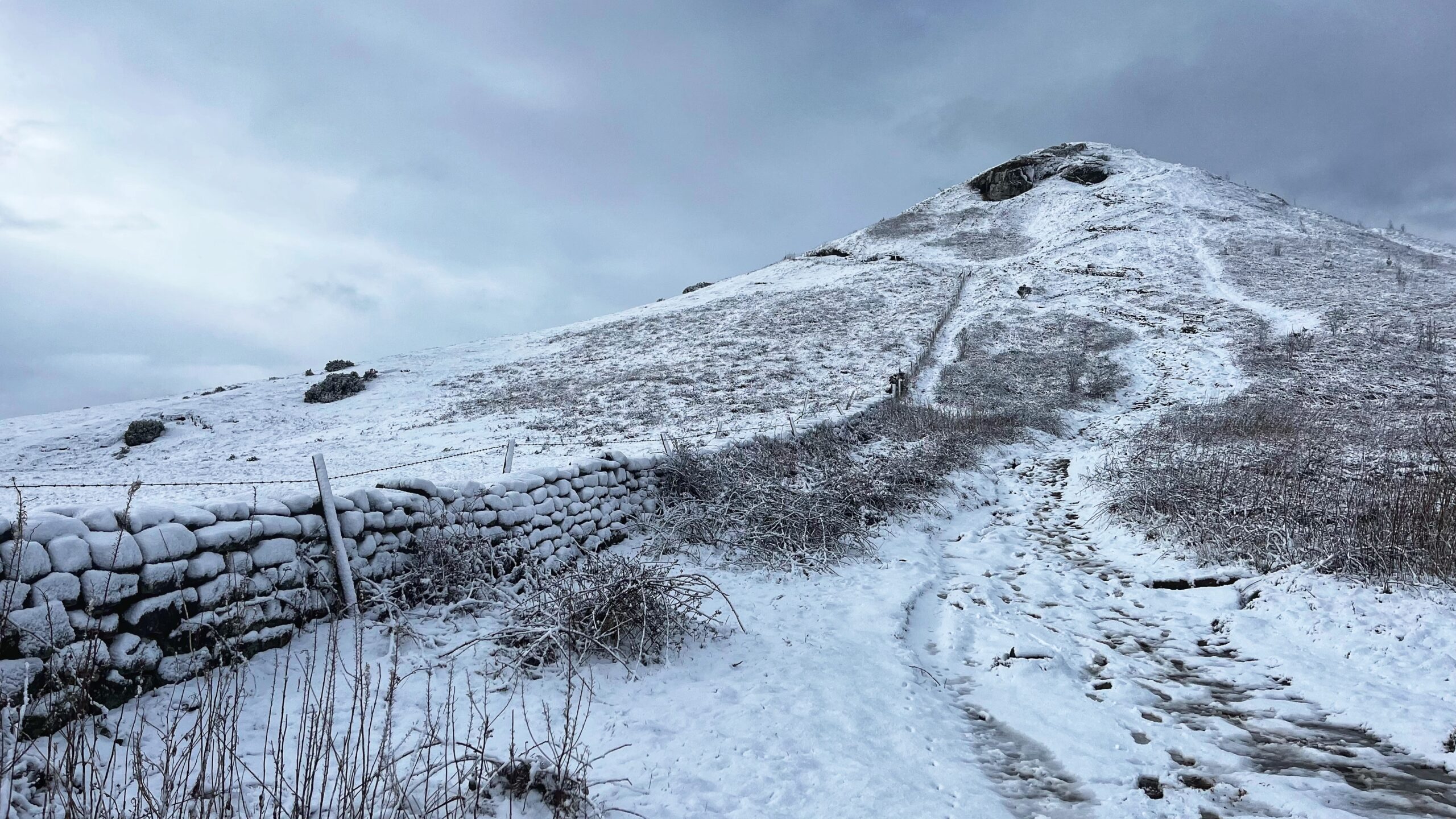
Despite the slush and the grey skies, snow lends even the most familiar ground a quiet grandeur. Roseberry Topping, half veiled in white, looks less like a hill and more like a stage set, its lines sharpened and its history briefly made visible.
This wall climbing its eastern flank marks the old parish boundary between Great Ayton and Newton. Medieval parishes were shaped with practical sense. Each aimed to include low meadows, workable farmland, and high moor, allowing communities to survive from their own resources. Sharing the slopes of Roseberry was therefore no accident. The boundary ran straight over the summit, dividing not only land but responsibility1“Roseberry Topping”. Great Ayton Community Archaeology Project. Page 162. 2006..
Today this wall also marks the edge of National Trust ownership, though modern boundaries rarely feel as firm as stone suggests. The further one looks into the past, the less certain ownership becomes, dissolving into fragments of record and rumour.
From the nineteenth century onward, the succession of owners is reasonably clear. Earlier claims are hazier. Some evidence hints that part of Roseberry belonged in the seventeenth century to the Cressy family of Birkin in the south-west of the North Riding. Their heiress, Dorothea Cressy, married the Scottish politician Archibald Primrose in 1690. A decade later he became Viscount of Rosebery, supposedly named for the hill and for the pleasing echo between ‘Primrose’ and ‘Roseberry’2“Roseberry Topping”. Great Ayton Community Archaeology Project. Page 19. 2006..
His title rose again in 1703, when Queen Anne granted an earldom in recognition of his support for William of Orange. His grandson, the fifth Earl, later served briefly as Prime Minister, though the hill itself appears never to have troubled his busy life.
- 1“Roseberry Topping”. Great Ayton Community Archaeology Project. Page 162. 2006.
- 2“Roseberry Topping”. Great Ayton Community Archaeology Project. Page 19. 2006.
Leave a Reply