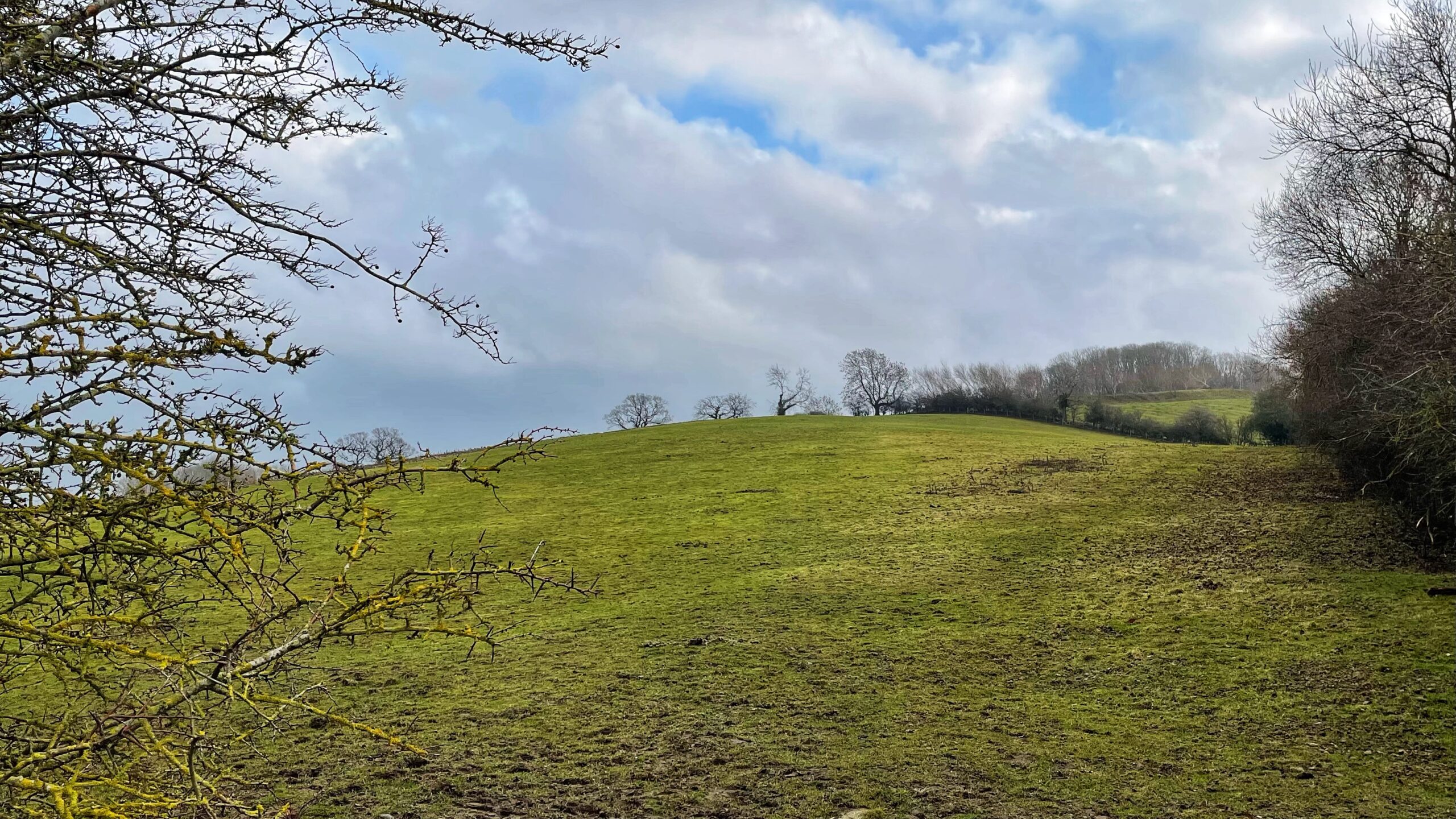
Not the most flattering view for today, I will admit. A quiet field, currently earning its keep as horse pasture, pressed up against Lowcross Farm. I took the photograph for two reasons, neither of them aesthetic.
First, for the record. This field sits under a planning application for a new estate of 117 houses1Planning Application Details R/2025/0840/OOM. Redcar and Cleveland Borough Council. https://planning.redcar-cleveland.gov.uk/Planning/Display/R/2025/0840/OOM?fbclid=IwZXh0bgNhZW0CMTEAc3J0YwZhcHBfaWQKNjYyODU2ODM3OQABHh6TyhTNZa5teyS3d0lhoM4zPQyDDETxHK8Parr8Yi5IUjlL3A_RU10e-AcZ_aem_NHtCogexl6FYj7VZycgGtQ. If it goes ahead, this view will vanish, including that of the wooded hill on the far left. That hill is my second reason.
Today it is mapped as Grove Hill. In medieval times it was probably known as ‘Tinghou’, meaning “the mound of the meeting or council place”2Dixon, Grace. “Two Ancient Townships – Studies of Pinchinthorpe and Hutton Lowcross”. 1991. Page 44. ISBN 0 9507827 2 6. The word comes from ‘thing‘, a governing assembly in early Germanic society where arguments were settled and decisions made. There is, as far as I know, no archaeological proof of Viking or later medieval activity on the hill, but it would repay a proper look. History often hides in plain sight, minding its own business.
The story flows down into the small valley to the right between Boulsdale Hill, now followed by the Pinchinthorpe Walkway. This valley is thought to be the ‘Tinghoudale‘ named in a fourteenth-century deed granted to the Hospital of Lowcross. That alone makes it one of the oldest recorded place names in the district, which is not nothing.
The Hospital of St Leonard of Lowcross is believed to have stood near what is now Lowcross Farm, close to the boundaries of Hutton, Barnaby and Pinchinthorpe, on land gifted for that purpose. In the thirteenth century it was granted to Guisborough Priory by William de Bernaldby, with the priory’s almoner installed as its master. A later charter records Richard de Hoton gifting the hospital a further two acres in Hoton, described as “formerly the location of the hospital”, although the main holding seems always to have been nearer Lowcross Farm. Other charters allowed the hospital free wood in Tinghoudale and grazing rights along the edge of Hutton.
Despite sometimes being called the ‘Hospital of the Sick Men of Bernaldby’, the inmates included both men and women, and not all were ill. Some were simply placed there by the donors. By around 1346 the hospital slips quietly out of the records, as support for such places dried up in the fourteenth century. It does not appear in the Dissolution Survey of Guisborough Priory, when Henry VIII had his wicked way.
So this field is not just grass and horses. It is a thin layer of present laid over a deep stack of names, deeds and vanished lives. Soon enough, it may be bricks instead. That is progress, apparently.
- 1Planning Application Details R/2025/0840/OOM. Redcar and Cleveland Borough Council. https://planning.redcar-cleveland.gov.uk/Planning/Display/R/2025/0840/OOM?fbclid=IwZXh0bgNhZW0CMTEAc3J0YwZhcHBfaWQKNjYyODU2ODM3OQABHh6TyhTNZa5teyS3d0lhoM4zPQyDDETxHK8Parr8Yi5IUjlL3A_RU10e-AcZ_aem_NHtCogexl6FYj7VZycgGtQ
- 2Dixon, Grace. “Two Ancient Townships – Studies of Pinchinthorpe and Hutton Lowcross”. 1991. Page 44. ISBN 0 9507827 2 6
Leave a Reply