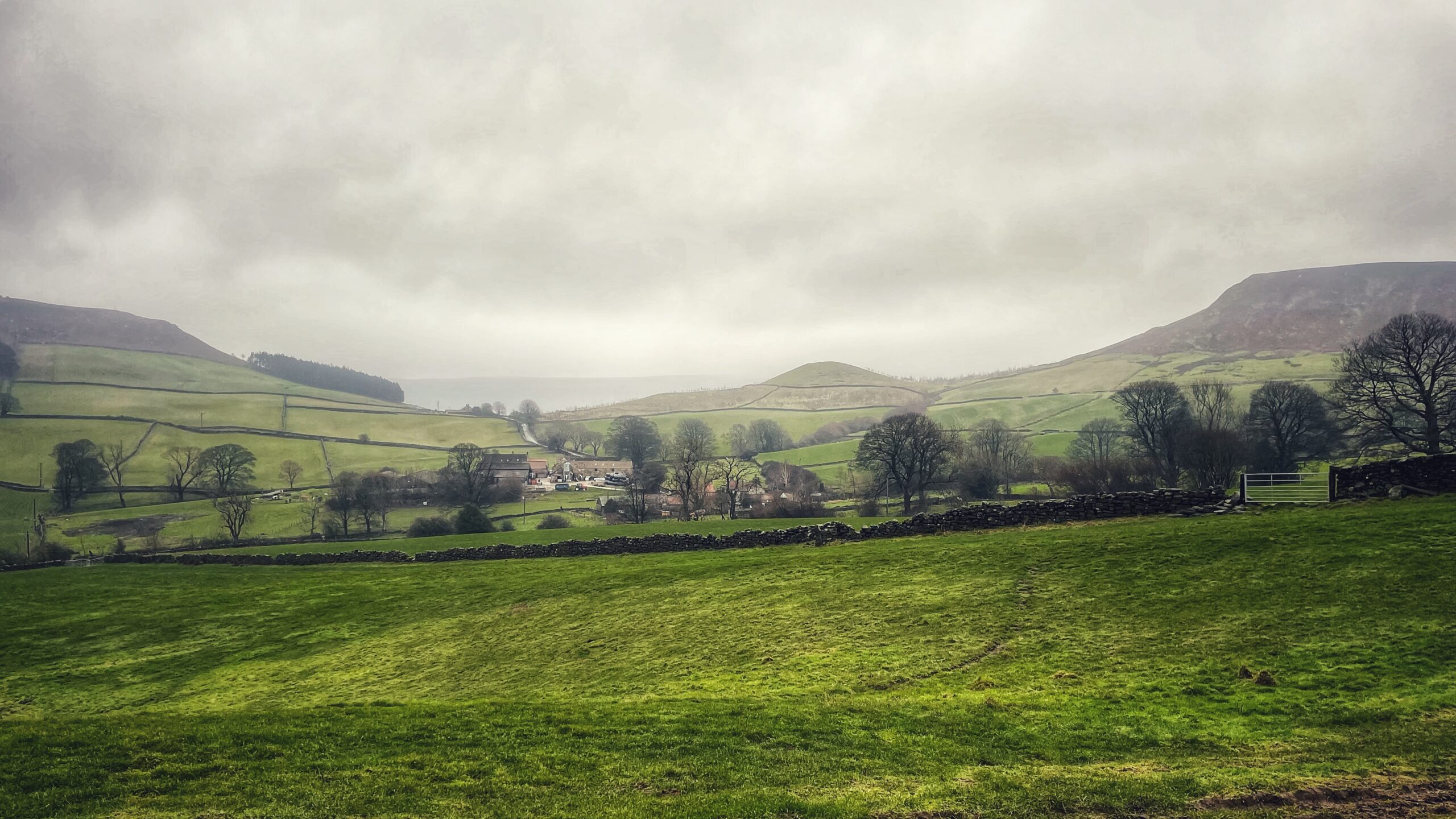
Little Fryup Dale on a very dreich day. The cloud lifts its base just enough to show the moors in the distance, a wide sweep of heather and bare earth. Even under this leaden sky it is both beautiful and desolate. It feels unchanged, as if wind and rain have been quietly getting on with the job for a few thousand years and see no reason to stop now.
Humans love a pattern. Give us a cloud and we will insist it is a face. Give us a tidy shape in the landscape and we will swear someone built it. So when Round Hill rises like a perfect cone over Fairy Cross Plain, sitting between Little and Great Fryup, the mind jumps to conclusions. An ancient burial mound, perhaps. A fort. Something important, something human. Several neat, pointy hills around the moors have been saddled with the same story. Once again, the land is having a laugh at our expense.
Round Hill is not a monument. It is geology showing off. Millions of years ago this area was part of a high, flat surface known as the “Tertiary peneplane.” Time, being patient and relentless, stripped away the softer rock and left the tougher bits standing. These leftovers are called “outliers,” isolated scraps of a long-lost world. Roseberry Topping is the famous example, but Round Hill belongs to the same club. It looks designed, but it is simply what remains. The harder “cap rock” has already gone, and the rest is waiting its turn1Spratt, D. A., ed. Prehistoric and Roman Archaeology of North-East Yorkshire. Council for British Archaeology, 1993..
Even better, these dramatic hills were mostly ignored by the people we like to credit with everything ancient. Archaeology finds little to suggest they mattered much at all. The reason is plain and dull. No water, no settlement. They were striking to look at and useless for living. Nature, it turns out, can produce clean lines and bold shapes without the slightest interest in human plans.
While the land was busy fooling the eye, people were busy inventing stories.
Below Round Hill on Fairy Cross Plain there are apparently large, neat rings of grass. Their fame rests less on their shape than on the warning that came with them. Children were told never to run around a ring exactly nine times, for fear it would “raise the fairies” and lead to being taken away for good. Science shrugs and points to the marasmius oreades fungus, but belief in a hidden “fairy kingdom” underfoot lingered well into the nineteenth century2Atkinson, Rev. J. C. “Forty years in a moorland parish; reminiscences and researches in Danby in Cleveland” 1891..
The moors are not just something to look at while pulling on waterproofs. They tell a story full of false leads and quiet truths. The hills that seem crafted by hand are tricks of deep time. The fairies are best left where they are, along with our urge to explain everything too neatly.
- 1Spratt, D. A., ed. Prehistoric and Roman Archaeology of North-East Yorkshire. Council for British Archaeology, 1993.
- 2Atkinson, Rev. J. C. “Forty years in a moorland parish; reminiscences and researches in Danby in Cleveland” 1891.


Leave a Reply