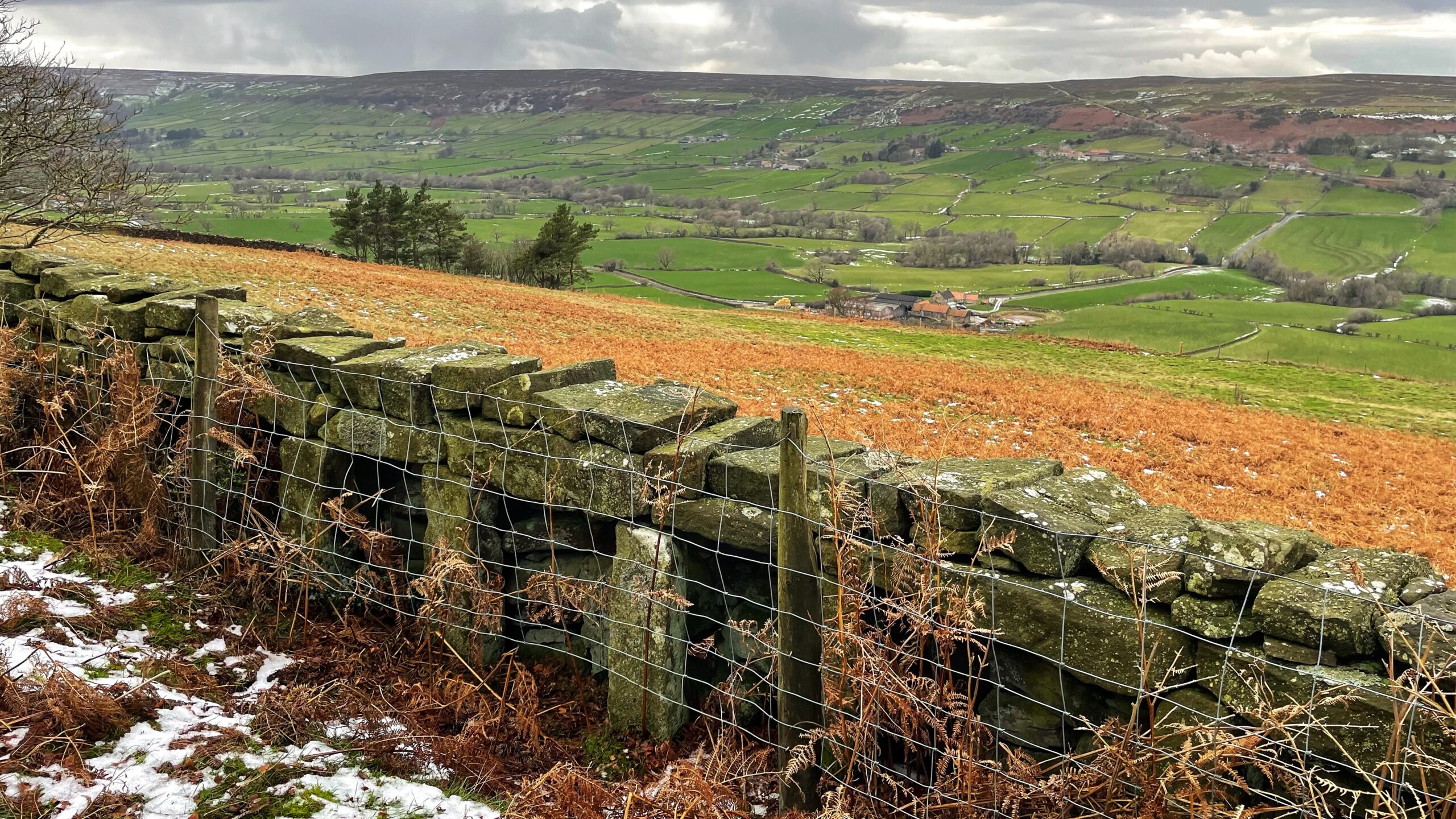
It is eleven years since I last walked this stretch of Glaisdale, and it is a quiet pleasure to find the bee boles still standing, having endured the long attrition of moorland winters1Out & About http://www.fhithich.uk/2015/02/05/bee-boles-glaisdale/. Even the ungainly stock fencing has earned its keep, discouraging sheep from testing their climbing skills.
Bee boles are recesses built into walls to shelter bee skeps, the woven baskets used before the box hives familiar today. Here in Glaisdale, they form part of a drystone wall marking the boundary between enclosed land and the open moor, a structure that can be traced back at least to the seventeenth century. What makes this site remarkable is its scale. Evidence suggests around seventy-seven recesses, all set into the sunny south-facing side of the wall. They vary in size and are formed by two dressed stone uprights and a lintel, with neighbouring boles often sharing the same uprights. Each would have housed one skep, perhaps two. The design suggests a clear purpose: to allow bees access to the flowering heather of the moor during summer. Moving so many skeps up here for only a few months each year must have required careful planning and no small amount of labour.
The boles are linked to a farmstead just to the north by a driftway, a funnel-like track connecting the farm to the common land, probably once flagged with stone. Repairs to the boles over time show they were valued and maintained. What remains uncertain is whether this was the enterprise of a single farmer producing honey for profit, or a shared resource managed by the local community.
Historical accounts make clear that beekeeping was both skilled work and potentially lucrative. In 1635, Sir William Brereton praised his host at Binchester for his “skillful beekeeping”. He recorded that a productive hive could be worth between £1 10s. and £2 a year, and noted a large pot of “purest honey” valued at £5 or £6, a considerable sum at the time2The Monthly Chronicle of North Country Lore and Legend. 1891..
Bees also occupied a place in popular belief. Foremost among the customs was “telling the bees”, where a death in the household had to be whispered to the hive. Failure to do so was thought to bring disaster, with the bees either leaving or dying. Hives might be dressed with black crape, and bees offered funeral cake or a taste of the feast3Wright, E.M., “Rustic Speech and Folk-lore”. lccn=14004537, H. Milford, 1913, https://books.google.co.uk/books?id=deWBAAAAMAAJ..
Other beliefs abounded. In Fife, bees were said to sing in their hives on Christmas Eve4BRAND, JOHN. “OBSERVATIONS ON THE POPULAR ANTIQUITIES OF THE ORIGIN OF OUR VULGAR AND PROVINCIAL CUSTOMS, CEREMONIES,AND SUPERSTITIONS.” 1848.. Swarming bees were “charmed” with improvised music, both to settle them and to mark ownership. Selling bees, or hiving a swarm after nightfall, was unlucky, while killing a toad was thought to encourage swarming5Wright, E.M., “Rustic Speech and Folk-lore”. lccn=14004537, H. Milford, 1913, https://books.google.co.uk/books?id=deWBAAAAMAAJ.. Even witchcraft found room for them: seventeenth-century testimony from the North Country claimed witches could dance in the shape of a bee, among other creatures6The Monthly Chronicle of North Country Lore and Legend. 1891..
Together, the bee boles of Glaisdale stand as a reminder of how closely work, landscape, and belief were once bound together.
- 1
- 2The Monthly Chronicle of North Country Lore and Legend. 1891.
- 3Wright, E.M., “Rustic Speech and Folk-lore”. lccn=14004537, H. Milford, 1913, https://books.google.co.uk/books?id=deWBAAAAMAAJ.
- 4BRAND, JOHN. “OBSERVATIONS ON THE POPULAR ANTIQUITIES OF THE ORIGIN OF OUR VULGAR AND PROVINCIAL CUSTOMS, CEREMONIES,AND SUPERSTITIONS.” 1848.
- 5Wright, E.M., “Rustic Speech and Folk-lore”. lccn=14004537, H. Milford, 1913, https://books.google.co.uk/books?id=deWBAAAAMAAJ.
- 6The Monthly Chronicle of North Country Lore and Legend. 1891.
Leave a Reply