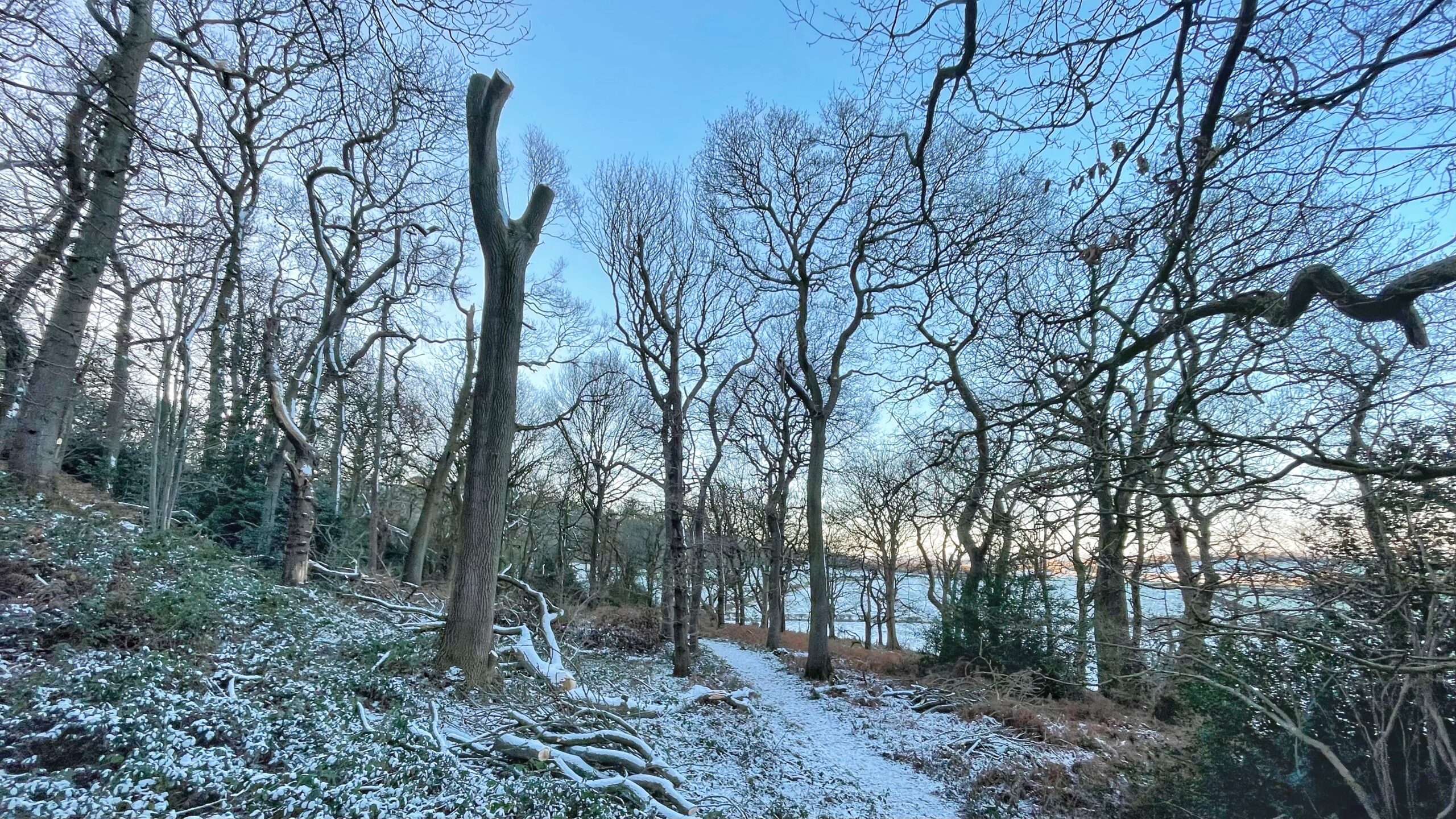
Just after dawn, Newton Wood sits under a light dusting of snow. The sky is a hard, clear blue. Bare deciduous trees stretch their thin arms upward, as if hoping for better weather later. Left of centre stands a prominent ash tree. Its trunk is tall and thick, brutally pruned and cut short. It looks less like a tree and more like a stone column.
The National Trust rangers call this a monolith. The name sounds grand, but the idea is plain enough. It is a dead or dying tree that has been reduced in height and spread. This is how they deal with ash trees struck by ash dieback. It is a compromise between keeping people safe and keeping nature alive.
Ash dieback, caused by the fungus Hymenoscyphus fraxineus, is expected to kill up to 80 percent of ash trees in the UK1Ash dieback. Woodland Trust. https://www.woodlandtrust.org.uk/trees-woods-and-wildlife/tree-pests-and-diseases/key-tree-pests-and-diseases/ash-dieback/ . That is not a minor setback. It is a body blow to the landscape and to the many species that depend on ash for food and shelter.
As the disease takes hold, trees weaken and eventually die, their brittle branches susceptible to breaking. Near footpaths, that becomes a risk no one can ignore. Monolithing removes heavy or unstable limbs, leaving the trunk standing but less likely to fall. The alternative would be to fell the tree entirely, which is neat, quick, and ecologically bleak.
In the past, woodland management meant clearing away dead trees, as if nature needed tidying up. We now know better. Deadwood is not rubbish. It is prime real estate. Monolithing is used only when a tree is too unstable to be left alone, but still valuable enough to keep standing.
We are still early in the ash dieback crisis. By keeping these trees in place, rangers retain wood in the landscape and buy time. Some ash may yet show tolerance to the fungus, and you will not find survivors if you cut everything down first.
Dead and decaying wood supports around 13 percent of all UK plant and animal species2Back from the Brink — Advice Sheet Managing Dead and Decaying Wood. Buglife. C Shellswell. https://cdn.buglife.org.uk/2022/01/BFTB-Advice-Sheet-Managing-Dead-and-Decaying-Wood.FINAL_.pdf . These saproxylic organisms include nearly 5,000 species of insects and fungi3David Humphries on standing dead trees Autumn 2014. https://www.ancienttreeforum.co.uk/wp-content/uploads/2016/12/David-Humphries-on-standing-dead-trees-Autumn-2014.pdf. Many are rare. Some are barely noticed. All of them matter.
Standing deadwood is especially useful. It rots from the inside out, slowly and unevenly, creating a range of small habitats. Cavities and rot holes become nesting and roosting sites for birds such as woodpeckers and owls, and for bats. Decaying heartwood feeds specialist insects like stag beetles and lesser stag beetles.
It takes decades, sometimes centuries, for young trees to develop these features naturally. Monoliths fill the gap, keeping habitats in place while the next generation grows up.
Even in decline, these trees are doing their bit. They strengthen the woodland, support its wildlife, and quietly hold the line while everything else catches up. Not bad for something that looks, at first glance, like a tree that has had its day.
- 1
- 2Back from the Brink — Advice Sheet Managing Dead and Decaying Wood. Buglife. C Shellswell. https://cdn.buglife.org.uk/2022/01/BFTB-Advice-Sheet-Managing-Dead-and-Decaying-Wood.FINAL_.pdf
- 3David Humphries on standing dead trees Autumn 2014. https://www.ancienttreeforum.co.uk/wp-content/uploads/2016/12/David-Humphries-on-standing-dead-trees-Autumn-2014.pdf


Leave a Reply to Fhithich Cancel reply