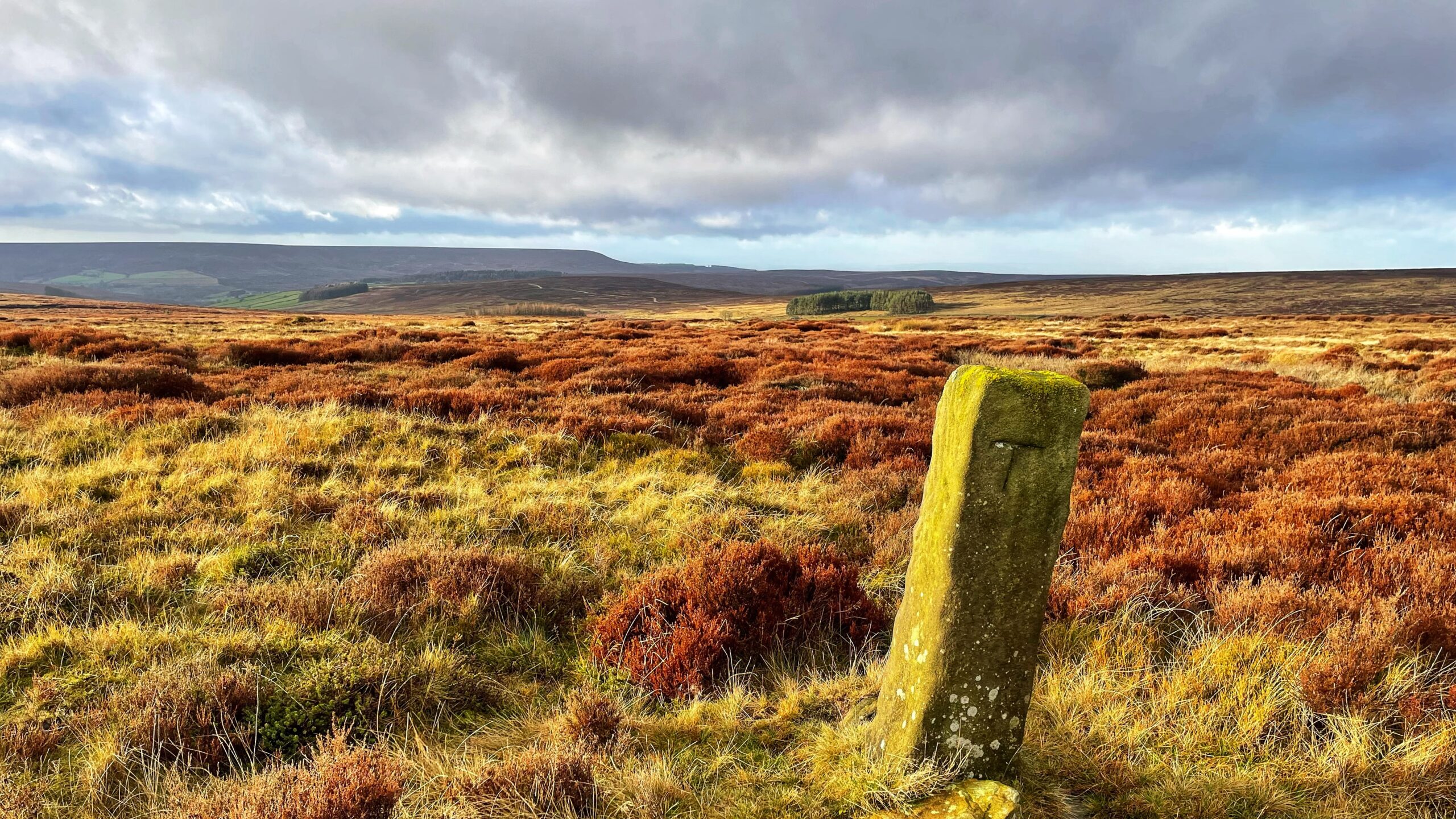
The North York Moors are littered with boundary stones, each one usually stamped with a dutiful little initial, the sort of thing an aristocratic landowner might choose when feeling terribly important. An “M” for Manners, an “F” for Feversham, a “CD” for Charles Duncombe. All very neat, all very tidy. Then you stumble upon a stone on Bilsdale West Moor bearing a solitary “T”, standing there as if daring anyone to ask why. Local lore insists that seven others just like it stand in a ragged line, a hundred metres or so west of the parish boundary and the watershed, marking out something far more curious than a simple estate limit.
This line of stones once defined a narrow strip of moor where the farmers of Bilsdale West, short on open ground, were granted the precious right on Snilesworth Moor to cut turves for fuel. A humble privilege, but in this bleak landscape it meant warmth, survival and the faint hope that winter might not swallow the farm whole.
Until the late nineteen-thirties, the hearths of these dales would have been fed by either turf or peat. Turf came from the top layer of heather and soil, carved out with a wide triangular spade and dragged forward by the “greaver”, whose leather thigh-guards hinted at just how forgiving the job was. The turves were dried and burned on those cavernous stone hearths that once glowed in every farmhouse. It was said that the fire in the Chequers Inn had not gone out for two centuries, though one suspects half the moors could have made the same boast.
Peat was another tale. Cut from a deep-faced “peat hole” with narrow, upturned spades, it came out in perfect bricks that were stacked to dry before the long haul home. It burned hotter and cleaner than turf, the fuel of choice for anyone lucky enough to have a bog worth digging.
Once the turf was cut, the pointed drying stacks rose like odd, silent monuments across the moor. Then came the descent. After haytime, wagons creaked down the steep banks with seven hundred turves apiece, the wheels chained or shod with iron to stop the whole lot bolting off into the valley. If the slope was particularly absurd, a small weighted sledge was dragged behind as a brake. Every load was packed with care, lashed down with ropes and sacks to keep the precious fuel from spilling. A modest farm needed twenty-five such loads each year, a reminder that life on these uplands ran on sweat, stoicism and the slow burn of moorland earth.
The “T” stones now stand abandoned, silent witnesses to a labour that shaped the land long before modern comforts crept into the dales.
Sources:
- Elgee, Frank. The Moorlands of North-Eastern Yorkshire: their natural history and origin. Page 35. London: A Brown & Sons. 1912.
- Cowley, Bill. “Snilesworth”. Page 124. Turker Books 1993.
- Hartley, Marie and Joan Ingilby. “Life and Tradition on The Moorlands of North-East Yorkshire”. Page 80. J.M. Dent & Son. 1990.
Leave a Reply