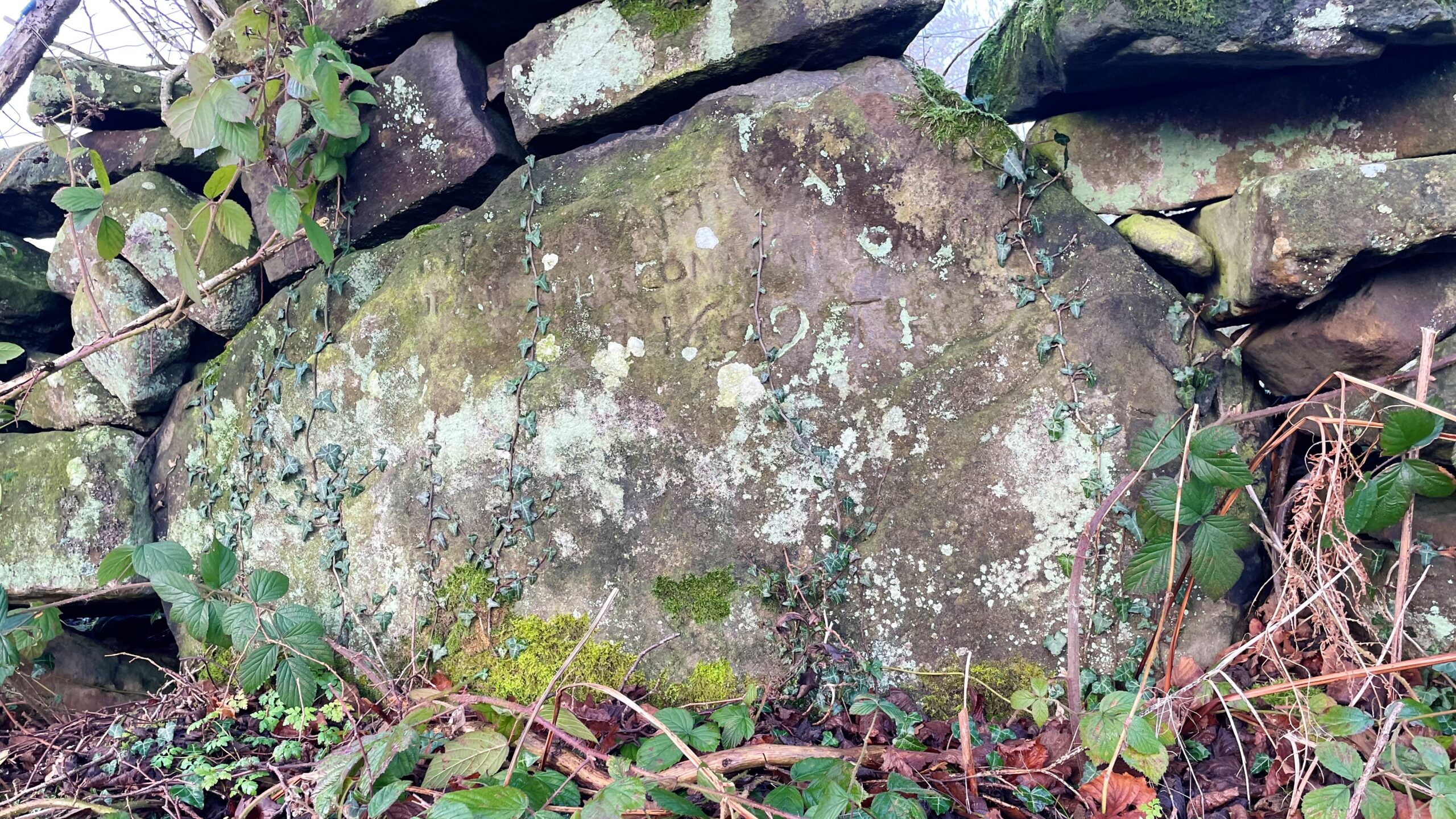
Some two hundred yards up from the foot of the lane that strains its way up Caper Hill, a dry-stone wall is built around a large orthostat. Rough-hewn at the edges and smoothed across its face, it carries a message cut by hand in the late seventeenth century. Kneeling in the damp and wind, its maker carved a declaration that has outlasted him. Time has scoured the letters and lichen has claimed the surface, yet the words survive in records carefully made:
FIRST DRAFT WAY MADE
UP ALL THE COMMAN LONING
IN 1699 T.H.
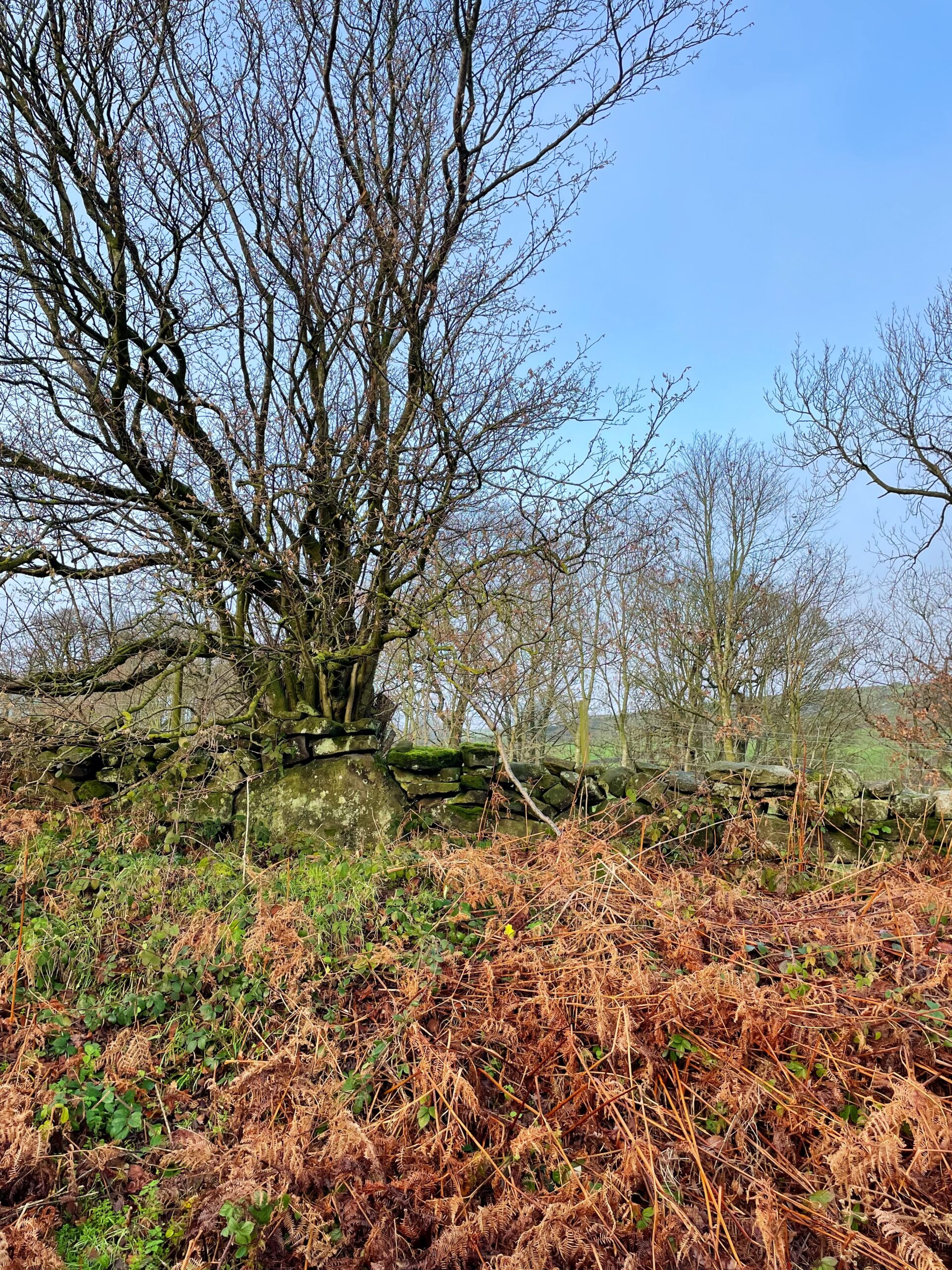
A puzzle is left behind. What tale lies behind this statement, and who stood behind the initials? Was “T.H.” the man who shaped the letters, or the one who held the rights to the ground under his feet?
Before any answer, “Comman Loning” maybe ought to be explained. This is Common Lane in local speech, shown as such on modern mapping. Now a metalled roadway, it was once a rough track, part of the pannier route from Egton to Kirkby Moorside. In 1699, it seems, it was widened to take draft wagons, and someone wanted that noted for posterity.
Not far away, where the bridleway from Red House meets the same lane, stands a gatepost etched with another piece of the story. Its top has broken away, but what can still be read, recorded again by others, shows a familiar hand:
TO REPARE
THIS YAT
AND THE
YATSTEAD
1737
TH
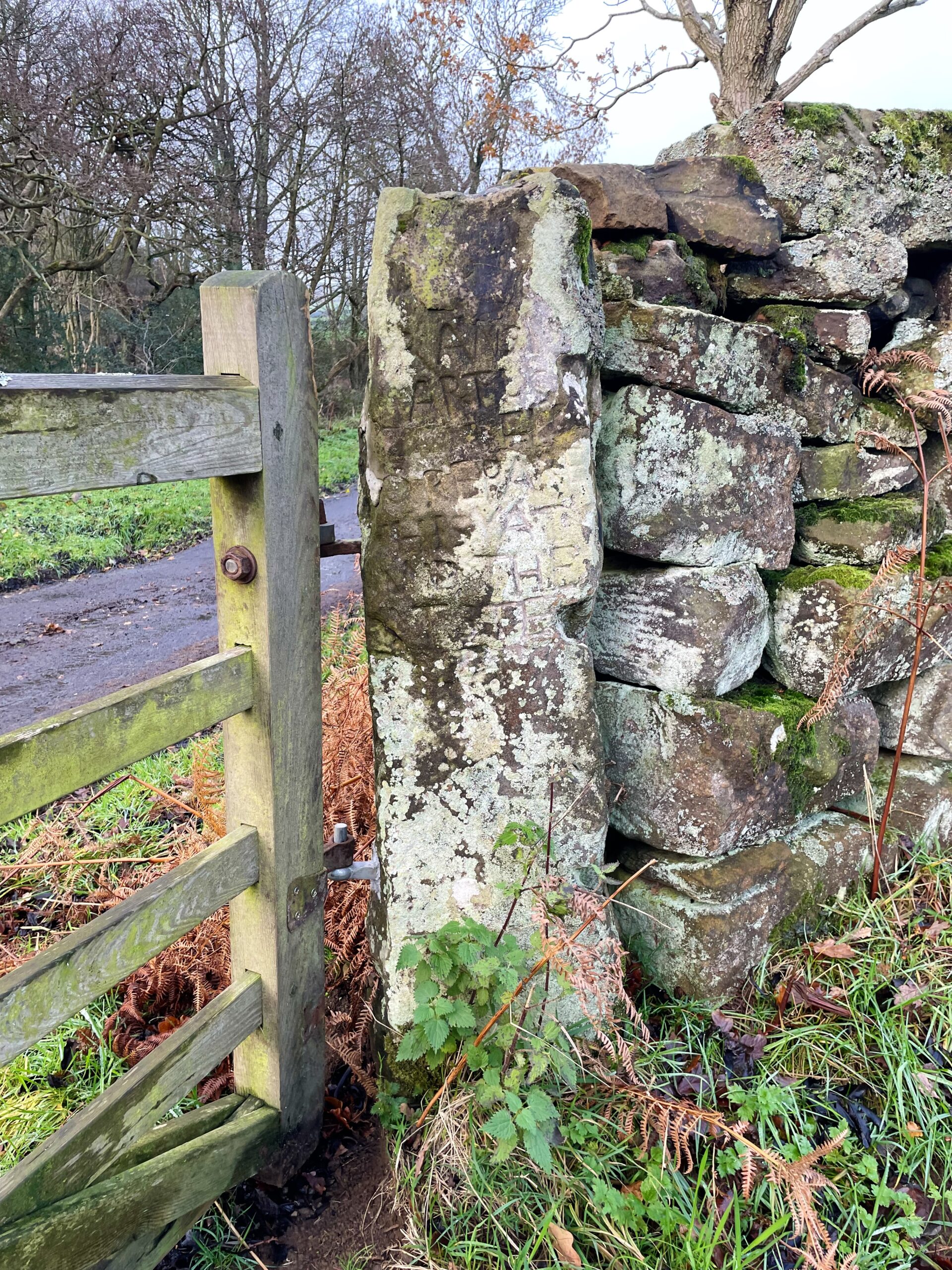
Here might have been evidence of the man tasked with the upkeep of the gate, yet whose name is now missing. “Yatstead”, a sturdy old Yorkshire word, refers to the sweep of ground taken by a gate as it opens and shuts. Today the soil here has turned to mire in the recent wet season, leaving a walker to plodge through. The hands behind “T.H.” clearly knew the trouble well enough almost three centuries ago.
There are said to be several more such inscriptions nearby at Glaisdale Head, and many scattered across the higher moors. On boundary stones and guideposts alike the same initials appear. One carving, dated 1737, which I failed to find, gives the name “Fransis Hartus” suggesting that this was the man responsible for carving at least this one of these inscrptions. The Hartus line has deep roots in the dales, their name in the Danby Registers from 1585 onward, and one Francis Hartus known to have moved from Danby-dale to Glaisdale around 1650. The silence of the registers concerning a “Fransis Hartus” in the early eighteenth century may owe much to Quaker habits, which often kept such names from parish books.
Another inscription, again proving elusive for me, points to “TH” as Thomas Harwood, yet the exact nature of his role remains uncertain. One local historian suggests he served as surveyor to the lord of the manor, a man charged with marking the landscape as part of his duty1Mead, Harry. Leaving no stone unturned. Yorkshire Post and Leeds Intelligencer – 03 August 1996. https://www.britishnewspaperarchive.co.uk/viewer/bl/0000687/19960803/071/0012.
The Harwood family themselves are recorded in the dale from 1585. They are thought to have lived opposite what is now Hutton Lodge, on a plot that now resembles a neglected orchard. Here once stood a stone house with mullioned windows and a salt cupboard, known to local people as “the shop”, its last incarnation being a modest store. All remains above ground have vanished, though it is recorded that its ruin once bore the carved characters:
M
TH
1726
“M” was presumably the wife of “T.H.”, as was common in such inscriptions. It cannot be proved, but it is striking that among the several Thomas Harwoods in the registers, only one married a woman whose name began with “M”. The date aligns with the possibility that this T.H. were responsible for the marks on the stones. The record reads:
Annuntiatio Dominæ 1700. Thomas Harwood et Maria Barry 26to die Nov.
Across the moor, the initials remain on stone after stone, silent markers of labour, land, duty and memory. They hint at men whose work shaped the paths and boundaries of the dale, their lives long faded, their marks left behind for those prepared to look.
Source: GLAISDALE HEAD INSCRIPTIONS. “T.H.”—HIS MARK. By Percy Burnett. WHITBY NATURALISTS’ CLUB. 1945-47. Vol. 10. Available at the Whitby Museum.
- 1Mead, Harry. Leaving no stone unturned. Yorkshire Post and Leeds Intelligencer – 03 August 1996. https://www.britishnewspaperarchive.co.uk/viewer/bl/0000687/19960803/071/0012


Leave a Reply