
A walk “On Ilkla Moor”, though not “Baht ’at,” as I had the good sense to wear a buff. The wind was still rather sharp.
Ilkley Moor, an eastern limb of the Pennines, sits between the Wharfe and Aire valleys. This expanse of rough moorland is littered with relics of prehistoric activity. Chief among them are the rock carvings—Gritstone boulders and outcrops adorned with mysterious symbols. The most common are the “cup and ring” marks: small hollows, sometimes circled by rings, pecked into the rock. Other carvings feature grooves and lines, all dating back to the Late Neolithic and Bronze Age. No one knows their true meaning, but scholars, as ever, have theories. Religious significance is a favourite guess.
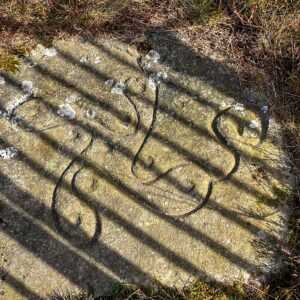
The plan was to visit some of these rocks, starting with the Swastika Stone1Historic England Research Records.. Hob Uid: 47995. Swastika Stone. It is so famous there are even signposts pointing to it.
It stands on Woodhouse Crag, safely imprisoned behind iron railings. The carving is a curving swastika-like shape, its arms embedded with small cup marks, with more scattered to the right. Estimates on its age range from the Early Bronze Age to the Late Iron Age. Quite the sight—except for one small detail. The version on display is a modern copy. The real one, closer to the edge, is blocked from proper view by the railings. We had no idea at the time, so didn’t look. The feeling now of being deceived is strong. But oblivious onward we went to the Badger Stone, the next rock on the itinerary.
I wondered whether “Swastika Stone” was a name given after the war, but a 1912 article in the Wharfedale & Airedale Observer mentions it in connection with a golf course extension that would grant the public better access. At least that small mystery was solved2“Opening the Paths”, Wharfedale & Airedale Observer, 5th January 1912, https://www.britishnewspaperarchive.co.uk/viewer/bl/0001823/19120105/094/0004.
- 1Historic England Research Records.. Hob Uid: 47995. Swastika Stone
- 2“Opening the Paths”, Wharfedale & Airedale Observer, 5th January 1912, https://www.britishnewspaperarchive.co.uk/viewer/bl/0001823/19120105/094/0004
Leave a Reply