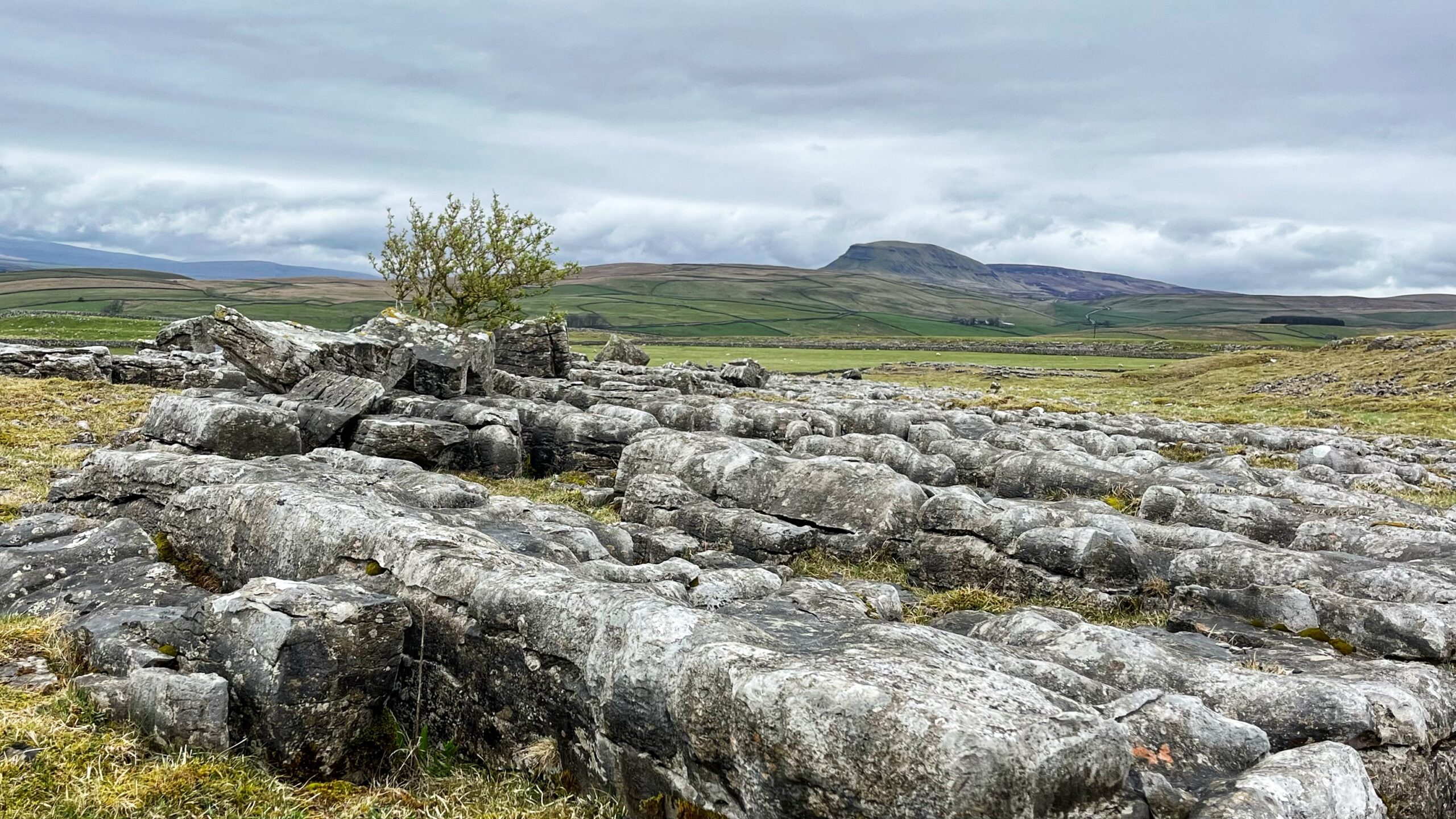
What a splendid view to stumble upon. Pen-y-Ghent, that stubborn Yorkshire monolith, standing proud above the limestone pavements of Winskill Stones, looking as though it has absolutely no intention of going anywhere.
A mountain with a name like that ought to come with legends attached, and Pen-y-Ghent does not disappoint. Stories of giants are ten a penny in the Yorkshire Dales, and this corner of the Dales has its fair share. In a valley to the north-east, old maps mark a site called the “Giant’s Graves” — grassy mounds by Pen-y-Ghent Gill, once thought to be the final resting places of some rather oversized residents1Pen-y-ghent. Three Peaks Walks. https://www.3peakswalks.co.uk/yorkshire-three-peaks/penyghent/#:~:text=maps%20as%20the-,Giant’s%20Graves,-.%20These%20grassy%20mounds [Accessed 5 April 2026]. Proof, if ever it were needed, that even giants have to go somewhere eventually.
One candidate for those graves may well be Samson himself, who, local folklore insists, lost his footing whilst jumping from Langcliffe Scar into Ribblesdale and broke off his toe. The offending digit remains at Winskill to this day, known as “Samson’s Toe.” Geologists, being precisely the sort of people who ruin a perfectly good story, will tell you it is merely a glacial erratic deposited here some 12,000 years ago2Welcome to the Settle Area. WINSKILL STONES NATURE RESERVE.https://www.visitsettle.co.uk/winskill-stones.html#:~:text=Sampson’s%20Toe,-Within%20the%20nature [Accessed 5 April 2026]. Nowhere near as interesting, frankly.
That same boulder has an even darker tale to tell. An old pagan ceremony is thought to have taken place around a well in nearby Langcliffe, involving the alignment of the first April moon with the boulder and an ancient ley-line pointing towards Ingleborough. If the shadow fell wrongly, bad luck would befall the village. And things did go rather badly wrong at some point. During the thirteenth century, invading Scots moved the boulder as an act of defiance, and the village was subsequently burnt to the ground3Scribble by the Ribble. 1st April 2018. https://www.jacksoneditorial.co.uk/only-fools-rush-in-the-dales/#:~:text=Ancient%20Dales%20tradition [Accessed 5 April 2026]. Whether the two events were connected is left, wisely, to the imagination.
On a rather more cheerful note, Winskill Stones is today a nature reserve, and it exists largely because one man thought limestone pavements were worth fighting for. Geoff Hamilton, who presented BBC2’s “Gardeners’ World” for seven years, was a passionate nature conservationist who threw his considerable weight behind a campaign to save these 64 acres from being quarried for garden rockeries at a rate of 1,000 tonnes a year4Daily Mirror – 24 August 1996. https://www.britishnewspaperarchive.co.uk/viewer/bl/0000560/19960824/524/0060. Geoff, who rather firmly believed limestone belonged in the landscape and not in suburban gardens, died just eight days before his 60th birthday in 1996. By then, £70,000 had been raised, allowing the charity Plantlife to purchase Winskill Stones outright. It is, as tributes go, not a bad one at all.
- 1Pen-y-ghent. Three Peaks Walks. https://www.3peakswalks.co.uk/yorkshire-three-peaks/penyghent/#:~:text=maps%20as%20the-,Giant’s%20Graves,-.%20These%20grassy%20mounds [Accessed 5 April 2026]
- 2Welcome to the Settle Area. WINSKILL STONES NATURE RESERVE.https://www.visitsettle.co.uk/winskill-stones.html#:~:text=Sampson’s%20Toe,-Within%20the%20nature [Accessed 5 April 2026]
- 3Scribble by the Ribble. 1st April 2018. https://www.jacksoneditorial.co.uk/only-fools-rush-in-the-dales/#:~:text=Ancient%20Dales%20tradition [Accessed 5 April 2026]
- 4Daily Mirror – 24 August 1996. https://www.britishnewspaperarchive.co.uk/viewer/bl/0000560/19960824/524/0060
Leave a Reply