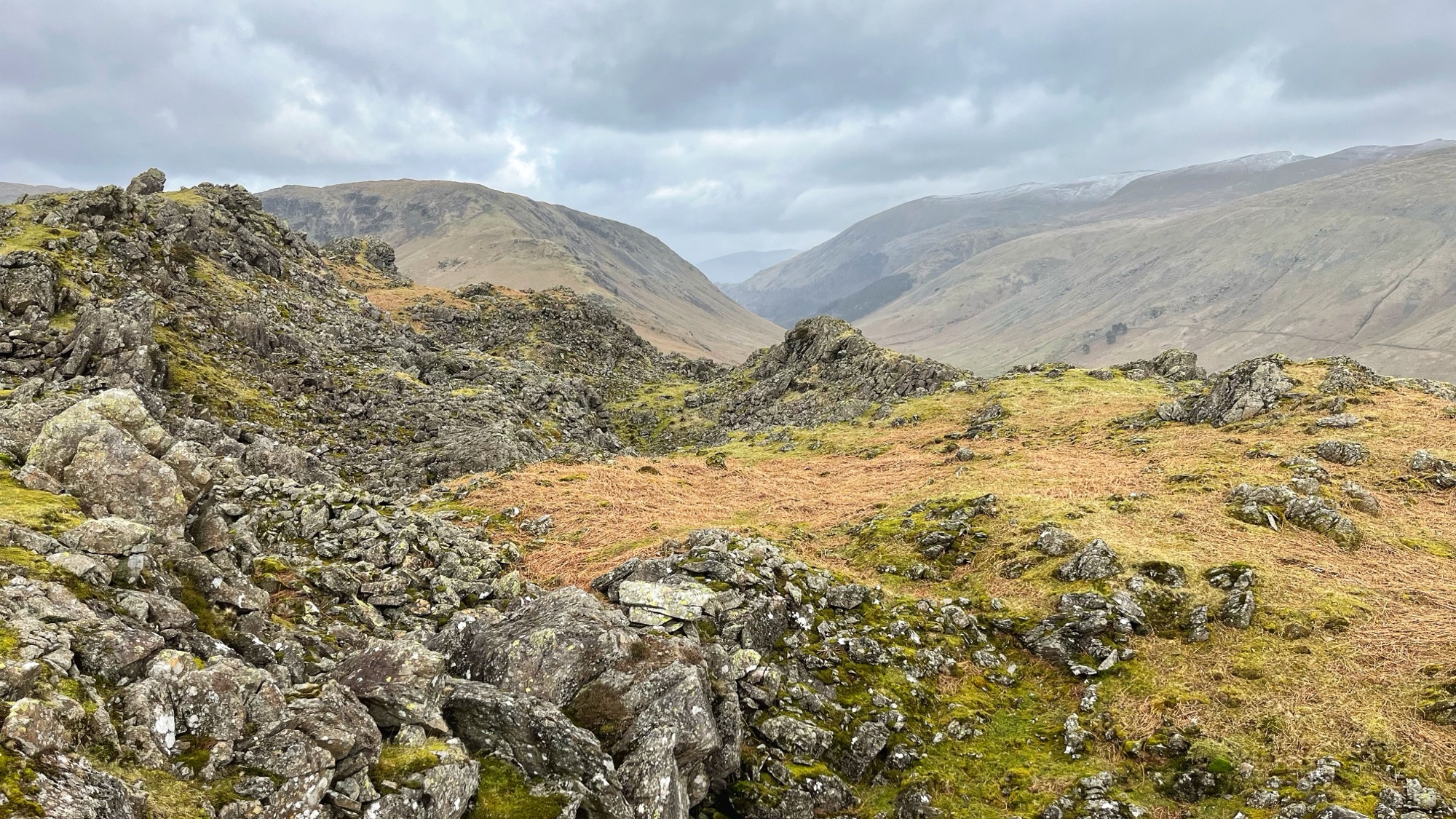
Helm Crag holds a unique distinction. It is the only Lake District fell that Wainwright openly admitted to never actually reaching the top of. He gave up on the final scramble needed to stand on the true summit — the northwestern pinnacle. For a man who climbed everything, that is quite an admission.
The summit ridge itself is worth the trip anyway. Two short parallel ridges run northwest to southeast with a hollow between them, the western one sitting higher. A little further down, the scene repeats — a third ridge, a ditch, a parapet, then the crags. The whole thing looks as though someone built it deliberately. Nobody did.
Wainwright called it a “natural convulsion.” He was not far wrong.
What actually happened was a rockslide. A large mass of ground simply slid a short distance downhill along a weakness in the rock — a shear plane — and more or less stayed in one piece where it stopped. This left behind a headscarp, a cliff from which the rock originally broke away, and created the dramatic features that give Helm Crag its character — the famous “Lion and the Lamb” and the summit pinnacle itself.
Anyone who has driven the Dunmail Raise road will have seen these shapes on the skyline. Very few will have wondered why they are there. Now you know.
Leave a Reply