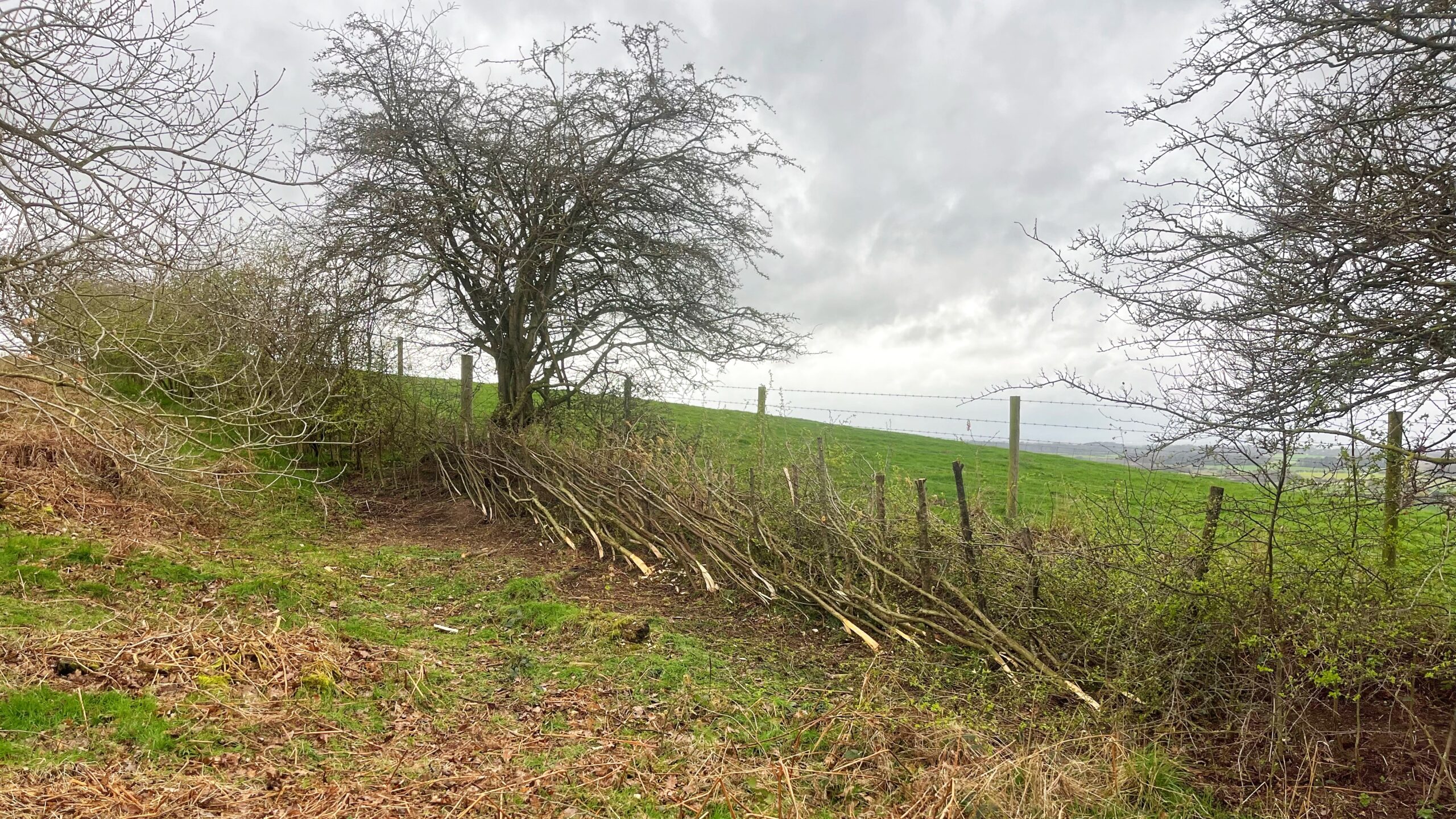
Ten years ago, I helped the National Trust plant 4,000 saplings along the north west boundary of Roseberry Topping, where it meets the fields known as Rye Banks. The North York Moors National Park Traditional Boundary Scheme footed the bill. Hawthorn made up the bulk of the planting, with blackthorn, maple, hazel and dog rose thrown in for good measure. The aim was simple: replace a tired post and wire fence with something rather more useful to wildlife.

Ten years on, that hedge is now ready for its first laying. Hedge laying is a time-honoured craft, far preferable to hacking everything to bits once a year, which is, frankly, a disaster for wildlife.
Beyond the uplands, hedges have served as living fences for centuries, keeping sheep and cattle in their rightful place while sheltering half of Britain’s mammals and nearly all its birds. The English countryside owes its famous patchwork appearance to the Enclosure Acts, which carved up open forest and prairie-type landscape into small, neat fields. Tenants of old were bound by covenant to maintain their hedges, and were permitted “hedging stuff” or “brushwood” for repairs and fuel. It was serious business.
Proper maintenance is everything. Without it, a hedge is finished. Each region of England has developed its own laying style, and the technique used here is the “Midland Bullock” method, used by farms with large, heavy animals. It involves almost, but not quite, cutting each stem at the base, then reclining and weaving it between upright stakes set at eighteen-inch intervals, producing a thick, impenetrable barrier that even a determined bullock would think twice about testing1‘Hedgelaying Styles – National Hedgelaying Society’. 2025. Hedgelaying.org.uk <https://www.hedgelaying.org.uk/hedgelaying/brash/#:~:text=Midland%20style,-The%20%E2%80%9CMidland%20Bullock> [accessed 13 March 2026].
This is a “single brush” style, meaning growth is cleared from one side to allow laying, leaving the other side bushy for livestock. The hedge is laid slightly offset from the original stem line, encouraging fresh growth from the cut stools below, which will form the basis of the next laying in years to come. And it is always laid uphill, because sap rises. Simple as that.
Hedge laying is considerably harder work than planting saplings. Though that may have rather more to do with being ten years older than with the nature of the task itself.
It is enormously satisfying to watch a proper wildlife habitat grow from scratch into something mature and thriving. One can only hope that visitors to Roseberry Topping might appreciate it enough to resist leaving coffee cups about, hanging dog poo bags on the nearest branch, or dismantling the dead hedges placed there to give the woodland verges half a chance to recover. That, it seems, may be hoping for rather a lot.
- 1‘Hedgelaying Styles – National Hedgelaying Society’. 2025. Hedgelaying.org.uk <https://www.hedgelaying.org.uk/hedgelaying/brash/#:~:text=Midland%20style,-The%20%E2%80%9CMidland%20Bullock> [accessed 13 March 2026]
Leave a Reply