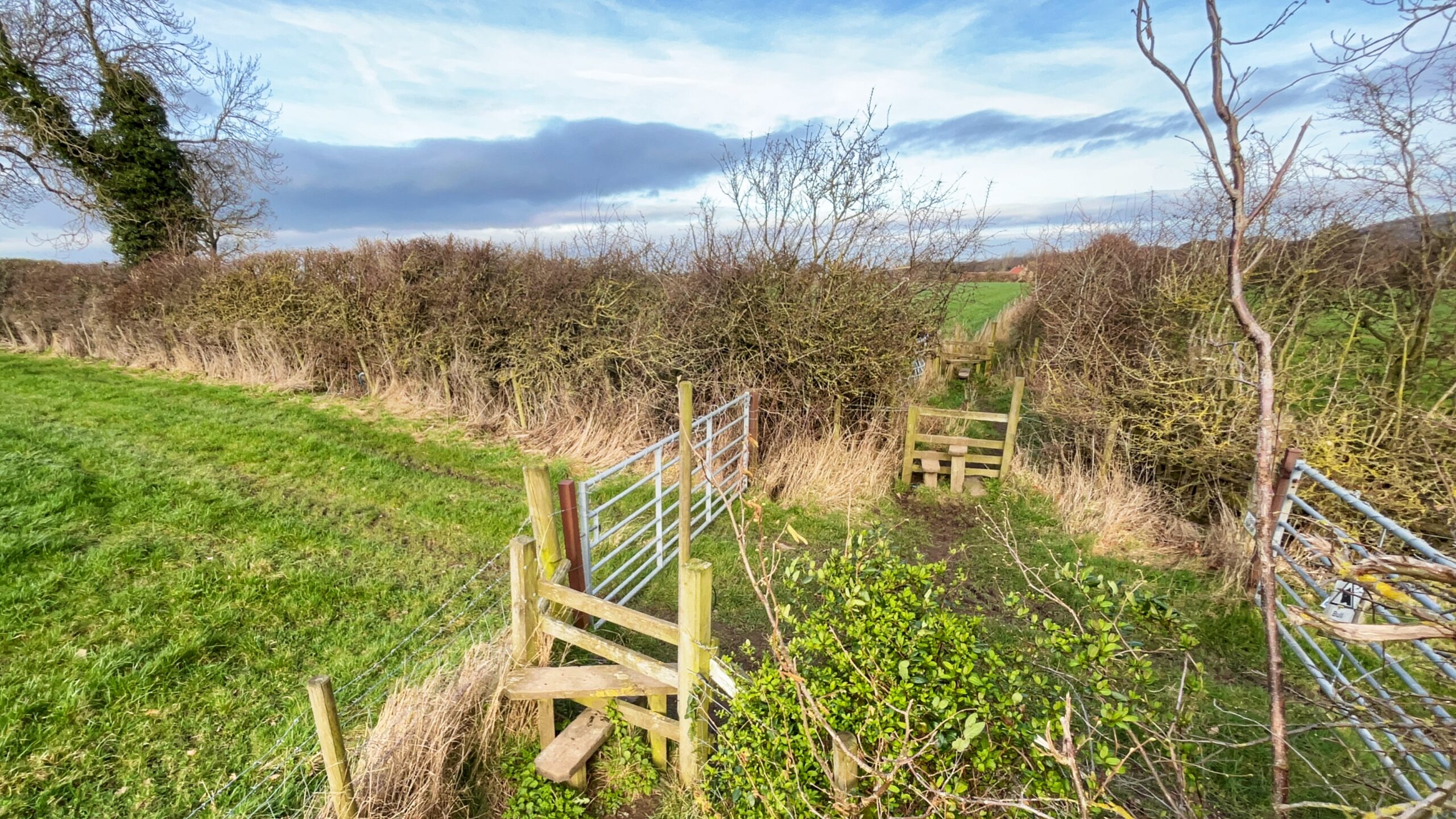
This morning’s photograph tells you everything. Three stiles, one after another, in close succession. Not one. Not two. Three. As if whoever built them wanted to make absolutely sure that anyone with a dodgy knee, a pushchair, or simply the misfortune of being over seventy would get the message: this path is not for you.
Welcome to the great British countryside. Mind the stile.
Here is the first surprise. Stiles were not built to help you cross a field boundary. They were built to stop a sheep from doing the same.
When landowners fenced off the English countryside during the enclosure period — from the 13th century, accelerating wildly in the 18th and 19th centuries — ancient footpaths had to be preserved by law. People still needed to walk to church and market. But livestock needed to stay put. The stile was the compromise.
“It was never designed for comfort or accessibility. It was designed for sheep.”1The Future of Stiles: Why Traditional Countryside Barriers Are Being Replaced. PROW Explorer, 27 Feb 2026. https://www.prowexplorer.com/blog/y3by1vv10s5olpatndor1g8tncgrcb [accessed 28 February 2026]
So next time you scrape your shin on a rotten wooden step in a muddy field, remember: you are using infrastructure designed for a farm animal’s convenience, not yours.
Here is the counterintuitive part. The countryside does not actively turn people away. It does something quieter and, frankly, more effective. It simply makes itself unusable for anyone who cannot climb.
Older walkers, families with small children, anyone with limited mobility — they do not complain. They do not write letters. They just stop going. They disappear without being counted.
“People who cannot use stiles simply avoid those routes. They disappear from the countryside without ever being counted.”2Ibid.
That invisibility is the point. A locked gate is obviously wrong. A stile with a broken step is just the countryside being the countryside. Nobody notices who is absent.
This is perhaps the most surprising takeaway of all. Policy already says stiles are wrong. Official guidance now requires the “least restrictive option.” Gates are preferred. Stiles are, in the words of one guide, considered “the least favourable due to accessibility concerns.”3Understanding Gaps, Gates, and Stiles on Public Rights of Way in England. PROW Explorer, 12 Mar 2021. https://www.prowexplorer.com/blog/gapsgates-and-stiles [accessed 2 March 2026]
Local authorities must even consider disability equality when authorising any new structure.4Ibid.
And yet, photograph the evidence. Three stiles. Before breakfast. To cross a single hedge.
Stiles emerged as enclosures transformed medieval England’s open landscape into a patchwork of private fields. For centuries they were the standard solution to the livestock-versus-walkers problem. Victorian painters romanticised them. Ramblers celebrated them. They became, absurdly, a symbol of rural charm.
They are, in reality, a symbol of a landscape designed to keep most people out.
But the countryside is changing. Gates are replacing stiles. Progress is real, if slow and uneven.
But here is the question to ponder on your next walk: if a structure built for a sheep has been allowed to exclude millions of people for two centuries, what else in the landscape are we defending out of habit rather than reason?
- 1The Future of Stiles: Why Traditional Countryside Barriers Are Being Replaced. PROW Explorer, 27 Feb 2026. https://www.prowexplorer.com/blog/y3by1vv10s5olpatndor1g8tncgrcb [accessed 28 February 2026]
- 2Ibid.
- 3Understanding Gaps, Gates, and Stiles on Public Rights of Way in England. PROW Explorer, 12 Mar 2021. https://www.prowexplorer.com/blog/gapsgates-and-stiles [accessed 2 March 2026]
- 4Ibid.
Leave a Reply