It never fails to weary me how interest groups reach for academic work as a drunk reaches for a lamppost, more for support than illumination. A paper appears, and before the ink is dry it is trimmed, polished, and made to serve a house creed. We have seen the trick before, from vaccine doubters to flat earth enthusiasts. The method rarely changes.
The Moorland Association has now reviewed a Norwegian study, Wildlife Management in the Anthropocene, which asks a serious question: should nature be left to recover alone, or has human influence gone so far that intervention is unavoidable. The debate matters. The review does not help it. Rather than weigh the science, the MA selects what suits its members, placing emphasis on intervention, predator control, and hunting1Brainerd, S. M. & Storaas, T. (2025). Wildlife Management in the Anthropocene: Perspectives from Norway. Scandinavian University Press. https://doi.org/10.18261/9788215075174-252Beeson, Rob. 2026. ‘Why Active Management Matters in a Changing World’, Moorland Association <https://www.moorlandassociation.org/post/lessons-from-the-north-why-active-management-matters-in-a-changing-world> [accessed 28 January 2026].
Predator control sits at the centre of their argument. Foxes and other adaptable predators are presented as chief villains behind declines in ground nesting birds, offered as proof that active management is essential. It sounds persuasive until one looks at what has been quietly left on the cutting room floor. The study devotes major attention to forestry, urban expansion, habitat fragmentation, collisions with infrastructure, and other human pressures. These scarcely appear in the MA’s review.
Both study and review accept that we live in the Anthropocene. Yet where the former describes a tangled web of human impacts, the MA isolates a single thread and calls it stewardship. Complex disagreement becomes a neat rural versus urban tale.
Science remains intact. The framing does not. When management is presented as inevitable, it is wise to ask which evidence has been shown, and which has slipped conveniently from view.
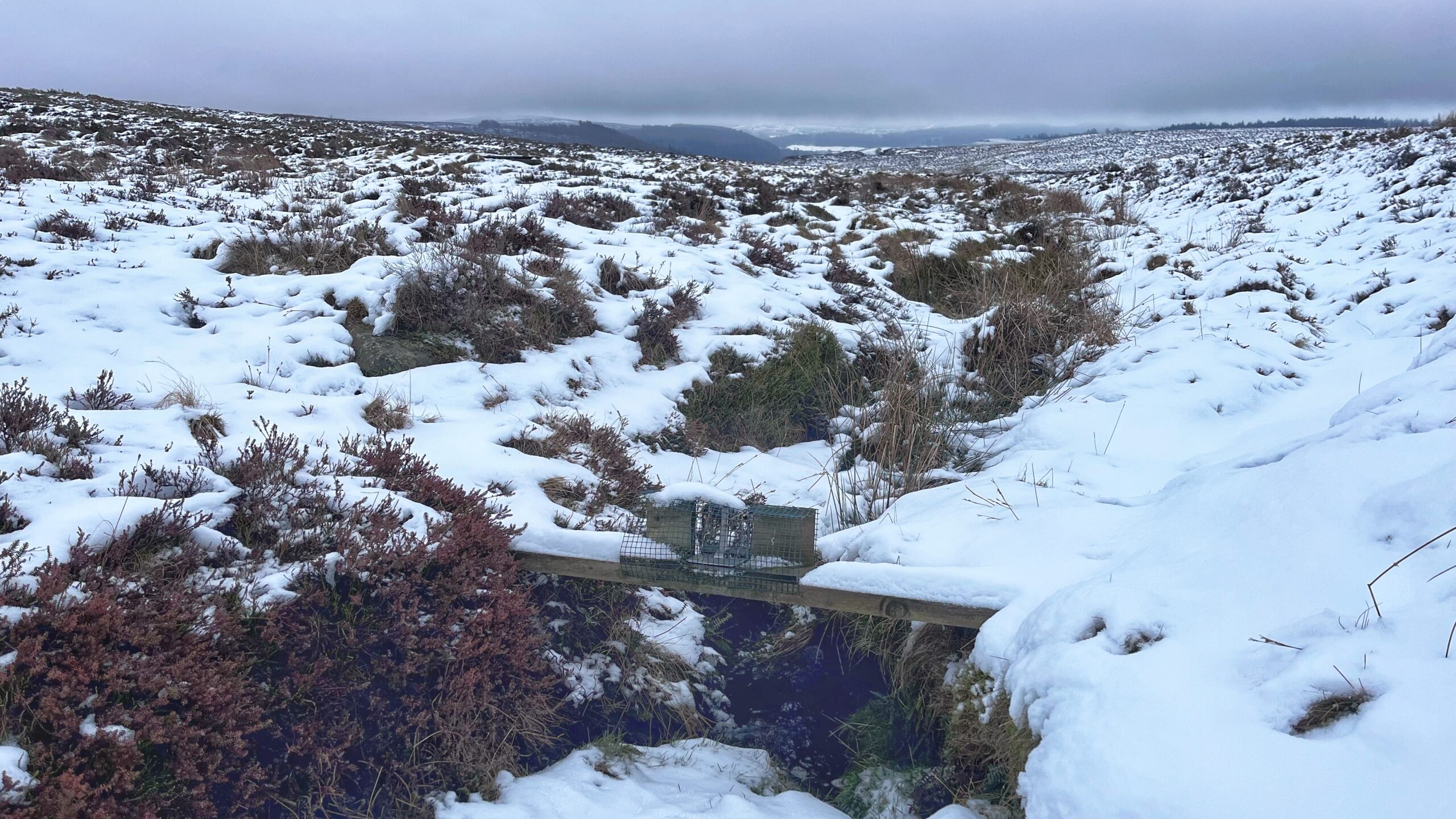
Photo: Fenn trap on Great Ayton Moor
- 1Brainerd, S. M. & Storaas, T. (2025). Wildlife Management in the Anthropocene: Perspectives from Norway. Scandinavian University Press. https://doi.org/10.18261/9788215075174-25
- 2Beeson, Rob. 2026. ‘Why Active Management Matters in a Changing World’, Moorland Association <https://www.moorlandassociation.org/post/lessons-from-the-north-why-active-management-matters-in-a-changing-world> [accessed 28 January 2026]


Leave a Reply