The UK’s Biodiversity Net Gain scheme was meant to be our environmental shield. A simple promise that development would leave habitats “in a measurably better state than they were before.” It is sold as a key tool to halt “catastrophic declines in nature.”1’Understanding Biodiversity Net Gain’, GOV.UK. 2023. <https://www.gov.uk/guidance/understanding-biodiversity-net-gain> [accessed 10 February 2026] Fine words, neatly printed.
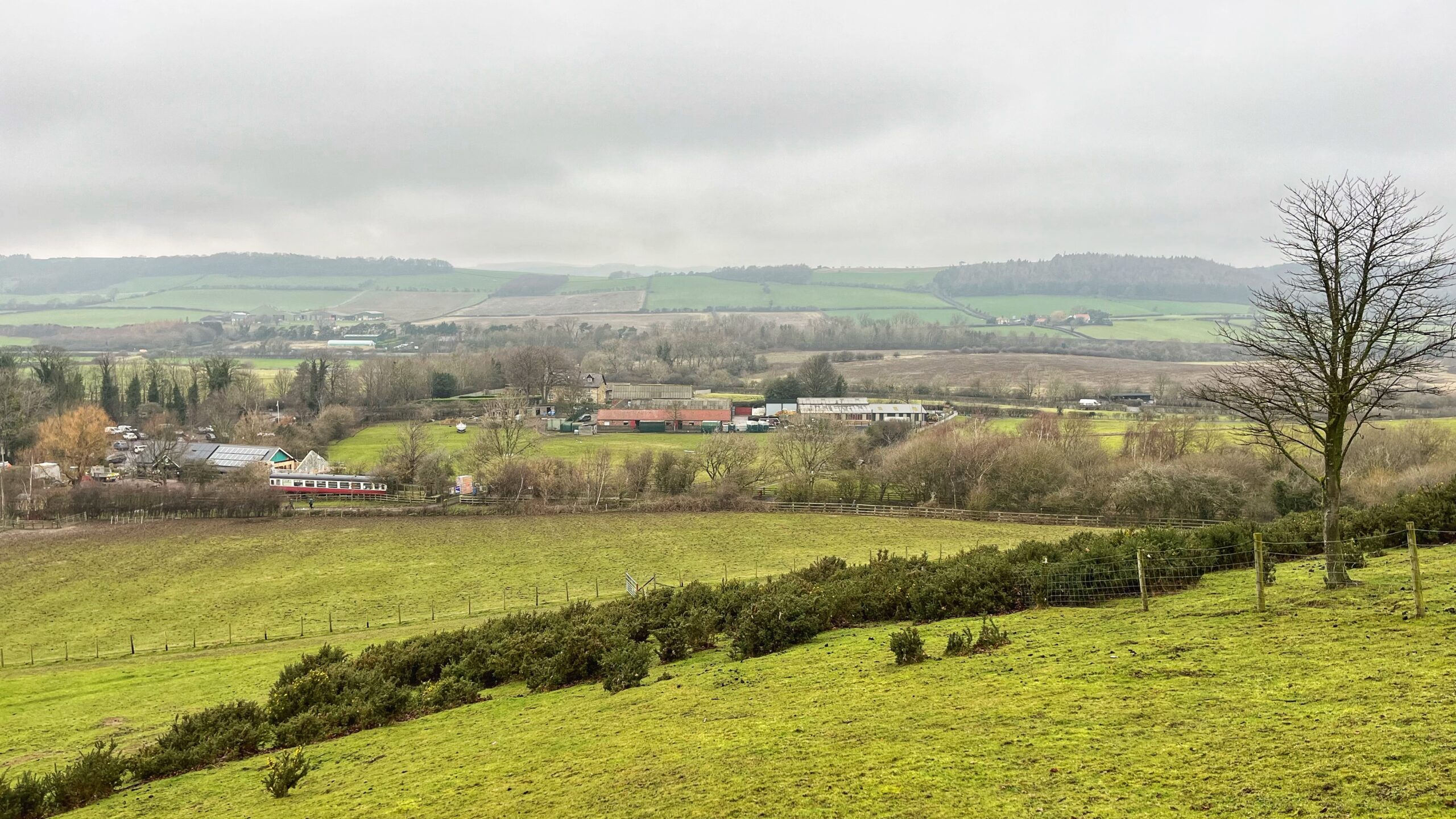
The proposal to develop an 11.63ha site overlooking the Pinchinthorpe walkway — the fields on the mid-right in the photograph — has raised some concern about its impact on nature2‘R/2025/0840/OOM Planning Application Details. Redcar-Cleveland.gov.uk <https://planning.redcar-cleveland.gov.uk/Planning/Display/R/2025/0840/OOM?fbclid=IwdGRleAP4RjpleHRuA2FlbQIxMQBzcnRjBmFwcF9pZA8xNzM4NDc2NDI2NzAzNzAAAR7VS1kDdmk_2CqfSizsTPCaz2ViX_C1as7N-EGV4CQMKs9Va6510XjVPe7S3g_aem_CROK61Hs5S_HYh6Kjx_w3Q> [accessed 10 February 2026]. The developers, however, are confident it will meet the BNG criteria. That confidence nudged me into looking more closely. What I found was not clarity but a legal bog, dense, deep, and best crossed with a map and a solicitor. Still, one clear concern has emerged for me.
The rhetoric may be green and glowing, but the system leaks. Badly. A full 43% of planning applications are exempt from BNG altogether3‘43% of Planning Applications Now Exempt from Biodiversity Net Gain’. 2026. Environmentjournal.online <https://environmentjournal.online/climate-change/43-of-planning-applications-now-exempt-from-biodiversity-net-gain/> [accessed 10 February 2026]. The Pinchinthorpe site does not qualify for an exemption, but its assessment shows how the targets are met by scraping under the bar rather than clearing it.
The first awkward fact is the low bar itself. Most of the site is classified as “Modified Grassland” in “Poor” condition. This is not a judgement call. It is arithmetic. Table 3.3 shows the land fails the species richness test, with fewer than six species per m², and is marked down for “physical damage due to horse poaching” 4OS Ecology Ltd, “Example BNG Assessment: Land at Guisborough,” Page 17. December 2025. 25351 BNG V.22. https://planning.redcar-cleveland.gov.uk/Planning/Display/R/2025/0840/OOM?fbclid=IwdGRleAP4RjpleHRuA2FlbQIxMQBzcnRjBmFwcF9pZA8xNzM4NDc2NDI2NzAzNzAAAR7VS1kDdmk_2CqfSizsTPCaz2ViX_C1as7N-EGV4CQMKs9Va6510XjVPe7S3g_aem_CROK61Hs5S_HYh6Kjx_w3Q#undefined:~:text=22/12/2025-,Bng%20Assessment,-%2D%20kb. Quite what that looks like on the ground is left to the imagination.
“The grassland is species poor and the sward is uniform and short.” 5OS Ecology Ltd, “Example BNG Assessment: Land at Guisborough,” December 2025. Page 11. 25351 BNG V.22. https://planning.redcar-cleveland.gov.uk/Planning/Display/R/2025/0840/OOM?fbclid=IwdGRleAP4RjpleHRuA2FlbQIxMQBzcnRjBmFwcF9pZA8xNzM4NDc2NDI2NzAzNzAAAR7VS1kDdmk_2CqfSizsTPCaz2ViX_C1as7N-EGV4CQMKs9Va6510XjVPe7S3g_aem_CROK61Hs5S_HYh6Kjx_w3Q#undefined:~:text=22/12/2025-,Bng%20Assessment,-%2D%20kb
When you begin with land described as little better than an ecological write-off, the maths does the rest. A modest tweak delivers a 10% “gain.” The spreadsheet beams. Nature barely notices. It is an award for turning up, not for doing well.
The site is also judged to have “Low Strategic Significance” because it does not appear on a Local Habitat Map and does not sit within a published Local Nature Recovery Strategy 6OS Ecology Ltd, “Example BNG Assessment: Land at Guisborough,” December 2025. Page 5. 25351 BNG V.22. https://planning.redcar-cleveland.gov.uk/Planning/Display/R/2025/0840/OOM?fbclid=IwdGRleAP4RjpleHRuA2FlbQIxMQBzcnRjBmFwcF9pZA8xNzM4NDc2NDI2NzAzNzAAAR7VS1kDdmk_2CqfSizsTPCaz2ViX_C1as7N-EGV4CQMKs9Va6510XjVPe7S3g_aem_CROK61Hs5S_HYh6Kjx_w3Q#undefined:~:text=22/12/2025-,Bng%20Assessment,-%2D%20kb. On paper, this downgrades its value. On the ground, it means the development will sit as an isolated patch, not part of any wider network. The Wildlife Trusts put it more plainly:
“It is widely acknowledged that 10% [Biodiversity Net Gain] is the bare minimum needed to maintain the status quo for nature. Given the catastrophic declines in nature over recent decades, clearly, greater ambition is needed.”7The Derbyshire Wildlife Trust. 2025. ‘One Year On, the Wildlife Trusts Set to Be One of the Largest Providers of Biodiversity Net Gain | Derbyshire Wildlife Trust’, Derbyshirewildlifetrust.org.uk. 11 February 2025 <https://www.derbyshirewildlifetrust.org.uk/news/one-year-wildlife-trusts-set-be-one-largest-providers-biodiversity-net-gain#:~:text=It%20is%20widely%20acknowledged%20that%2010%25%20is%20the%20bare%20minimum%20needed%20to%20maintain%20the%20status%20quo%20for%20nature.%20Given%20the%20catastrophic%20declines%20in%20nature%20over%20recent%20decades%2C%20clearly%2C%20greater%20ambition%20is%20needed.> [accessed 10 February 2026]
To reach the required figures, real fields are replaced with “Modified Grassland,” “urban trees,” and “vegetated gardens” 8OS Ecology Ltd, “Example BNG Assessment: Land at Guisborough,” December 2025. Page 6. 25351 BNG V.22. https://planning.redcar-cleveland.gov.uk/Planning/Display/R/2025/0840/OOM?fbclid=IwdGRleAP4RjpleHRuA2FlbQIxMQBzcnRjBmFwcF9pZA8xNzM4NDc2NDI2NzAzNzAAAR7VS1kDdmk_2CqfSizsTPCaz2ViX_C1as7N-EGV4CQMKs9Va6510XjVPe7S3g_aem_CROK61Hs5S_HYh6Kjx_w3Q#undefined:~:text=22/12/2025-,Bng%20Assessment,-%2D%20kb. This is where the scheme turns sour. Research from the Parliamentary Office of Science and Technology points to a yawning “governance gap.” Unlike off-site schemes, these on-site gains are not logged on the national BNG register9UK Parliament POST, “Biodiversity Net Gain,” 2 September 2024. https://researchbriefings.files.parliament.uk/documents/POST-PN-0728/POST-PN-0728.pdf. They vanish into paperwork.
There is nothing to stop a homeowner paving over a “vegetated garden” the week they move in. Parkland grass is worn thin by constant use. The promised gains are slippery, hard to measure, and easier still to lose. Enforcement becomes a polite fiction.
Yes, the plan meets the 10% legal minimum. It does so by stepping over a bar left flat on the ground and leaning on landscaping that no one can properly track. If this is what passes for success, we are not restoring nature. We are simply organising its decline.
So the question lingers, like damp in the walls. Is a 10% increase on paper really worth the loss of real, living space on our doorstep?
Further Source: “A New Era for Nature Positive Development Biodiversity Net Gain and The Wildlife Trusts”. The Royal Society of Wildlife Trusts 2024. https://www.wildlifetrusts.org/sites/default/files/2024-02/February_2024_Biodiversity_Net_Gain_Briefing.pdf
- 1’Understanding Biodiversity Net Gain’, GOV.UK. 2023. <https://www.gov.uk/guidance/understanding-biodiversity-net-gain> [accessed 10 February 2026]
- 2‘R/2025/0840/OOM Planning Application Details. Redcar-Cleveland.gov.uk <https://planning.redcar-cleveland.gov.uk/Planning/Display/R/2025/0840/OOM?fbclid=IwdGRleAP4RjpleHRuA2FlbQIxMQBzcnRjBmFwcF9pZA8xNzM4NDc2NDI2NzAzNzAAAR7VS1kDdmk_2CqfSizsTPCaz2ViX_C1as7N-EGV4CQMKs9Va6510XjVPe7S3g_aem_CROK61Hs5S_HYh6Kjx_w3Q> [accessed 10 February 2026]
- 3‘43% of Planning Applications Now Exempt from Biodiversity Net Gain’. 2026. Environmentjournal.online <https://environmentjournal.online/climate-change/43-of-planning-applications-now-exempt-from-biodiversity-net-gain/> [accessed 10 February 2026]
- 4OS Ecology Ltd, “Example BNG Assessment: Land at Guisborough,” Page 17. December 2025. 25351 BNG V.22. https://planning.redcar-cleveland.gov.uk/Planning/Display/R/2025/0840/OOM?fbclid=IwdGRleAP4RjpleHRuA2FlbQIxMQBzcnRjBmFwcF9pZA8xNzM4NDc2NDI2NzAzNzAAAR7VS1kDdmk_2CqfSizsTPCaz2ViX_C1as7N-EGV4CQMKs9Va6510XjVPe7S3g_aem_CROK61Hs5S_HYh6Kjx_w3Q#undefined:~:text=22/12/2025-,Bng%20Assessment,-%2D%20kb
- 5OS Ecology Ltd, “Example BNG Assessment: Land at Guisborough,” December 2025. Page 11. 25351 BNG V.22. https://planning.redcar-cleveland.gov.uk/Planning/Display/R/2025/0840/OOM?fbclid=IwdGRleAP4RjpleHRuA2FlbQIxMQBzcnRjBmFwcF9pZA8xNzM4NDc2NDI2NzAzNzAAAR7VS1kDdmk_2CqfSizsTPCaz2ViX_C1as7N-EGV4CQMKs9Va6510XjVPe7S3g_aem_CROK61Hs5S_HYh6Kjx_w3Q#undefined:~:text=22/12/2025-,Bng%20Assessment,-%2D%20kb
- 6OS Ecology Ltd, “Example BNG Assessment: Land at Guisborough,” December 2025. Page 5. 25351 BNG V.22. https://planning.redcar-cleveland.gov.uk/Planning/Display/R/2025/0840/OOM?fbclid=IwdGRleAP4RjpleHRuA2FlbQIxMQBzcnRjBmFwcF9pZA8xNzM4NDc2NDI2NzAzNzAAAR7VS1kDdmk_2CqfSizsTPCaz2ViX_C1as7N-EGV4CQMKs9Va6510XjVPe7S3g_aem_CROK61Hs5S_HYh6Kjx_w3Q#undefined:~:text=22/12/2025-,Bng%20Assessment,-%2D%20kb
- 7The Derbyshire Wildlife Trust. 2025. ‘One Year On, the Wildlife Trusts Set to Be One of the Largest Providers of Biodiversity Net Gain | Derbyshire Wildlife Trust’, Derbyshirewildlifetrust.org.uk. 11 February 2025 <https://www.derbyshirewildlifetrust.org.uk/news/one-year-wildlife-trusts-set-be-one-largest-providers-biodiversity-net-gain#:~:text=It%20is%20widely%20acknowledged%20that%2010%25%20is%20the%20bare%20minimum%20needed%20to%20maintain%20the%20status%20quo%20for%20nature.%20Given%20the%20catastrophic%20declines%20in%20nature%20over%20recent%20decades%2C%20clearly%2C%20greater%20ambition%20is%20needed.> [accessed 10 February 2026]
- 8OS Ecology Ltd, “Example BNG Assessment: Land at Guisborough,” December 2025. Page 6. 25351 BNG V.22. https://planning.redcar-cleveland.gov.uk/Planning/Display/R/2025/0840/OOM?fbclid=IwdGRleAP4RjpleHRuA2FlbQIxMQBzcnRjBmFwcF9pZA8xNzM4NDc2NDI2NzAzNzAAAR7VS1kDdmk_2CqfSizsTPCaz2ViX_C1as7N-EGV4CQMKs9Va6510XjVPe7S3g_aem_CROK61Hs5S_HYh6Kjx_w3Q#undefined:~:text=22/12/2025-,Bng%20Assessment,-%2D%20kb
- 9UK Parliament POST, “Biodiversity Net Gain,” 2 September 2024. https://researchbriefings.files.parliament.uk/documents/POST-PN-0728/POST-PN-0728.pdf
Leave a Reply