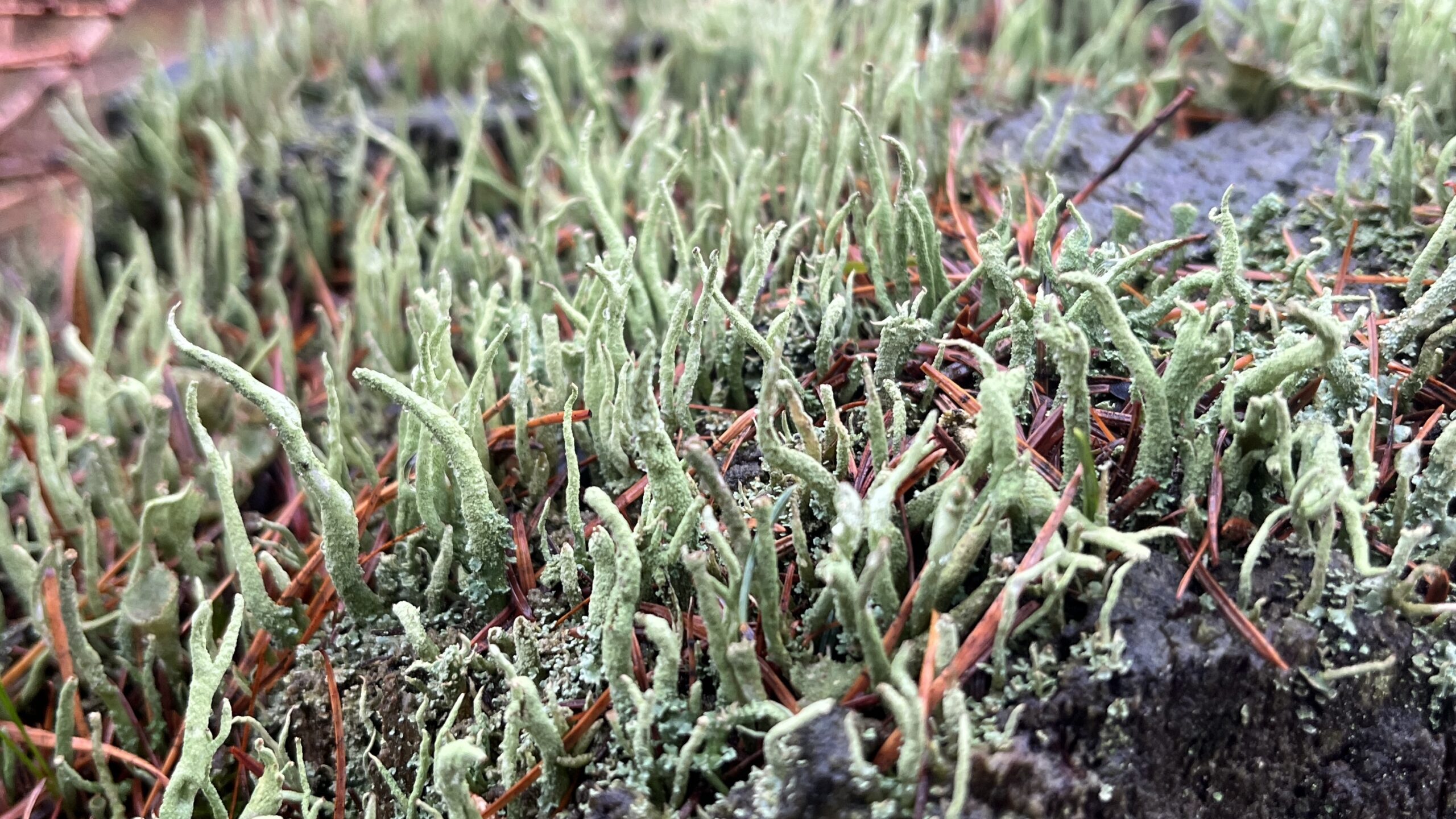
I have discovered an app on my phone that had been hiding in plain sight. The ‘Magnifier’. A small thing, yet it has opened a door. The everyday world has shrunk and turned strange. Tree stumps become miniature forests. Rough wood turns into a map of ridges and valleys.
Peering at a pale green stand of upright stalks on the stump of a conifer, and with a nudge from my AI pal Gemini, I arrive at a working guess. This lichen likely belongs to the genus Cladonia. A modest conclusion, but it will do.
That is where my confidence sensibly stops. It is a lichen, not a moss, which already feels like progress. Confusion is built into the subject. One of the best known Cladonia carries the misleading name Reindeer Moss, which tells you something about how tidy nature is not.
There are many species of Cladonia, and they are a taxonomic minefield. The stalks, known as podetia, rise a few millimetres or a couple of centimetres and end in fruiting bodies. These can help, in theory. Some form neat cups, the Pixie cup lichen. Others sport red or orange tips, the Devil’s matchstick lichen. That one, at least, I can spot without squinting.
Lichens like these are often called “pioneer species.” They move in where others refuse to go. Poor soil, acidic ground, bare wood. They break things down, hold things together, and quietly lay the bricks and mortar for mosses and larger plants to follow. Someone has to go first, after all.
As for usefulness, they are not just there to be admired. Some Cladonia species produce compounds used in antibiotic creams. Reindeer moss also keeps reindeer herders in business. Even the smallest fry earns its keep.
Leave a Reply