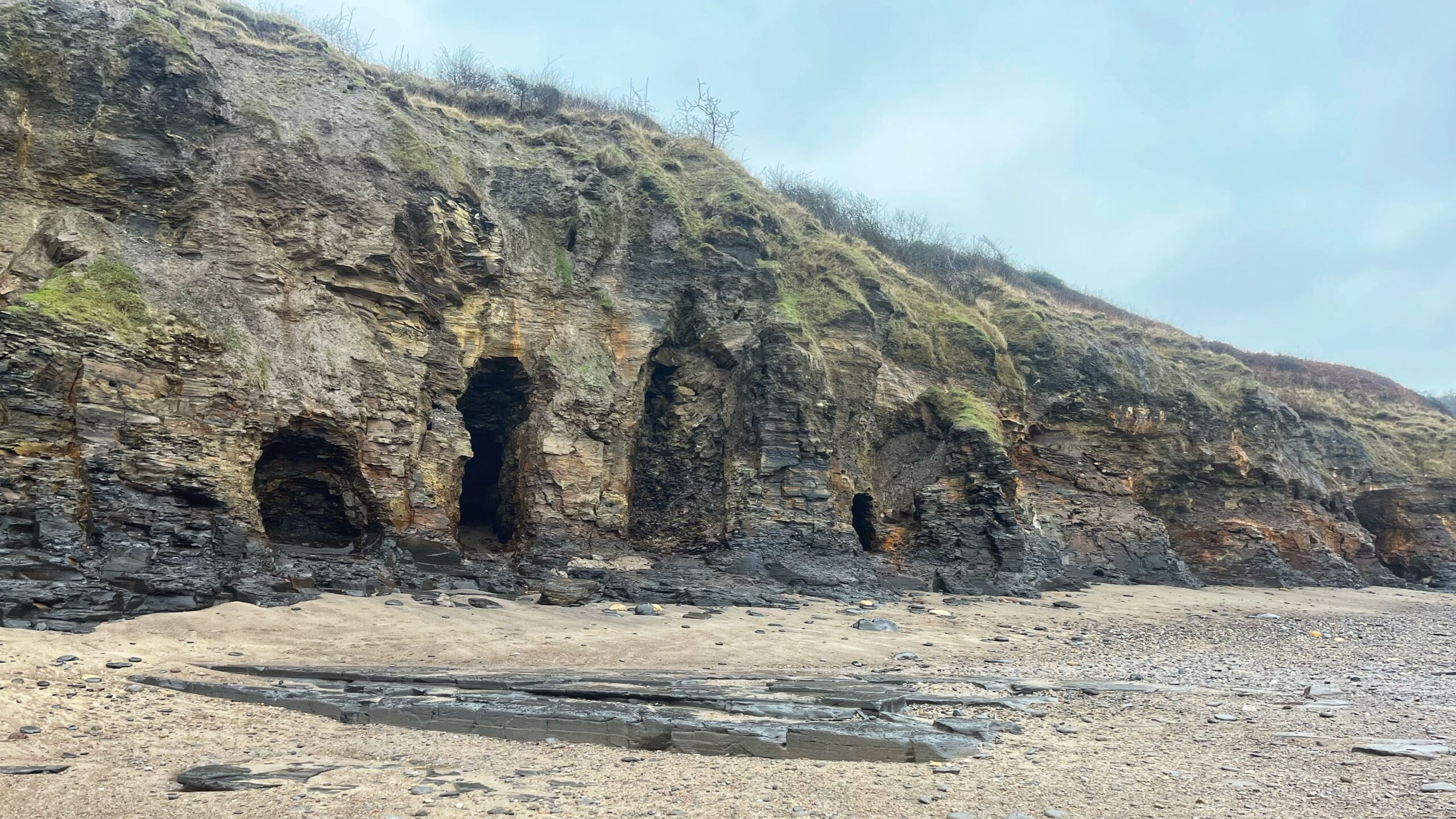
Runswick Bay takes its character from the Hob Holes, raw wounds in the shale cliffs cut by the North Sea going about its daily vandalism. They are not just the work of water on stone. They are the blank spaces where memory used to live. In those gaps sat the Hob, a local figure of some standing, half menace, half comfort, binding old fears to everyday life on the Yorkshire coast.1John Leyland, “The Yorkshire Coast and the Cleveland Hills and Dales,” 1892.
The Hob was a walking contradiction. He lured the careless towards a wet end, yet he was also the village doctor when doctors were thin on the ground. Mothers with children gripped by whooping cough turned to him because there was little else to turn to. They carried their children to the cave and called out:
“Hob-hole Hob,
Ma bairn’s getten t’ kink-cough,
Tak’t off—tak’t off!”
In the end, belief did not fade away politely. It was smashed to pieces. In the nineteenth century the jet-diggers arrived and tore into the Hob Holes for profit. Stone mattered more than stories. Industry did what reason had not managed, and the Hob was pushed out by pick and shovel. It was myth against money, and money rarely loses.
A faint taste of the old world still hangs about the place, like a smell that will not quite shift. We have swapped caves for our phones and spirits for screens, but the question lingers. Have we really grown up, or have we just found new names for the things that haunt the edges of what we understand.
- 1John Leyland, “The Yorkshire Coast and the Cleveland Hills and Dales,” 1892.
Leave a Reply