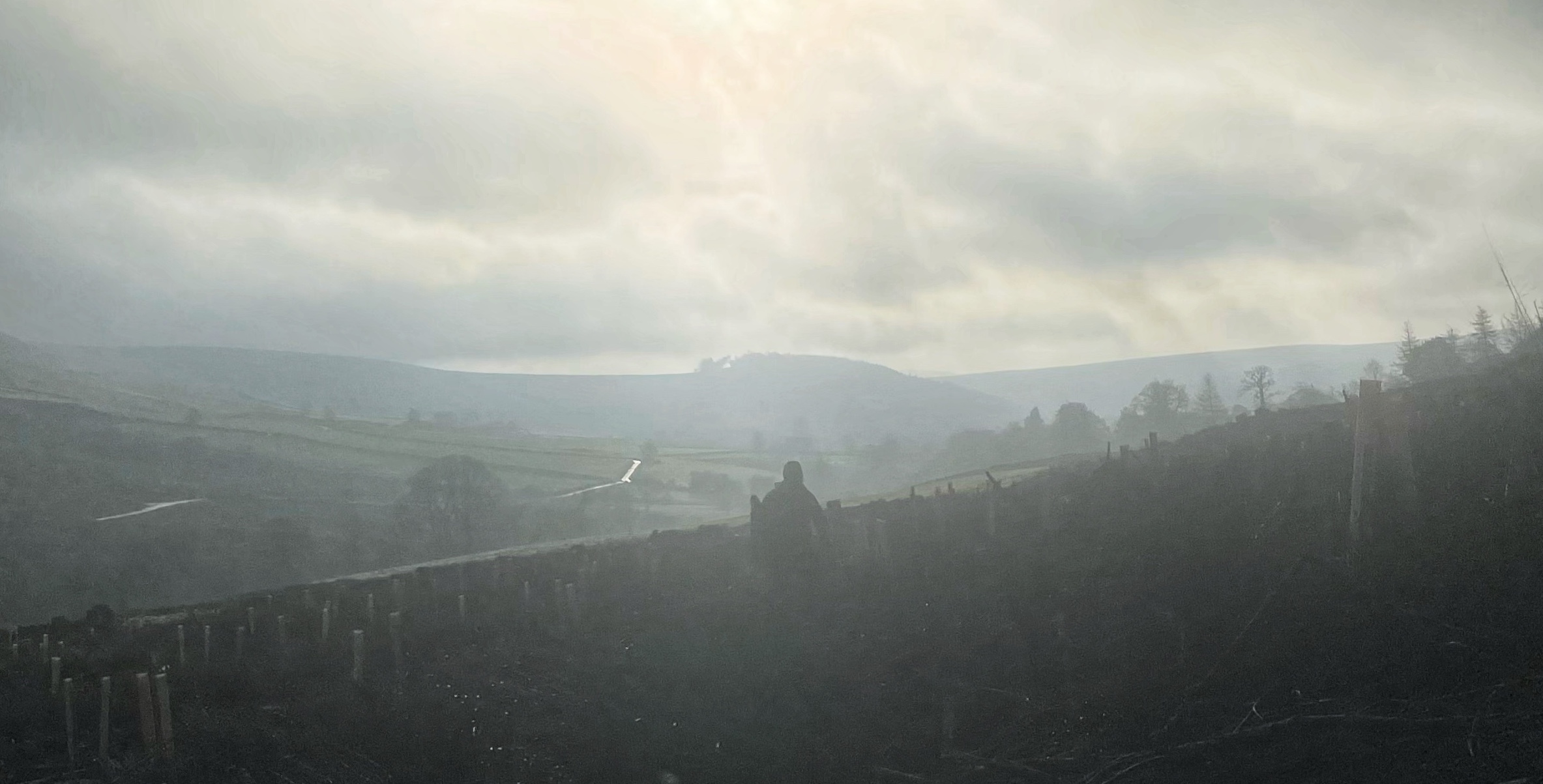
A return to Bransdale, where last winter the National Trust planted 6,000 saplings onto the steep side of Bloworth Slack. The site had been clear-felled, a blank but messy page waiting for a better story than rows of timber grown for profit.
To give the youngsters a fighting chance, the usual tree guards went in. They are not pretty, but necessary to prevent deer from having a free lunch. Fresh saplings are easy pickings, and a healthy deer population can mow through a new woodland faster than you can put the kettle on.
Not every tree makes it. That is the way of things. Some fail, some snap, some simply give up. Today’s task with the Trust was to fill these gaps and straighten or mend guards knocked about by the wind. The rangers put losses at around 20 per cent, which, apparently, is par for the course. Standing there, spit spade in hand, it felt lower than that, though optimism is cheap in dreich weather when one is stumbling over brashings and rotting trunks.
All this sits inside a bigger picture. The previous UK government set a target to lift woodland cover in England from 12.8 per cent to 16.5 per cent by 20501“Britain’s wild woods are under threat and we’re running out of time to save them”. 23 March 2023. https://theconversation.com/britains-wild-woods-are-under-threat-and-were-running-out-of-time-to-save-them-201979. Critics have long said that this chase for numbers risks favouring neat blocks of non-native conifers over the slower, messier business of natural woodland. Around 14,000 hectares are planted each year, yet only about half counts as broadleaf woodland. Campaigners warn that advice to prioritise native trees is too often brushed aside. The National Trust, to its credit and no great surprise, has planted a mix of native species here.
That 16.5 per cent target has not been quietly dropped. It still stands, now locked into law2Tree canopy and woodland cover Environment Act target delivery plan. Published 1 December 2025. https://www.gov.uk/government/publications/tree-canopy-and-woodland-cover-environment-act-target-delivery-plan/tree-canopy-and-woodland-cover-environment-act-target-delivery-plan#:~:text=target%2Ddelivery%2Dplan-,Statutory%20Environment%20Act%20target,England%20by%2031%20December%202050. The current government has restated it within its “Plan for Change” and wider environmental plans. On paper at least, the direction of travel is clear3The Environmental Targets (Woodland and Trees Outside Woodland) (England) Regulations 2022. https://www.legislation.gov.uk/ukdsi/2022/9780348242942#:~:text=EXPLANATORY%20NOTE,trees%20outside%20woodland%20by%202050.. Whether it turns into real woods rather than tidy spreadsheets is another matter, but days like this suggest the effort is more than just hot air.
- 1“Britain’s wild woods are under threat and we’re running out of time to save them”. 23 March 2023. https://theconversation.com/britains-wild-woods-are-under-threat-and-were-running-out-of-time-to-save-them-201979
- 2Tree canopy and woodland cover Environment Act target delivery plan. Published 1 December 2025. https://www.gov.uk/government/publications/tree-canopy-and-woodland-cover-environment-act-target-delivery-plan/tree-canopy-and-woodland-cover-environment-act-target-delivery-plan#:~:text=target%2Ddelivery%2Dplan-,Statutory%20Environment%20Act%20target,England%20by%2031%20December%202050
- 3The Environmental Targets (Woodland and Trees Outside Woodland) (England) Regulations 2022. https://www.legislation.gov.uk/ukdsi/2022/9780348242942#:~:text=EXPLANATORY%20NOTE,trees%20outside%20woodland%20by%202050.
Leave a Reply