Folklore has a habit of latching itself to a place, especially when the landscape looks as if it needs an explanation. A strange rock, an awkward slope, a stone where no stone ought to be, and the human mind gets to work, explaining things away with a story.
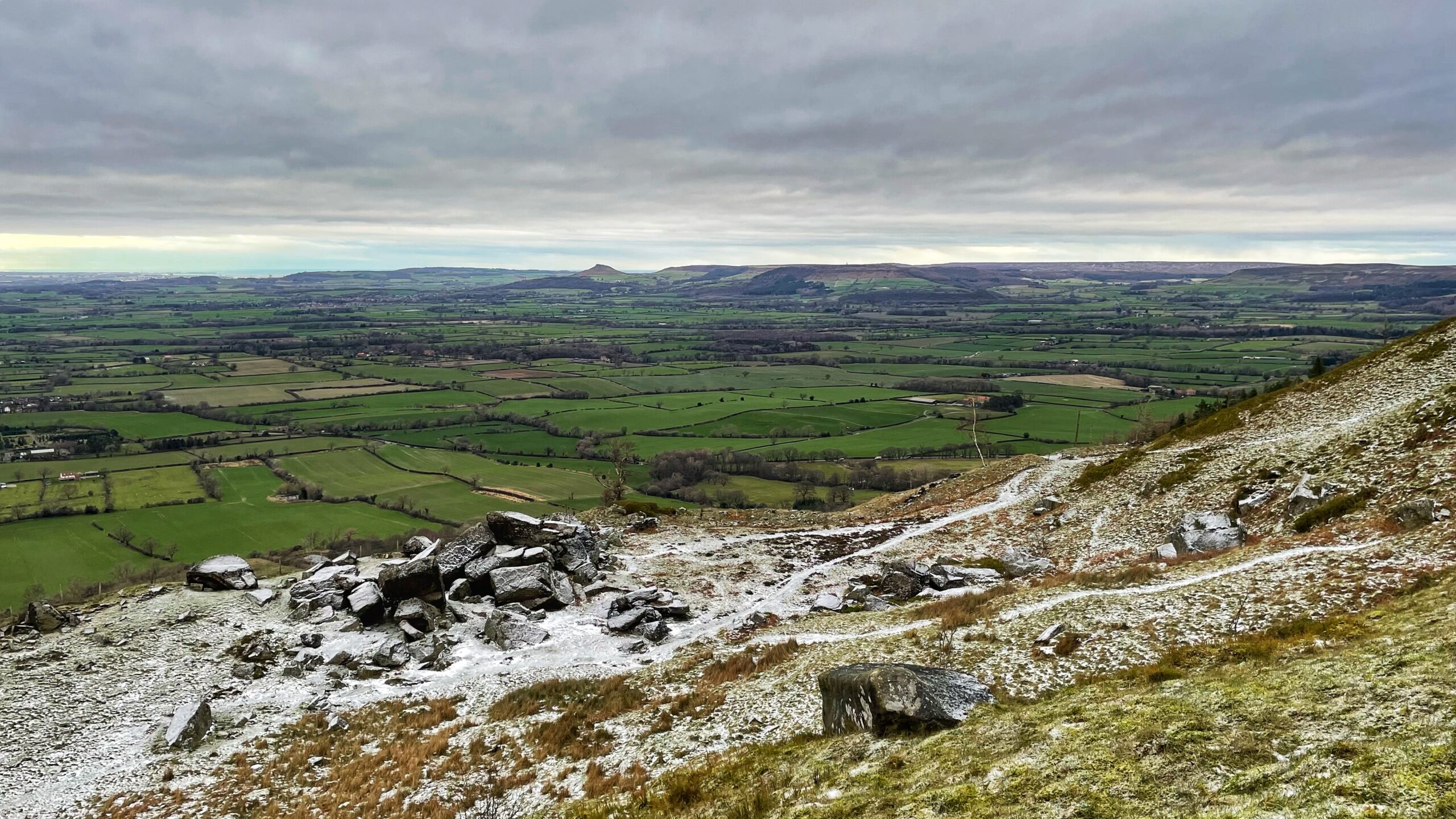
Few landmarks on the North York Moors do this better than the Wainstones. They sit there like a half-built ruin, a playground for climbers, made of tumbled columns of Middle Jurassic sandstone that once lay quietly under the sea. A little way down Broughton Bank lies a scattered heap of rocks. Its centrepiece is a giant slab leaning at a dramatic 45 degrees, marked with clear prehistoric carvings. A single winding groove runs for 2.5 metres, picked out with deep peck marks. It is remarkable in its own right, though it lives in the long shadow cast by the Wainstones above1North York Moors Historical Environment Record No: 22929.
According to legend, the Wainstones is where a Danish chieftain came to a bad end. The name is said to come from the Old Saxon wanian, meaning to lament. One can picture the scene easily enough: snow on the rocks, a poor decision, and a great deal of regret. Oddly, the jumble of rocks where this may well have happened appears to have no name at all, which feels like an oversight2The History of Cleveland, in the North Riding of the County of York … By John Graves. Available online at https://books.google.co.uk/books?redir_esc=y&id=9UQQAAAAYAAJ&q=wain+stones#v=snippet&q=wain%20stones&f=false.
An 1872 newspaper adds another layer, referring to “The Ancient British Druidical Logan or Rocking Stone” near the Wainstones. A logan stone is simply a rock balanced so finely that it rocks when pushed, the word likely coming from the Old English log, meaning to rock. The “Ancient British Druidical” part is pure Victorian enthusiasm, the sort of label applied to anything older than the Romans and not nailed down. No stone in the jumble rocks today, yet the description fits the place too neatly to dismiss3Britishnewspaperarchive.co.uk. (2022). Immense Landslip On | Daily Gazette For Middlesbrough | Monday 24 June 1872 | British Newspaper Archive. Available online at: https://www.britishnewspaperarchive.co.uk/viewer/bl/0000486/18720624/015/0003[Accessed 1 Jul. 2022]..
Across the country, rocking stones attract stories of witchcraft, cures, and quiet magic. Here, the folklore is more sparse. All that remains is the tale of a Danish chieftain, and the idea that his cries still echo among the stones. The moors, as ever, keep their silence, which somehow makes the story linger all the longer4Wikipedia Contributors (2021). Rocking stone. [online] Wikipedia. Available at: https://en.wikipedia.org/wiki/Rocking_stone#Name[Accessed 1 Jul. 2022]..
- 1North York Moors Historical Environment Record No: 22929
- 2The History of Cleveland, in the North Riding of the County of York … By John Graves. Available online at https://books.google.co.uk/books?redir_esc=y&id=9UQQAAAAYAAJ&q=wain+stones#v=snippet&q=wain%20stones&f=false
- 3Britishnewspaperarchive.co.uk. (2022). Immense Landslip On | Daily Gazette For Middlesbrough | Monday 24 June 1872 | British Newspaper Archive. Available online at: https://www.britishnewspaperarchive.co.uk/viewer/bl/0000486/18720624/015/0003[Accessed 1 Jul. 2022].
- 4Wikipedia Contributors (2021). Rocking stone. [online] Wikipedia. Available at: https://en.wikipedia.org/wiki/Rocking_stone#Name[Accessed 1 Jul. 2022].
Leave a Reply