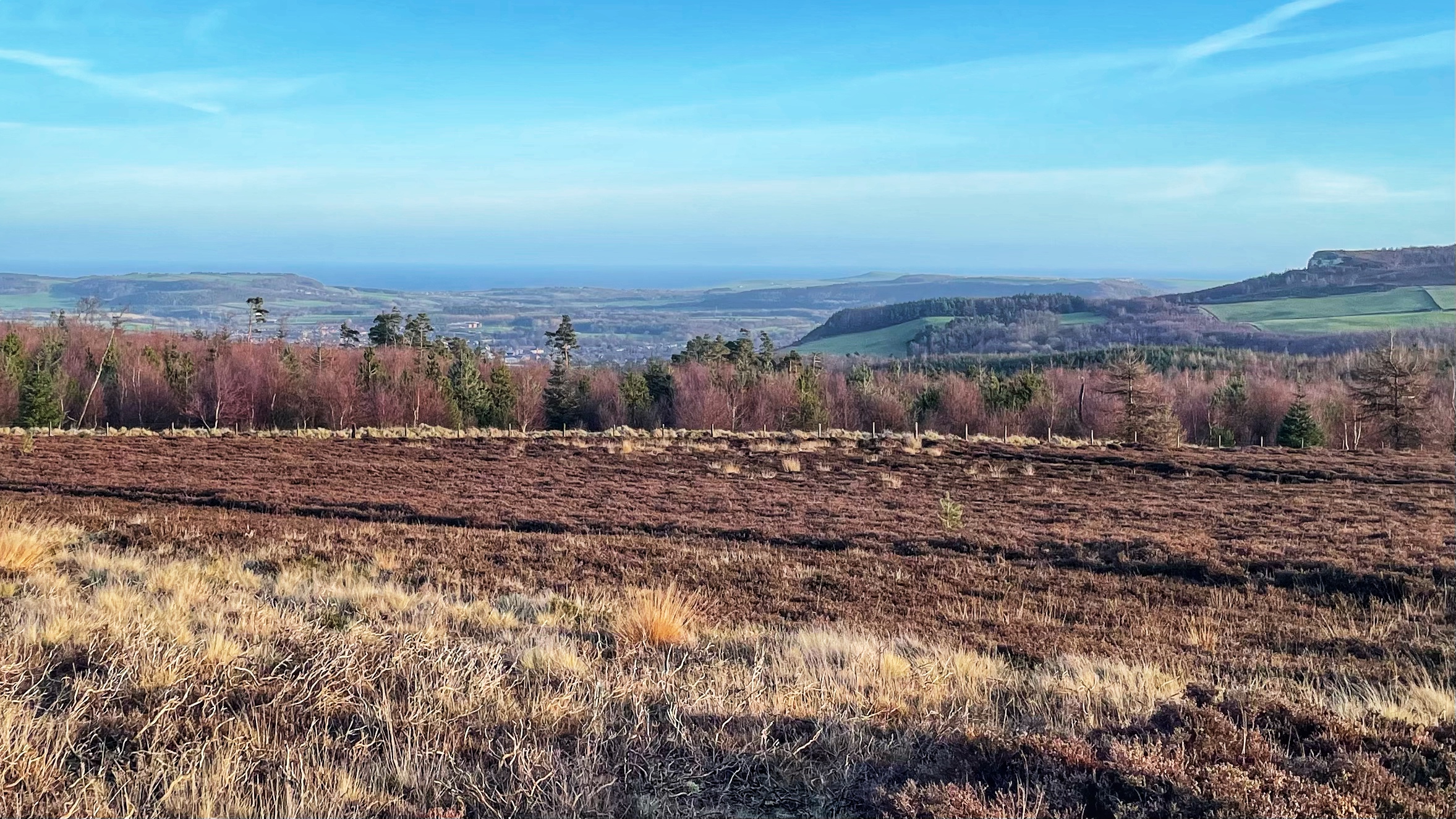
A cracking morning. This view looks north-east from Newton Moor, over Guisborough, out to the North Sea and whatever lies beyond it, behaving impeccably for once.
“Grid to mag, add; mag to grid, get rid” is the sort of mnemonic that lodges in the brain for life, usually thanks to the Cubs and a damp field. It explains how to shuffle between map bearings and compass bearings by adding or subtracting magnetic variation. Sensible, tidy, reassuring. Unfortunately, the Earth has not read the handbook. With Magnetic North drifting east in the UK, the rule has lost its bite. In some places the variation is negligible, in others it wants the opposite treatment. Add east, subtract west. Keep up.
Just to keep everyone alert, there is also True North, which points politely at the Earth’s geographic North Pole. At this time of year that doubles as Santa’s postcode.
For centuries these three versions of north have wandered about, sometimes close, sometimes squabbling, rarely agreeing. Very occasionally, however, they line up perfectly. Today that alignment passes through Berwick-upon-Tweed, before leaving England altogether, which is rather a moment for something as abstract as direction.
This rare triple alignment first appeared in England in November 2022 at Langton Matravers in Dorset. Geography does not often do drama, but this counted.
Over the next three years it trudged north, leaving Dorset in late 2022, passing Poole, then Chippenham, and reaching Birmingham in early 2024. By October 2024 it had crossed the Pennines and reached Hebden Bridge, which is about as poetic as northward drift gets.
In total it has covered 576 kilometres in 1,127 days while in England, managing roughly 511 metres a day. Not exactly a sprint. More a determined shuffle.
This calm alignment ended on 13 December 2025, when, by the time you read this, it will have slipped out of England at Berwick-upon-Tweed and be heading into the North Sea, presumably without ceremony.
It is not gone for good. In late October 2026 it is expected to reappear in Scotland at Drums, just south of Newburgh, pass through Mintlaw, and make its final Scottish appearance at Fraserburgh around mid-December, before wandering offshore again.
Out over the North Sea, the three norths are expected to stay aligned for another couple of years, after which Magnetic North will once again go its own way.
Because the Earth’s magnetic field moves slowly and behaves unpredictably over long periods, scientists estimate it will be several hundred years before this alignment returns to Great Britain. Something for future walkers to post about.
Despite sounding momentous, the experts insist there will be no practical impact. Pilots, sailors, and navigators will still need to work out the difference between where the compass points and where the map thinks north is. Direction, it seems, remains a matter of effort rather than destiny. Or you could just rely on GPS.
Sources:
‘Three norths’ set to leave England. Ordnance Survey. 12 Dec 2025. https://www.ordnancesurvey.co.uk/news/three-norths-departing-england [Accessed 13 Dec 2025]
‘Three norths’ set to leave England and not return for hundreds of years. British Geological Survey. 12 Dec 2025. https://www.bgs.ac.uk/news/three-norths-set-to-leave-england-and-not-return-for-hundreds-of-years [Accessed 13 Dec 2025]
Leave a Reply