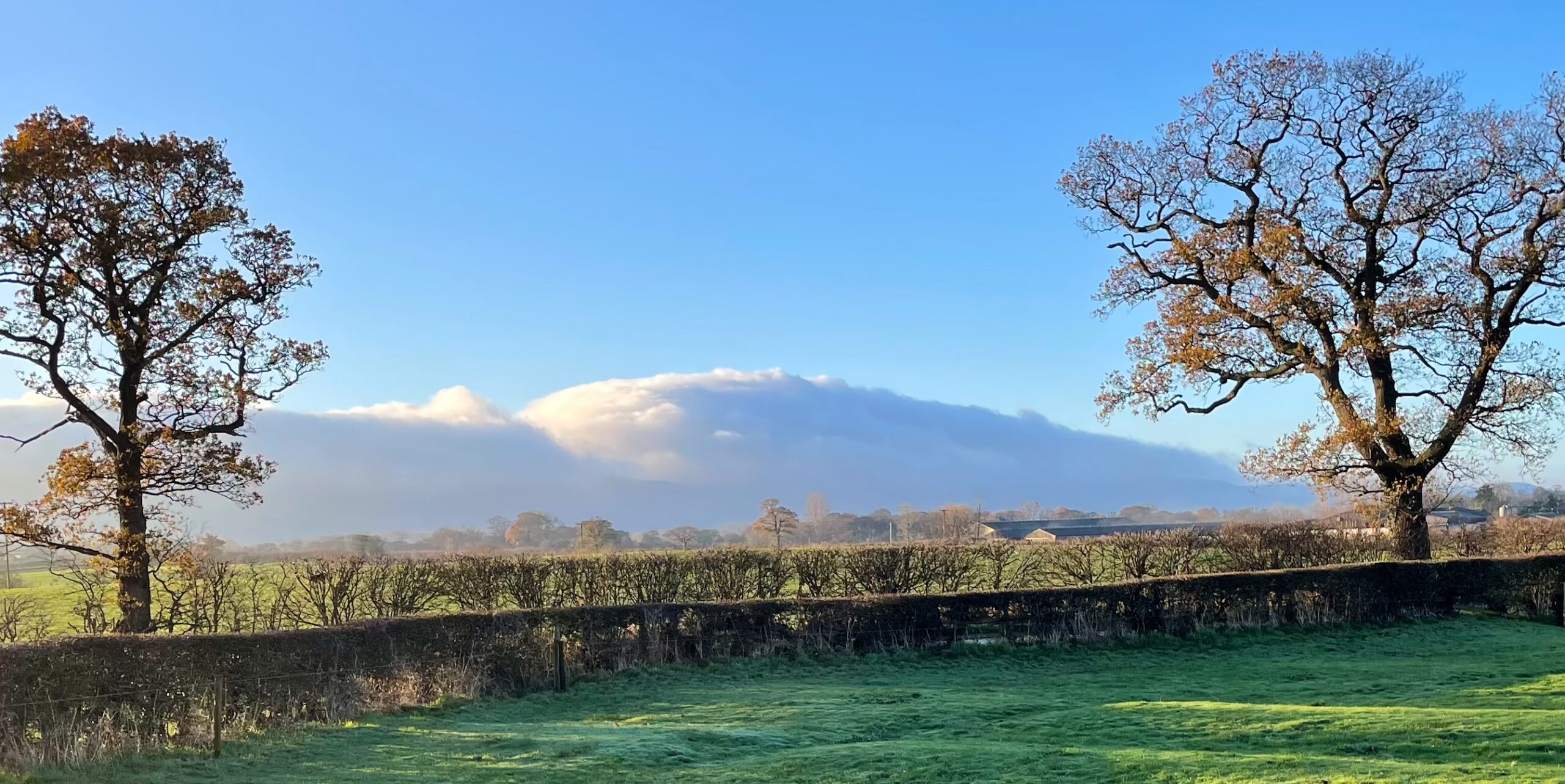
The morning sky was as clear as one could hope for December, though the Cleveland Hills had chosen to hide beneath a bank of cloud. One could call it an orographic cloud, if one wished to sound as if one had paid attention in geography lessons. The term comes from the Greek oros for mountain, which is rather generous for the Cleveland Hills, but let us humour ourselves.
Moist air has been pushed northwards up Bilsdale and its neighbours, rising obediently as the southerly winds drove it uphill. Now we all know that rising air cools to its dew point, when the vapour obligingly turns to cloud. Bilsdale, ever eager to play the part, sat in the gloom and felt several degrees cooler for its trouble.
Once the air had crested the hills, it began its descent towards the plain. Now sinking air warms, droplets vanish, and the whole performance delivers clear skies on this side, like a cut-price rain shadow effect.
The cloud bank keeps its wave-like form because the wind refuses to let the show end. Fresh moist air is shoved up the slope, cools, turns to cloud, then losses its shape the instant it slides down this side. The cloud will exist only for as long as the air is prepared to rise and cool, a fleeting little drama put on by the weather to keep us alert.
Leave a Reply