
I thought I might as well head over to Wayworth Moor to cast a jaded eye over the so-called stone circle1NYMNP HER No: 3983. Stone circle on Wayworth Moor. I have been there more times than I remember, and—shockingly—it still has not transformed into a majestic North York Moors Stonehenge. Given its steadfast refusal to evolve in the past three millennia, I cannot say I was stunned to find that my photographs looked exactly like the ones I have already posted. And why would they not? I was standing in the exact same spot. So, in the spirit of Blue Peter, here is one I prepared earlier.
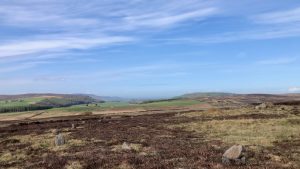
On the way though, I took a minor detour to take a gander at this round barrow—or what remains of a prehistoric burial mound—on the eastern side of Commondale Moor. I was drawn by its prominent pile of grey loose stones, spanning about 20 metres and rising to a dizzying height of 1.2 metres. Apparently an original stone kerb has either been pilfered or has been graciously buried by thousands of years of vegetation. A large hollow in the centre suggests someone in the past simply could not resist poking about in it. Unlike some of its more usual cousins, this one lacks a ditch from which the earth used to create the mound came. This could be just a deliberate design decision or maybe evidence of prehistoric budget cuts2‘Heritage Gateway – List Entry Number: 1015400’. 2018. Heritagegateway.org.uk <https://www.heritagegateway.org.uk/Gateway/Results_Single.aspx?uid=1015400&resourceID=5> [accessed 11 April 2025].
The tumulus is in distinguished company—surrounded by a cairn cemetery, ancient fields, and clearance cairns—all very impressive, although hard to decipher3NYMNP HER No: 9284. Cairn cemetery on Commondale Moor west of North Ings Plantation4NYMNP HER No: 51. Prehistoric funerary and agricultural landscape Commondale Moor..
Perhaps coincidentally, or not if one wishes to sound profound, the geology beneath all these monuments is a dependable grey mix of interbedded sandstone and limestone, which someone decided to name the Scarborough Formation5‘BGS Lexicon of Named Rock Units – Result Details’. 2020. Bgs.ac.uk <https://webapps.bgs.ac.uk/lexicon/lexicon.cfm?pub=SCR> [accessed 11 April 2025]. Its outcrop forms a narrow band. Perhaps the Ancients thought the grey stone had mystical properties and buried their dead here, or perhaps it was simply because the area is on the crest of a ridge.
Bowl barrows, being the most prolific of these earth mounds, date from the Late Neolithic to the Late Bronze Age, somewhere between 2400 and 1500 BC. They served the usual function: burial—either solitary or communal, depending on how popular you were. Some have ditches, some do not. Some are large, others are less so. In short, they vary, and that variation, we are told, is deeply meaningful. These modest bumps in the landscape are apparently a goldmine for understanding ancient beliefs and social structure. Or, depending on your mood, just more piles of earth with aspirations.
Despite the best efforts of Victorian antiquarians, I read that this barrow remains in passable condition. Who knows, it might still be hoarding a few secrets about how it was built or who was buried inside. Any ancient land use beneath it is presumably still there, waiting patiently for someone with a grant and a trowel to care. As one of many similar mounds scattered across the North York Moors, it offers an exciting opportunity to theorise about prehistoric burial customs and the ever-thrilling topic of social land division.
- 1NYMNP HER No: 3983. Stone circle on Wayworth Moor
- 2‘Heritage Gateway – List Entry Number: 1015400’. 2018. Heritagegateway.org.uk <https://www.heritagegateway.org.uk/Gateway/Results_Single.aspx?uid=1015400&resourceID=5> [accessed 11 April 2025]
- 3NYMNP HER No: 9284. Cairn cemetery on Commondale Moor west of North Ings Plantation
- 4NYMNP HER No: 51. Prehistoric funerary and agricultural landscape Commondale Moor.
- 5‘BGS Lexicon of Named Rock Units – Result Details’. 2020. Bgs.ac.uk <https://webapps.bgs.ac.uk/lexicon/lexicon.cfm?pub=SCR> [accessed 11 April 2025]
Leave a Reply