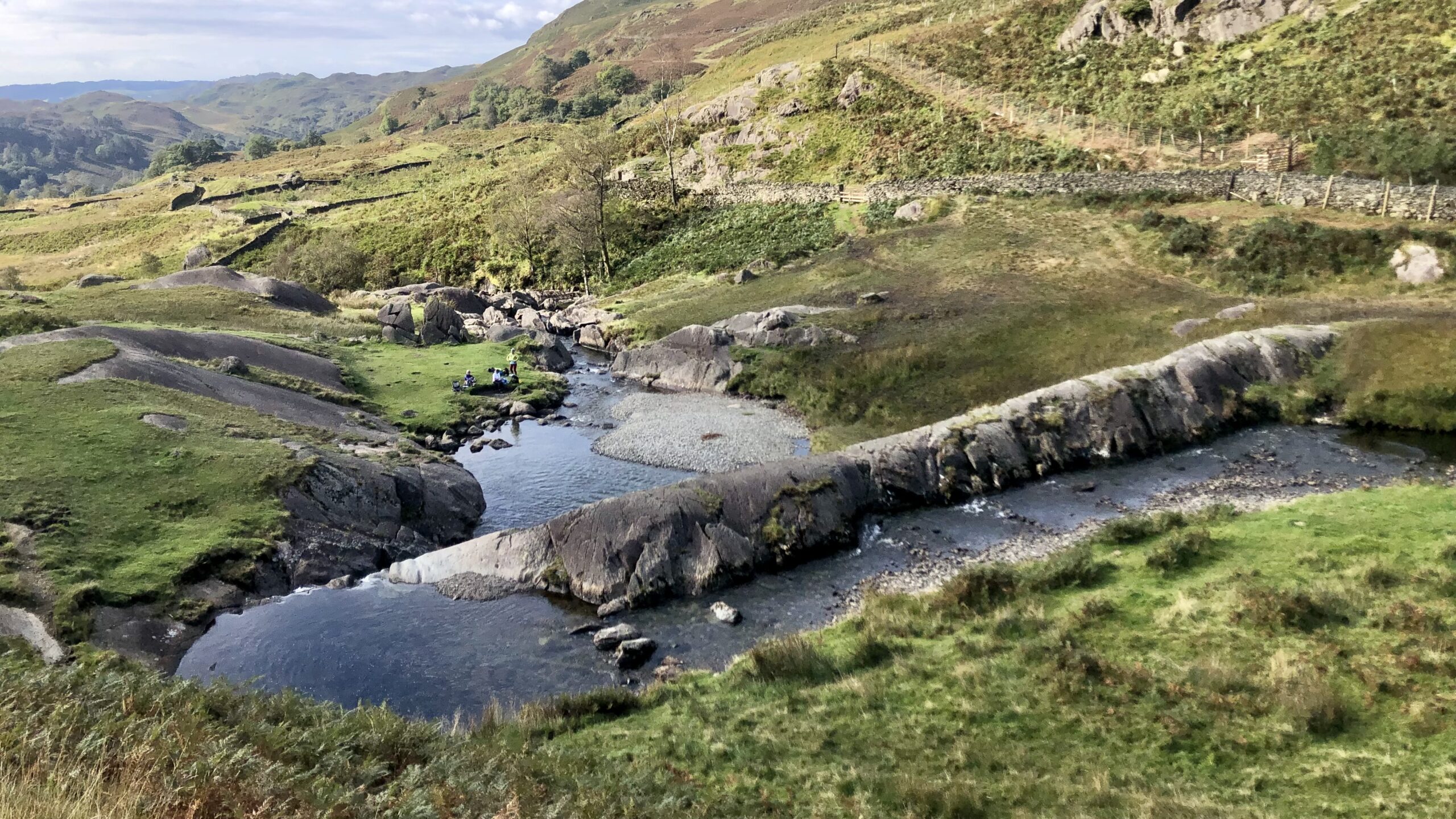
I seem to have become a regular visitor of open-water swimming spots, though I’ve yet to sully my person with an actual dip. I am sure that one need not plunge into icy water to commune with nature. The gentle rustling of the murmur of streams, and the occasional squelch of boggy earth beneath one’s feet can be just as invigorating as a cold dip. Or so I tell myself, while remaining respectably dry.
Take, for instance, Buckstones Jump — or is it Buckstones Jum? A quaint little plunge pool up Rydal Beck, with a rock slab that doubtless tempts many to fling themselves into its depths. I can see the appeal. It is undeniably picturesque, serene even, for those inclined to appreciate such things. But while others leap into its crystalline waters with reckless abandon, I remain on the sidelines, contemplating the peculiarities of local spelling.
Is it ‘Jump’ or ‘Jum’? My well-thumbed 2014 map insists on ‘Jum’, though modern digital cartographers, in their infinite wisdom, have added a superfluous ‘p’. The oldest maps, such as the venerable six-inch Ordnance Survey from 1863, also favour the pared-down ‘Jum’. A sensible economy of letters, one might think. And yet, one is left to wonder about the significance of this ‘p’ – a mere trifle to some, but a vexing detail to those of us with nothing better to do than scrutinise cartographical inconsistencies. Could it be simply that the O.S. erred all those years ago?
This word ‘Jum’ does invite curiosity. Could it be an example of the quaint local dialect where vowels and consonants drift about as aimlessly as sheep on the fells? The English Dialect Dictionary of 1898 offers four possible meanings for ‘Jum’, none of which provide much clarity:
- A sudden jolt or concussion from encountering an unperceived obstacle
- An injury from a fall; an accident; a narrow escape
- A heavy loss in cattle or money
- A slang term for Lolium temulentum, typically known as darnel, poison darnel, darnel ryegrass or cockle, an annual plant similar to wheat.
Naturally, the most plausible explanation is that ‘Jum’ is simply an archaic or local spelling of ‘Jump’. However, this minor mystery pales in comparison to the unsettling discovery of Buckstone’s Jump in a 1909 report on an otter hunt1Field, 22 May 1909. Note the apostrophe. The passage describes, with uncomfortable precision, how a pack of hounds pursued an otter to this very spot, only to have it “rolled over” after a brisk half-hour hunt. A euphemism, no doubt, for the grim end of the poor creature.
It casts an unpleasant shadow over the otherwise idyllic scene, doesn’t it? One pictures the serene waters of Buckstone’s Jum, or Jump, no longer a place of peaceful reflection, but the site of a rather undignified chase. The otter, bolted from its hiding place, meets its fate in a manner that makes one reconsider the term “sport” altogether.
It is a curious thing how places of such natural beauty often come with a sordid footnote in the annals of human history. Buckstone’s Jum, serene and inviting as it may be, now carries the unfortunate association of that long-ago otter hunt, a pastime that fortunately has long lost its charm.
And yet, despite these grim associations and the perplexing debate over the spelling of its name, Buckstone’s Jum—or Jump—remains a spot for the intrepid, the reflective, and the hopelessly pedantic. While others hurl themselves into its frigid waters, braving the elements with commendable enthusiasm, I shall continue to content myself with the view, the sound of rushing water, and my reassuring dryness.
After all, it is not every day one can wrestle with the complexities of dialect, history, and cartography all at once.
- 1Field, 22 May 1909
Leave a Reply